
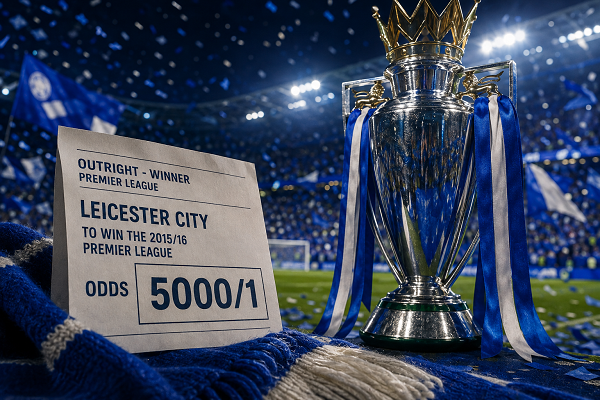
Leicester City 5000/1 Odds Explained: How the Biggest Premier League Shock Ever Happened
Leicester City’s 5,000/1 Premier League title win remains one of the most extraordinary stories in the history of sport.
At the beginning of the 2015/16 season, bookmakers considered Leicester so unlikely to become champions that some offered odds of 5,000/1.
In simple terms, a successful £1 bet at that price would return £5,001, including the original stake.
Yet, against all reasonable expectations, Leicester went on to finish top of the Premier League, ahead of clubs with vastly bigger budgets, more expensive squads and considerably shorter odds.
So, what did Leicester City’s 5,000/1 odds actually mean? Why were the Foxes priced as such enormous outsiders? And how much did the lucky supporters who backed them stand to win?
Let’s take a closer look.
What Did Leicester City’s 5000/1 Odds Mean?
Fractional odds of 5,000/1 mean that for every £1 staked, you would make a profit of £5,000 if the bet won.
Your original stake would also be returned.
Here are some examples:
| Stake | Profit at 5,000/1 | Total Return |
|---|---|---|
| £1 | £5,000 | £5,001 |
| £2 | £10,000 | £10,002 |
| £5 | £25,000 | £25,005 |
| £10 | £50,000 | £50,010 |
| £20 | £100,000 | £100,020 |
| £100 | £500,000 | £500,100 |
That means somebody placing just £10 on Leicester to win the league before the season could theoretically have collected more than the average UK annual salary at the time several times over.
In decimal format, 5,000/1 converts to decimal odds of 5001.00.
The basic calculation is:
Stake × fractional odds = profit
Therefore:
£10 × 5,000 = £50,000 profit
Add the £10 stake, and the total return becomes £50,010.
What Was the Implied Probability of 5000/1 Odds?
Odds can also be converted into an implied probability.
For odds of 5,000/1: that equals approximately a 0.02% chance of winning the title.
In other words, odds of 5,000/1 suggested Leicester had roughly a one-in-5,001 chance of winning the Premier League.
However, this should not necessarily be treated as a precise prediction.
Bookmaker odds are influenced by anticipated betting activity, trading decisions, liability management and profit margins.
At extremely large prices, the relationship between the odds and the team’s true mathematical chance can become particularly loose.
The price nevertheless demonstrates just how improbable a Leicester title victory was considered.
Why Were Leicester City 5000/1 to Win the League?

The 5,000/1 price may look ridiculous with hindsight, but there were plenty of logical reasons for bookmakers to dismiss Leicester before the 2015/16 season.
They had narrowly avoided relegation
Leicester had only returned to the Premier League in 2014 after a decade outside the top flight.
During the following campaign, they appeared destined to go straight back down. They were bottom of the table for much of the 2014/15 season before producing an excellent late run to survive.
Having spent the previous season fighting relegation, Leicester were naturally expected to face another battle near the bottom.
They were seen as more likely to be relegated than to qualify for Europe, let alone win the title.
Claudio Ranieri was not an obvious title-winning appointment
Leicester appointed Claudio Ranieri as manager in July 2015 following the departure of Nigel Pearson.
Ranieri was experienced and had managed several major European clubs, but his appointment received a mixed response. He had also recently endured an unsuccessful spell as manager of the Greece national team.
Very few observers saw his arrival as the beginning of a Premier League title challenge.
Ranieri himself initially focused on reaching the 40-point mark generally considered sufficient to avoid relegation. Winning the league was not a realistic public objective.
Leicester lacked the financial power of their rivals
The Premier League title was normally contested by wealthy clubs such as Manchester City, Manchester United, Chelsea and Arsenal.
Those teams could spend tens of millions of pounds on individual players. Leicester’s squad, by comparison, contained footballers who had arrived from lower leagues, less fashionable European clubs and relatively modest transfer deals.
N’Golo Kanté, one of the most influential players in Leicester’s title-winning team, joined from Caen for a reported fee of around £6 million.
Jamie Vardy had previously played non-league football, while Riyad Mahrez arrived from French second-tier side Le Havre for a modest fee.
On paper, Leicester did not resemble a team capable of competing with the Premier League’s financial heavyweights.
How Did Leicester City Win the Premier League?
Leicester did not simply get lucky for a few weeks. They produced consistent results across an entire 38-match league season.
The Foxes eventually finished with 81 points, ten clear of second-placed Arsenal. They lost only three league matches and secured the title with two games remaining.
Several factors contributed to their remarkable success.
Jamie Vardy’s goals
Jamie Vardy became the face of Leicester’s title challenge.
His pace caused enormous problems for opposing defences, particularly when Leicester attacked quickly after winning possession. Vardy scored 24 Premier League goals and set a then-record by scoring in 11 consecutive Premier League matches.
His journey from non-league football to Premier League champion made Leicester’s achievement even more compelling.
Riyad Mahrez’s creativity
Riyad Mahrez provided the flair and imagination.
The Algerian winger scored 17 league goals and supplied 11 assists, earning the PFA Players’ Player of the Year award.
Mahrez could create chances, beat defenders and score decisive goals. His performances transformed him from a relatively unknown signing into one of the most sought-after players in European football.
N’Golo Kanté’s influence
Kanté was arguably the player who made Leicester’s system work.
His anticipation, energy and ability to regain possession allowed Leicester to defend compactly before breaking forward at speed. It often seemed as though there were two Kantés on the pitch because of the amount of ground he covered.
Alongside Danny Drinkwater in midfield, he helped give Leicester a balance that many more expensive teams struggled to match.
A settled and highly motivated team
Leicester benefited from having a relatively settled side.
Kasper Schmeichel, Wes Morgan, Robert Huth, Danny Simpson, Christian Fuchs, Marc Albrighton and Shinji Okazaki all understood their roles. The team did not depend entirely on one superstar.
They defended with discipline, worked tirelessly and attacked with speed. Ranieri resisted the temptation to overcomplicate matters and built a system around the players’ strengths.
Leicester were happy to allow opponents to have possession in less threatening areas before launching direct counter-attacks.
How Leicester City’s Title Odds Changed
Leicester remained available at enormous prices even after starting the season well.
According to a season-long odds review, they were still available at 5,000/1 in early October despite sitting fifth in the Premier League table.
It was the last point at which that price was reportedly offered.
As the season progressed, the odds shortened dramatically:
| Stage of Season | Approximate Leicester Title Odds |
|---|---|
| August | 5,000/1 |
| September | 1,500/1 |
| October | 1,500/1 |
| November | 500/1 |
| December | 66/1 |
| January | 16/1 |
| February | 7/1 |
These prices varied between bookmakers and at different points within each month, but they illustrate how slowly the market initially accepted Leicester as genuine contenders.
Even after it became clear that Leicester were capable of finishing in the top four, many punters and pundits expected them to fall away.
They did not.
Did Anyone Actually Bet on Leicester at 5000/1?

Yes. Although relatively few people backed Leicester at the full 5,000/1 price, several supporters turned small pre-season bets into life-changing sums.
One of the biggest reported winners placed a £20 each-way bet with Sky Bet in August 2015. As an each-way wager consists of separate win and place bets, the customer’s total outlay was £40.
By April, Leicester were seven points clear with only five games remaining. Rather than risk the value of the bet falling if the Foxes suffered a late collapse, the anonymous punter accepted a cash-out offer of £108,703.41.
Had the customer allowed the bet to run and Leicester gone on to win the title, the return would reportedly have been a little over £133,000.
However, the each-way structure also provided some protection: a second- or third-place finish would have returned £25,020, while finishing fourth would have produced nothing.
It was an interesting example of the dilemma faced by anyone holding a valuable long-odds bet.
By April, Leicester looked increasingly likely to finish the job, but turning down a guaranteed six-figure sum would still have required extraordinary nerve.
Another supporter faced the same decision much earlier in the title race. An anonymous man from Warwickshire had placed £50 on Leicester at 5,000/1, leaving him with a potential return of approximately £250,000.
On 5 March 2016, with Leicester still having nine league matches to play, he accepted a cash-out payment of £72,000.
Leicester then beat Watford 1-0 later that day, after which the reported cash-out value of his bet would have risen to £91,000.
The supporter nevertheless said he was delighted with the decision. The money allowed him to plan a holiday and pay off his mortgage, while removing the stress of watching Leicester’s remaining matches with £250,000 riding on the outcome.
With hindsight, both customers would have earned more by holding their bets until Leicester were officially crowned champions. However, that is easy to say once the result is known.
At the time, Leicester could still have suffered injuries, lost form or been overtaken by Tottenham.
Accepting £72,000 or more than £108,000 from a comparatively small initial stake was therefore an entirely understandable decision.
Other supporters did keep their wagers running and collected the full return. A straightforward £5 win bet at 5,000/1, for example, would have produced £25,000 in profit and a total return of £25,005.
These stories also show why cashing out is not automatically a poor choice. It generally reduces the maximum possible return and gives some value back to the bookmaker, but it can also turn an uncertain bet into a guaranteed, life-changing payment.
How Much Did Leicester’s Win Cost the Bookmakers?
Bookmakers faced millions of pounds in payouts, although the overall picture was more complicated than the headline 5,000/1 bets suggested.
Many of the largest liabilities had been built at shorter prices, such as 500/1, 100/1 or below, once Leicester’s title challenge began to look credible.
William Hill reportedly described Leicester’s victory as its worst result on a single sport since Frankie Dettori won all seven races at Ascot in 1996.
The bookmaker reported a loss of approximately £2.2 million on the Leicester result.
Across the betting industry, the total payout was estimated to be considerably higher.
However, bookmakers would also have taken many losing bets on traditional favourites including Chelsea, Manchester City, Arsenal and Manchester United.
When Did Leicester Officially Win the Title?
Leicester were confirmed as Premier League champions on 2 May 2016.
They had drawn 1-1 with Manchester United the previous day, meaning second-placed Tottenham needed to beat Chelsea to keep the title race alive.
Tottenham led 2-0 at Stamford Bridge but Chelsea fought back to draw 2-2. Eden Hazard scored the equaliser, confirming that Leicester could no longer be caught.
Leicester therefore won the title without playing that evening, with many members of the squad watching the Chelsea–Tottenham match together at Jamie Vardy’s house.
They later lifted the Premier League trophy following a 3-1 home victory over Everton.
Were Leicester Really a 5000/1 Chance?

This is an interesting question.
The odds accurately reflected the widespread belief that Leicester had almost no chance of winning. However, it does not necessarily follow that their true probability was exactly one in 5,001.
Bookmakers had little incentive to spend significant time calculating the precise title chances of a team expected to finish near the bottom.
A price such as 5,000/1 was partly a way of saying the outcome was considered virtually impossible.
There was also a limit to how much customers could generally stake at those odds. A bookmaker offering 5,000/1 would not necessarily have accepted an unlimited six-figure wager.
In hindsight, Leicester were clearly underestimated. Their squad contained players whose ability had not yet been fully recognised, while several established title contenders underperformed.
That does not mean backing every huge outsider is a sensible strategy. Leicester’s success was memorable precisely because results of this kind occur so rarely.
Could a 5000/1 Premier League Winner Happen Again?
It is possible, but extremely unlikely.
Leicester’s victory required an unusual combination of circumstances. They had an outstanding manager, several players producing the best football of their careers, a settled team and relatively few injuries to key individuals.
At the same time, the traditional leading clubs failed to produce dominant seasons.
Modern bookmakers may also be more cautious about offering prices as large as 5,000/1 on any Premier League team.
Leicester demonstrated that an event considered almost impossible can still happen.
That does not necessarily mean another outsider will never win the Premier League. However, a future surprise champion would probably begin the season at considerably shorter odds.
Final Thoughts on Leicester City’s 5000/1 Odds
Leicester City’s 5,000/1 title win was not simply a famous betting result. It was a reminder that odds represent an assessment of probability rather than a guarantee.
A £1 bet returned £5,001. A £10 wager returned £50,010. For the small number of supporters who backed Leicester and held their nerve, the result produced extraordinary payouts.
More importantly, Leicester proved that intelligent recruitment, tactical discipline, team spirit and outstanding individual performances could overcome an enormous financial disadvantage.
The odds told bettors that a Leicester title was almost impossible.
The team showed that almost impossible is not the same as impossible.




Leave a Reply
Want to join the discussion?Feel free to contribute!