
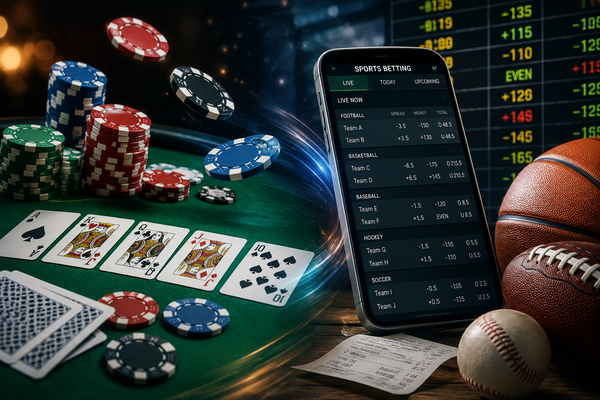
Poker vs. Sports Betting: Why US Players Choose a Game of Skill in 2026
Legal gambling in the United States looks very different from how it did a decade ago.
Sportsbook apps have become a familiar sight during football and basketball seasons, while poker continues to attract players who prefer sitting at a table, whether physical or virtual, and making decisions themselves.
The two activities are often grouped together, but the experience is fundamentally different. A sports bettor predicts what will happen in an event controlled by athletes, coaches and countless variables.
A poker player participates directly, making decisions on every hand against other players.
This distinction also shapes what players look for when comparing the best poker sites at Worldpokerdeals.com, where game selection, competition, software and the overall playing experience can matter as much as convenience.
Both involve chance and financial risk. Yet for Americans drawn to strategy and competition, poker offers something sports betting cannot fully replicate: the ability to influence the outcome through repeated decisions.
The Biggest Difference Is Who You Play Against
Place a sports bet, and the basic relationship is between the customer and the sportsbook. The operator publishes a line or price, and the bettor decides whether it offers value.
The bettor cannot influence what happens next.
A quarterback injury, questionable penalty or last-second field goal can completely change the outcome.
Research may improve a person’s decision before placing the bet, but once the game starts, control effectively ends.
Poker works differently. Players usually compete against one another while the poker room takes a fee, commonly called rake.
Every hand presents decisions. Should you fold before the flop? Is a raise better than a call? Does an opponent’s bet represent a strong hand or a bluff?
Cards are random, but responses to those cards are not.
Why Poker Is Considered a Skill Game
Calling poker a game of skill does not mean luck disappears.
Anyone who has watched a strong hand lose to an unlikely river card knows that chance can dominate a single pot.
A beginner can beat an experienced player over one hand, one session or even longer.
Skill becomes clearer through repetition.
Experienced players think about probability, position, bet sizing, ranges and opponent tendencies.
They learn when to avoid marginal situations and when taking a calculated risk makes sense.
Research comparing poker and sports betting often points to this distinction. Both require judgment under uncertainty, but poker provides far more opportunities to make decisions after play begins.
That ongoing decision-making is a major part of its appeal.
Sports Betting Requires Skill Too
The contrast should not be exaggerated. Successful sports betting is not simply picking whichever team looks stronger.
Serious bettors analyze prices rather than just outcomes. They study statistics, injuries, schedules, matchups and market movement while trying to determine whether the odds accurately reflect the probability of an event.
The difficulty is that sportsbooks are doing the same thing with sophisticated models and enormous amounts of data.
Sports betting also includes a built-in operator margin. Being right slightly more often than wrong is not necessarily enough to produce positive long-term results.
Poker has its own cost in the form of rake, but the competition comes primarily from other players.
If someone can consistently make better decisions than the people sharing the table, there is at least a strategic advantage to pursue.
Poker Gives Players More Ways to Improve
One reason poker appeals to competitive personalities is that mistakes can be studied.
A player can review a hand and ask specific questions. Was the preflop raise too large? Should the turn have been checked? Was calling the river mathematically justified?
Modern poker education has made that process easier. Strategy articles, training videos, equity calculators and hand-analysis software allow motivated players to examine decisions in considerable detail.
Improvement can also be noticeable at the table. Beginners learn basic starting-hand selection.
Later, they become more comfortable with position and pot odds. More experienced players can study concepts such as range construction and expected value.
That learning curve gives poker a game-like progression that many people find satisfying regardless of whether they ever intend to play professionally.
The Social Element Still Matters
Poker also has a social identity that separates it from many forms of online wagering.
A traditional poker table is a shared competition. Players watch one another, talk, bluff and react to changing dynamics.
Online poker removes some face-to-face interaction, but the underlying structure remains the same: people are competing against other people.
Sports betting is generally more individual.
Friends may discuss picks or build bets together, but the wager itself does not require interaction with another bettor.
You can place a bet, put your phone away and check the score hours later.
Poker demands participation. Even folding is a decision.
For players who grew up with competitive card games, chess, strategy games or esports, that interactive quality can make poker feel more engaging than simply predicting a result.
Online Access Has Changed Both Activities
Mobile technology has transformed the way Americans encounter gambling.
Sportsbooks allow eligible users in regulated states to compare markets and place bets without visiting a physical location.
Poker has undergone a similar digital shift, with online tables making it possible to find games without having to organize a home poker night or travel to a cardroom.
The legal picture, however, is not identical.
Since the 2018 Supreme Court decision that opened the door for states to authorize sports wagering, legal sportsbooks have expanded across much of the country.
Regulated real-money online poker remains available in fewer jurisdictions.
That difference can create confusion. The fact that sports betting is legal in a particular state does not automatically mean real-money online poker is legal there, too.
Players should verify their state’s current rules and an operator’s licensing status before depositing money.
Bankroll Management Applies to Both
Whether someone prefers poker or sports betting, neither should be treated as guaranteed income.
Variance exists in both.
A poker player can make mathematically sound decisions and lose several sessions. A sports bettor can identify a reasonable wager only for an unexpected injury or late-game play to change the result.
Setting a budget is therefore more useful than focusing on short-term wins and losses. Money used for either activity should be separate from funds needed for rent, bills, food or other essentials.
Chasing losses is particularly dangerous because it replaces decision-making with emotion.
Raising poker stakes after a bad session or increasing sports bets to recover yesterday’s losses does not change the risk without improving the underlying opportunity.
Why Some Players Keep Coming Back to Poker
Sports betting offers simplicity and an obvious connection to games people already watch. For an NFL fan, putting a small wager on Sunday’s matchup requires little additional explanation.
Poker asks for more participation.
Players have to learn the rules, understand betting structures and make repeated choices while adapting to opponents.
That creates a steeper learning curve, but it is also precisely what attracts people who want gambling to feel more like a competitive game.
In 2026, US players will have more wagering options than previous generations could access easily.
The choice between poker and sports betting ultimately comes down to what kind of experience someone wants.
Those who prefer predicting what athletes will do may naturally favor a sportsbook. Those who would rather make their own decisions may find poker more compelling.
Luck remains part of both. The difference is that at a poker table, the next move is still yours.