

RNG Meaning in Gaming: How Random Number Generators Really Work
If you’ve ever played an online slot machine, casino game or even a video game, you’ve probably come across the term RNG.
It’s one of those technical expressions that gets thrown around quite regularly, particularly when players are discussing whether a game is fair, whether winning streaks are genuine or whether a casino is manipulating the results.
But what exactly does RNG mean in gaming, and how does it affect your chances of winning?
The answer is surprisingly straightforward. However, understanding how RNG works can help you avoid some common gambling mistakes and recognise why certain betting strategies simply don’t work.
Let’s take a closer look.
What Does RNG Mean in Gaming?
RNG stands for Random Number Generator.
It’s a system used by computers to generate numbers that are random, or sufficiently unpredictable, with those numbers determining the outcome of events within a game.
In online gambling, RNG technology is responsible for deciding things such as:
- Which symbols appear when you spin a slot machine.
- Where a virtual roulette ball lands.
- Which cards are dealt in an online blackjack game.
- The results of digital dice rolls.
- The outcomes of certain bonus rounds and jackpots.
RNG also plays an important role in ordinary video games, determining anything from random enemy encounters to the rewards players receive when opening loot boxes.
The main principle is that results should be determined by chance rather than deliberately selected to favour a particular player.
How Does an RNG Work?
Most online casino games use something called a Pseudo-Random Number Generator (PRNG).
Despite the slightly confusing name, this doesn’t mean the results are fake or necessarily unfair.
Instead, a PRNG uses mathematical algorithms to produce sequences of numbers that behave unpredictably in practice.
Here’s a simplified example of how an online slot machine works.
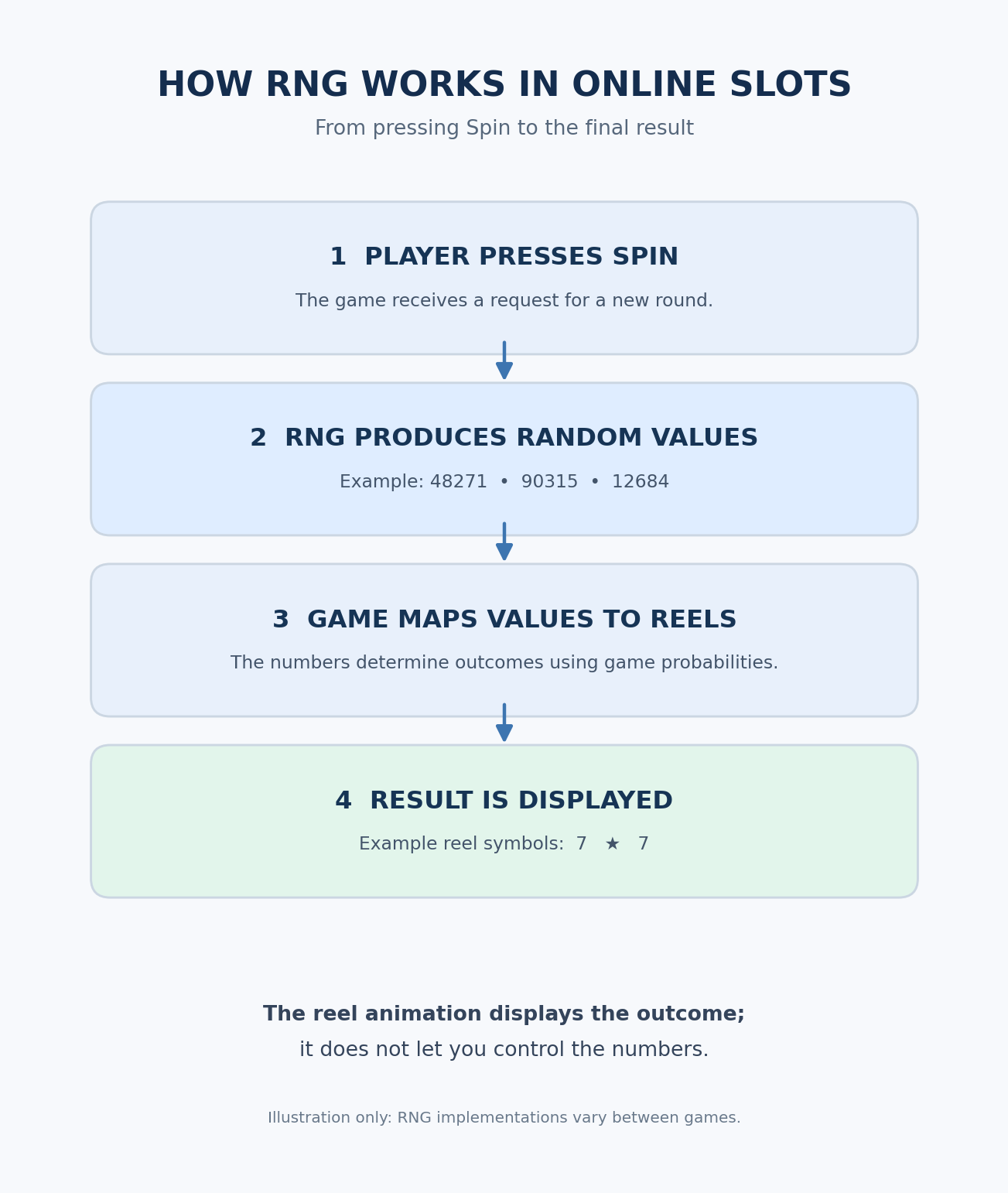
Illustrative process only. Individual games may implement RNG differently.
The important point is that the spinning reels are essentially a visual representation of a result determined by the game’s software.
The animation might last several seconds, but it doesn’t mean you can influence where the reels eventually stop by clicking at a particular moment.
Is RNG Gaming Really Random?
This is where things become interesting.
A computer algorithm is technically deterministic. Given exactly the same starting conditions, it can reproduce the same sequence of numbers.
However, properly designed PRNG systems use unpredictable starting information, known as a seed, to make their outputs extremely difficult to predict.
Some systems use physical sources of randomness instead, such as electronic noise.
For gambling purposes, the key requirement isn’t that every random number comes from a physical process. It’s that the results meet strict standards of unpredictability and statistical randomness.
The UK Gambling Commission’s RNG requirements specify that outcomes must be acceptably random and follow the expected probabilities.
Generation of random outcomes
Can Online Casinos Manipulate RNG Results?
A common suspicion among casino players is that slot machines deliberately stop paying after a big win or increase payouts when someone has been losing for a while.
For properly regulated online casino games in Great Britain, this type of adaptive manipulation is prohibited.
The Gambling Commission specifically bans compensated behaviour in remote RNG games, where the probabilities are altered during play to respond to previous results.
Licensed games must also undergo independent testing before being offered to players.
Generation of random outcomes+1
That doesn’t mean every casino website on the internet is trustworthy.
Unlicensed operators may not be subject to equivalent controls, which is one reason we recommend checking a casino’s regulatory status before depositing money.
Also, it’s worth distinguishing between a game being fair and a game offering good value.
An RNG can be completely fair while the casino still has a substantial mathematical advantage.
RNG vs RTP: What’s the Difference?
Two expressions that frequently appear together are RNG and RTP.
However, they’re not the same thing.
-
RNG determines which result occurs on an individual round.
-
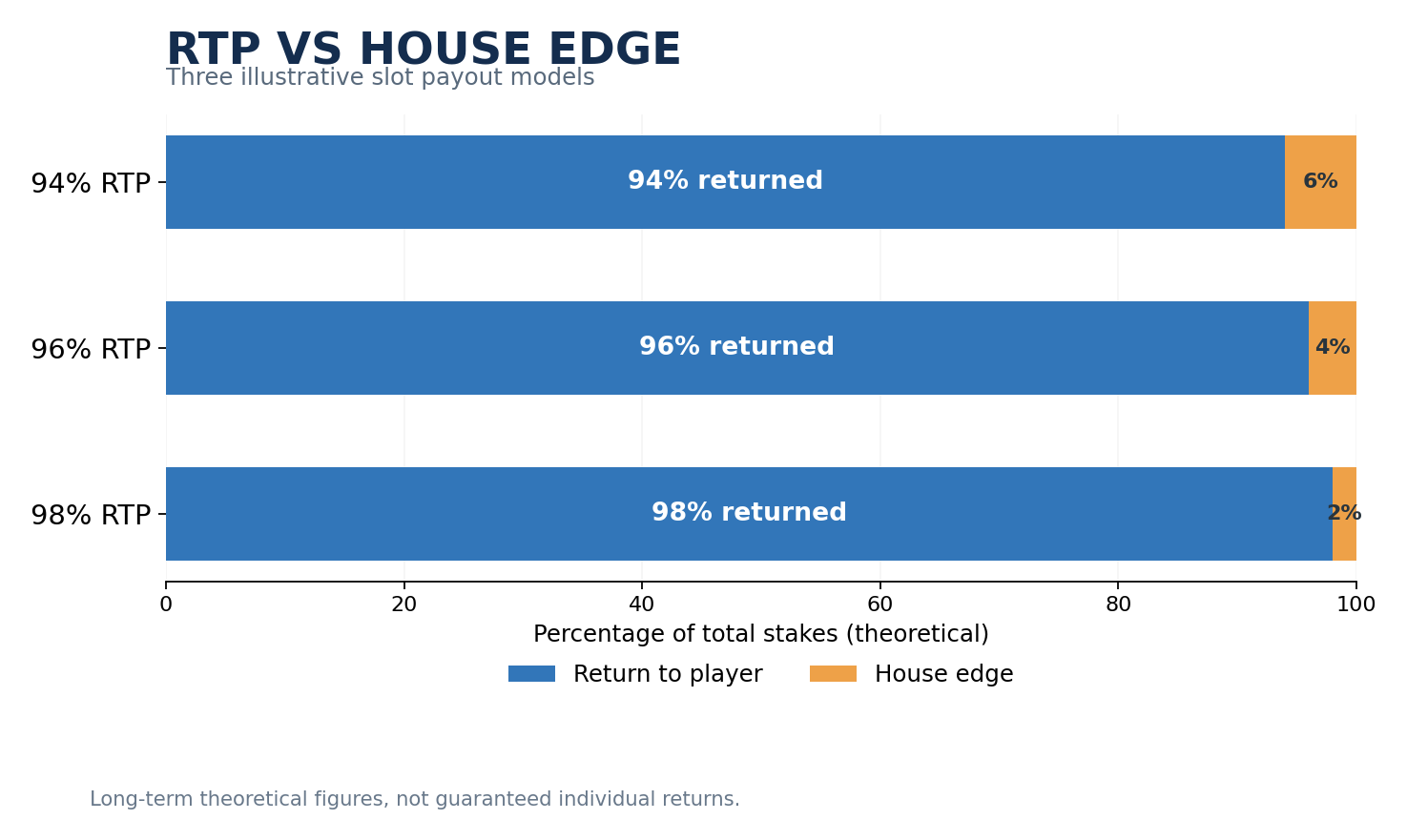
RTP (Return to Player) describes the theoretical percentage of total stakes a game returns over a very large number of rounds.
For example, imagine a slot game with an RTP of 96%.
Over an enormous number of spins, the game is designed to return approximately £96 for every £100 wagered, leaving a theoretical £4 house advantage.
That doesn’t mean you’ll receive £96 back every time you wager £100.
You might win £500, lose the entire £100 or finish somewhere in between.
The RNG determines the unpredictable individual outcomes, while the game’s mathematics establishes its long-term expected return.
For more practical advice on selecting games, see our slot betting strategy guide.
Can You Predict or Beat an RNG?
Unfortunately, there’s no reliable method of predicting the next result from a properly implemented casino RNG.
You’ll sometimes see websites advertising RNG prediction software, slot hacks or systems that supposedly identify when a jackpot is about to appear.
We’d be extremely sceptical of these claims.
For conventional independent-spin slots, three common beliefs are particularly misleading:
-
A slot is due to pay out: Previous losses don’t make a future win more likely.
-
Playing at certain times improves your odds: The time of day doesn’t change the game’s underlying probabilities.
-
Increasing stakes after losses improves your chances: A staking system cannot overcome a negative mathematical expectation.
One important distinction is that some games contain special features where probabilities or rewards change according to disclosed game rules. That doesn’t mean the RNG itself is being manipulated unfairly.
You can read more about these misconceptions in our guide to winning at casino slots.
RNG Meaning in Gaming: Frequently Asked Questions
What does RNG mean in gaming slang?
Gamers frequently use RNG to describe the role of luck in a game. For example, someone might say they had “bad RNG” after repeatedly receiving poor rewards or experiencing an unlucky sequence.
Are RNG games rigged?
Not necessarily. Properly tested RNG games are designed to produce unpredictable outcomes according to their published rules. However, randomness doesn’t eliminate the house edge, and unregulated games may not offer the same safeguards.
Does RNG mean every outcome has an equal chance?
No. A game can use a random number generator while giving different outcomes different probabilities. A jackpot might have an extremely small probability compared with a minor prize.
Can an RNG produce the same result twice?
Absolutely. Randomness doesn’t prevent identical results occurring consecutively. Getting the same slot combination or roulette number several times isn’t, by itself, evidence of manipulation.
Overall Verdict: Understanding RNG Makes You a Better-Informed Player
RNG technology is fundamental to modern online gaming, particularly casino slots, roulette and digital card games.
Its purpose is to generate unpredictable results according to a game’s programmed probabilities.
However, there’s an important distinction between randomness and profitability.
A perfectly functioning RNG doesn’t mean players have an equal chance of winning and losing money. The casino can still maintain its advantage through the game’s payout structure.
At Honest Betting Reviews, our advice is simple: concentrate on the RTP, house edge and volatility of a game rather than trying to predict its RNG.
You cannot control random outcomes, but you can understand the risks, select games with more favourable theoretical returns and set sensible limits on your spending.
Ultimately, that’s a far more useful approach than chasing a slot machine that supposedly owes you a win.