
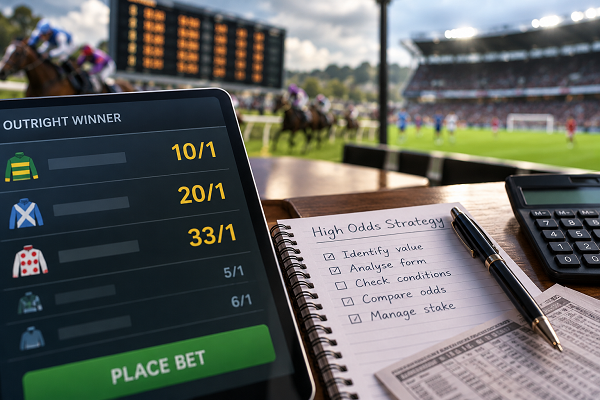
High Odds Betting Strategy: Can Backing Outsiders Really Be Profitable?
Everyone loves backing a big-priced winner. There are few better feelings in betting than seeing a 20/1 outsider come home when practically nobody gave it a chance.
But can you actually make money consistently by backing selections at high odds? Or is it simply a recipe for long losing runs and an empty betting account?
The answer is that a high odds betting strategy can be profitable, but only if you’re consistently finding bets that offer genuine value.
Simply backing long shots because they offer attractive payouts is unlikely to get you very far.
In fact, there are some interesting arguments for why higher odds selections can sometimes offer better opportunities than short-priced favourites.
In this guide, we’ll look at how high odds betting works, the strategies you can use to identify potentially profitable outsiders, and how to manage the inevitable losing runs that come with this approach.
What Is a High Odds Betting Strategy?
A high odds betting strategy involves deliberately looking for selections at relatively large prices, rather than concentrating on favourites or other short-priced bets.
There isn’t an official definition of high odds, but for the purposes of this article we’re generally talking about selections priced at 5/1 (6.00 decimal odds) or bigger.
Some bettors specialise in odds of 10/1, 20/1 or even 50/1 and above.
The attraction is obvious. You don’t need many winning bets to generate a substantial return.
For example, consider the potential profits from a £10 win bet:
| Fractional Odds | Decimal Odds | Total Return | Profit |
|---|---|---|---|
| 5/1 | 6.00 | £60 | £50 |
| 10/1 | 11.00 | £110 | £100 |
| 20/1 | 21.00 | £210 | £200 |
| 33/1 | 34.00 | £340 | £330 |
| 50/1 | 51.00 | £510 | £500 |
| 100/1 | 101.00 | £1,010 | £1,000 |
Swipe left to see the full table →
Of course, there’s a catch.
The higher the odds, the less likely a selection is generally considered to win. That means a high odds strategy will normally involve a much lower strike rate than a strategy focused on favourites.
However, a low strike rate doesn’t necessarily mean a losing strategy, as we’ll explain below.
Can You Make Money Betting on High Odds?
Absolutely, at least in principle. The important factor isn’t how often you win, but whether your winning bets generate enough profit to cover your losers.
Let’s consider a simple example.
Suppose you place 100 bets at average odds of 15/1, staking £10 on each selection.
Your total stakes would be £1,000.
Now let’s see how your returns would vary depending on the number of winners.
| Winners | Strike Rate | Total Returns | Net Profit/Loss |
|---|---|---|---|
| 3 | 3% | £480 | -£520 |
| 5 | 5% | £800 | -£200 |
| 7 | 7% | £1,120 | +£120 |
| 10 | 10% | £1,600 | +£600 |
| 12 | 12% | £1,920 | +£920 |
Swipe left to see the full table →
As you can see, a strike rate of just 7% would be enough to generate a profit of £120.
At a 10% strike rate, you’d make £600 profit from £1,000 staked, equivalent to a 60% return on investment (ROI).
That’s quite remarkable when you consider that nine out of every ten bets are losing.
The break-even strike rate at 15/1 is 6.25%, before any commission or other costs.
This illustrates one of the most important principles in betting: you don’t have to pick lots of winners to make money. You just have to obtain the right odds about the winners you do pick.
Naturally, this is a simplified example. In reality, your selections will probably be at varying odds, and finding enough genuinely profitable outsiders is far from straightforward.
The Favourite–Longshot Bias: Does It Help High Odds Bettors?
One of the most interesting concepts in betting research is something called the favourite–longshot bias.
This is the tendency, observed in various betting markets, for outsiders to offer worse average value than favourites.
In other words, bettors may be willing to pay too much for the possibility of a large payout, resulting in longshots being priced shorter than their true chances justify.
For example, a horse with a genuine 2% chance of winning should theoretically be priced at 49/1.
But if bookmakers offer only 33/1, that represents poor value, even though the potential payout looks attractive.
This is an important warning for anyone considering a high odds betting strategy.
You might think bookmakers will occasionally underestimate outsiders because they’re concentrating on the favourites. Sometimes that may happen, but the evidence doesn’t support assuming that longshots are systematically better value.
In fact, the opposite has frequently been documented.
The key, therefore, isn’t simply to back outsiders. It’s to find outsiders whose odds are bigger than they should be.
That’s a much more demanding task, but it’s also where the potential profits lie.
5 High Odds Betting Strategies Worth Considering

There are several different approaches you can take when looking for value at bigger prices.
None guarantees success, but each provides a more structured approach than simply picking selections with attractive odds.
1. Back Outsiders When the Market Has Overreacted
One potentially fruitful strategy is looking for occasions when the betting market has overreacted to recent events.
This is particularly relevant in football, horse racing and other sports where public sentiment can have a significant influence on prices.
Imagine a Premier League team has lost four consecutive matches.
Confidence in the side has collapsed, the media is questioning the manager, and bookmakers are offering 8/1 about them winning their next away fixture.
But when you examine those defeats more closely, you discover the team actually played reasonably well.
Perhaps they created plenty of chances, suffered some unfortunate refereeing decisions or were missing key players who have now returned.
If you believe the team’s true chance of winning is 15%, fair odds would be approximately 5.67/1.
Backing them at 8/1 would therefore represent a potentially attractive value bet.
The important point is that you’re not backing the team because they’re outsiders. You’re backing them because you believe the market has underestimated their chances.
Of course, that assessment needs to be supported by meaningful evidence rather than simply a hunch.
2. Look for Each-Way Value in Horse Racing
Horse racing is arguably one of the most suitable sports for a high odds betting strategy, particularly because each-way betting allows you to profit from selections that don’t actually win.
Let’s say you find a horse priced at 20/1 in a competitive handicap.
The bookmaker offers each-way terms of one-fifth the odds for the first four places.
You stake £5 each-way, making a total bet of £10.
If your horse wins, your returns would be:
- Win portion: £105 returned.
- Place portion: £25 returned.
- Total return: £130.
- Net profit: £120.
If the horse finishes second, third or fourth, your win portion loses but the place portion returns £25.
That leaves you with a £15 net profit.
This means an outsider can still generate a positive return without winning the race.
However, you need to examine the each-way terms carefully. The number of places, place fraction and available win odds all affect whether the bet represents value.
An apparent bargain at 20/1 could be less attractive than another bookmaker offering 18/1 but paying an additional place.
The same principle applies to enhanced each-way offers and extra-place promotions.
These can occasionally provide attractive opportunities, although they don’t automatically turn a poor-value selection into a good bet.
3. Use Statistics to Identify Overpriced Outsiders
One of the more disciplined approaches to high odds betting involves using statistics to estimate the true probability of an outcome.
For football, this might involve analysing:
- Expected goals (xG) and underlying performances.
- Home and away results.
- Team news, injuries and suspensions.
- Historical performance against comparable opponents.
- Fixture congestion and rest periods.
For horse racing, relevant factors might include official ratings, speed figures, course suitability, trainer form and previous performances under similar conditions.
The objective is to arrive at your own probability estimate and compare it with the available odds.
For example, suppose your analysis suggests a football team has a 12% chance of winning.
Its fair decimal odds would be:
1 ÷ 0.12 = 8.33, equivalent to approximately 7.33/1.
If bookmakers are offering 11/1 (12.00 decimal), you’ve potentially identified value.
The expected return on a £10 stake would be:
(0.12 × £120) − £10 = £4.40 expected profit.
That’s an expected ROI of 44%.
However, there’s one major qualification: your probability estimate must be accurate.
It’s easy to convince yourself an outsider has a 12% chance when its true probability is only 6%.
And that would turn what appears to be an outstanding bet into a poor one.
For that reason, serious bettors should test their statistical models against historical results before committing significant money.
4. Target Overlooked Markets
Another approach is to look beyond the most popular betting markets.
Major Premier League matches and high-profile horse races attract substantial attention from bookmakers, professional traders and recreational bettors alike.
Consequently, prices are often highly competitive.
Smaller markets may sometimes present opportunities because they receive less attention.
Examples include lower-division football, smaller horse racing meetings, niche sports and certain specialist outright markets.
However, there are drawbacks.
Less popular markets often have lower liquidity, smaller betting limits and wider bookmaker margins.
You might identify what looks like an excellent 25/1 opportunity, only to discover that you can get just a few pounds matched at that price.
That’s why price availability is so important.
At Honest Betting Reviews, we always consider whether the advertised odds are realistically achievable, rather than just looking at impressive theoretical profits.
A strategy that relies on prices nobody can actually obtain isn’t particularly useful.
5. Compare Bookmakers and Betfair Exchange Prices

When you’re betting at bigger odds, even relatively small differences in price can have a substantial effect on long-term profitability.
Imagine you’re backing a horse that one bookmaker prices at 16/1, while another offers 20/1.
With a £10 stake, the difference in profit on a winner is £40.
Over a series of successful selections, those additional returns can really add up.
Betting exchanges such as Betfair can also offer competitive prices, particularly in liquid horse racing markets.
Some bettors even concentrate on backing outsiders at Betfair Starting Price (BSP), rather than taking fixed odds beforehand.
This can be worth considering if a strategy regularly identifies selections whose prices drift before the start.
However, BSP isn’t guaranteed to beat early bookmaker prices, and exchange commission can reduce your returns.
It’s worth recording both the advised odds and BSP when testing a betting strategy to see which approach actually performs better.
How to Manage Your Bank with a High Odds Betting Strategy
This is perhaps the most important section of the entire guide.
Because even if you’ve identified a profitable betting strategy, poor staking can still lead to disaster.
High odds betting typically involves long losing runs.
And we’re not talking about five or six consecutive losers.
If you’re backing selections at 20/1 or 30/1, it’s entirely possible to go 30, 40 or even 50 bets without a winner.
That’s not necessarily evidence that your strategy has stopped working.
It’s simply the nature of betting on relatively unlikely outcomes.