
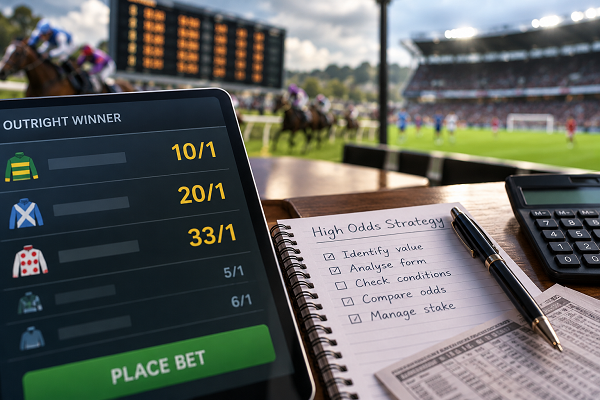
High Odds Betting Strategy: Can Backing Outsiders Really Be Profitable?
Everyone loves backing a big-priced winner. There are few better feelings in betting than seeing a 20/1 outsider come home when practically nobody gave it a chance.
But can you actually make money consistently by backing selections at high odds? Or is it simply a recipe for long losing runs and an empty betting account?
The answer is that a high odds betting strategy can be profitable, but only if you’re consistently finding bets that offer genuine value.
Simply backing long shots because they offer attractive payouts is unlikely to get you very far.
In fact, there are some interesting arguments for why higher odds selections can sometimes offer better opportunities than short-priced favourites.
In this guide, we’ll look at how high odds betting works, the strategies you can use to identify potentially profitable outsiders, and how to manage the inevitable losing runs that come with this approach.
What Is a High Odds Betting Strategy?
A high odds betting strategy involves deliberately looking for selections at relatively large prices, rather than concentrating on favourites or other short-priced bets.
There isn’t an official definition of high odds, but for the purposes of this article we’re generally talking about selections priced at 5/1 (6.00 decimal odds) or bigger.
Some bettors specialise in odds of 10/1, 20/1 or even 50/1 and above.
The attraction is obvious. You don’t need many winning bets to generate a substantial return.
For example, consider the potential profits from a £10 win bet:
| Fractional Odds | Decimal Odds | Total Return | Profit |
|---|---|---|---|
| 5/1 | 6.00 | £60 | £50 |
| 10/1 | 11.00 | £110 | £100 |
| 20/1 | 21.00 | £210 | £200 |
| 33/1 | 34.00 | £340 | £330 |
| 50/1 | 51.00 | £510 | £500 |
| 100/1 | 101.00 | £1,010 | £1,000 |
Swipe left to see the full table →
Of course, there’s a catch.
The higher the odds, the less likely a selection is generally considered to win. That means a high odds strategy will normally involve a much lower strike rate than a strategy focused on favourites.
However, a low strike rate doesn’t necessarily mean a losing strategy, as we’ll explain below.
Can You Make Money Betting on High Odds?
Absolutely, at least in principle. The important factor isn’t how often you win, but whether your winning bets generate enough profit to cover your losers.
Let’s consider a simple example.
Suppose you place 100 bets at average odds of 15/1, staking £10 on each selection.
Your total stakes would be £1,000.
Now let’s see how your returns would vary depending on the number of winners.
| Winners | Strike Rate | Total Returns | Net Profit/Loss |
|---|---|---|---|
| 3 | 3% | £480 | -£520 |
| 5 | 5% | £800 | -£200 |
| 7 | 7% | £1,120 | +£120 |
| 10 | 10% | £1,600 | +£600 |
| 12 | 12% | £1,920 | +£920 |
Swipe left to see the full table →
As you can see, a strike rate of just 7% would be enough to generate a profit of £120.
At a 10% strike rate, you’d make £600 profit from £1,000 staked, equivalent to a 60% return on investment (ROI).
That’s quite remarkable when you consider that nine out of every ten bets are losing.
The break-even strike rate at 15/1 is 6.25%, before any commission or other costs.
This illustrates one of the most important principles in betting: you don’t have to pick lots of winners to make money. You just have to obtain the right odds about the winners you do pick.
Naturally, this is a simplified example. In reality, your selections will probably be at varying odds, and finding enough genuinely profitable outsiders is far from straightforward.
The Favourite–Longshot Bias: Does It Help High Odds Bettors?
One of the most interesting concepts in betting research is something called the favourite–longshot bias.
This is the tendency, observed in various betting markets, for outsiders to offer worse average value than favourites.
In other words, bettors may be willing to pay too much for the possibility of a large payout, resulting in longshots being priced shorter than their true chances justify.
For example, a horse with a genuine 2% chance of winning should theoretically be priced at 49/1.
But if bookmakers offer only 33/1, that represents poor value, even though the potential payout looks attractive.
This is an important warning for anyone considering a high odds betting strategy.
You might think bookmakers will occasionally underestimate outsiders because they’re concentrating on the favourites. Sometimes that may happen, but the evidence doesn’t support assuming that longshots are systematically better value.
In fact, the opposite has frequently been documented.
The key, therefore, isn’t simply to back outsiders. It’s to find outsiders whose odds are bigger than they should be.
That’s a much more demanding task, but it’s also where the potential profits lie.
5 High Odds Betting Strategies Worth Considering

There are several different approaches you can take when looking for value at bigger prices.
None guarantees success, but each provides a more structured approach than simply picking selections with attractive odds.
1. Back Outsiders When the Market Has Overreacted
One potentially fruitful strategy is looking for occasions when the betting market has overreacted to recent events.
This is particularly relevant in football, horse racing and other sports where public sentiment can have a significant influence on prices.
Imagine a Premier League team has lost four consecutive matches.
Confidence in the side has collapsed, the media is questioning the manager, and bookmakers are offering 8/1 about them winning their next away fixture.
But when you examine those defeats more closely, you discover the team actually played reasonably well.
Perhaps they created plenty of chances, suffered some unfortunate refereeing decisions or were missing key players who have now returned.
If you believe the team’s true chance of winning is 15%, fair odds would be approximately 5.67/1.
Backing them at 8/1 would therefore represent a potentially attractive value bet.
The important point is that you’re not backing the team because they’re outsiders. You’re backing them because you believe the market has underestimated their chances.
Of course, that assessment needs to be supported by meaningful evidence rather than simply a hunch.
2. Look for Each-Way Value in Horse Racing
Horse racing is arguably one of the most suitable sports for a high odds betting strategy, particularly because each-way betting allows you to profit from selections that don’t actually win.
Let’s say you find a horse priced at 20/1 in a competitive handicap.
The bookmaker offers each-way terms of one-fifth the odds for the first four places.
You stake £5 each-way, making a total bet of £10.
If your horse wins, your returns would be:
- Win portion: £105 returned.
- Place portion: £25 returned.
- Total return: £130.
- Net profit: £120.
If the horse finishes second, third or fourth, your win portion loses but the place portion returns £25.
That leaves you with a £15 net profit.
This means an outsider can still generate a positive return without winning the race.
However, you need to examine the each-way terms carefully. The number of places, place fraction and available win odds all affect whether the bet represents value.
An apparent bargain at 20/1 could be less attractive than another bookmaker offering 18/1 but paying an additional place.
The same principle applies to enhanced each-way offers and extra-place promotions.
These can occasionally provide attractive opportunities, although they don’t automatically turn a poor-value selection into a good bet.
3. Use Statistics to Identify Overpriced Outsiders
One of the more disciplined approaches to high odds betting involves using statistics to estimate the true probability of an outcome.
For football, this might involve analysing:
- Expected goals (xG) and underlying performances.
- Home and away results.
- Team news, injuries and suspensions.
- Historical performance against comparable opponents.
- Fixture congestion and rest periods.
For horse racing, relevant factors might include official ratings, speed figures, course suitability, trainer form and previous performances under similar conditions.
The objective is to arrive at your own probability estimate and compare it with the available odds.
For example, suppose your analysis suggests a football team has a 12% chance of winning.
Its fair decimal odds would be:
1 ÷ 0.12 = 8.33, equivalent to approximately 7.33/1.
If bookmakers are offering 11/1 (12.00 decimal), you’ve potentially identified value.
The expected return on a £10 stake would be:
(0.12 × £120) − £10 = £4.40 expected profit.
That’s an expected ROI of 44%.
However, there’s one major qualification: your probability estimate must be accurate.
It’s easy to convince yourself an outsider has a 12% chance when its true probability is only 6%.
And that would turn what appears to be an outstanding bet into a poor one.
For that reason, serious bettors should test their statistical models against historical results before committing significant money.
4. Target Overlooked Markets
Another approach is to look beyond the most popular betting markets.
Major Premier League matches and high-profile horse races attract substantial attention from bookmakers, professional traders and recreational bettors alike.
Consequently, prices are often highly competitive.
Smaller markets may sometimes present opportunities because they receive less attention.
Examples include lower-division football, smaller horse racing meetings, niche sports and certain specialist outright markets.
However, there are drawbacks.
Less popular markets often have lower liquidity, smaller betting limits and wider bookmaker margins.
You might identify what looks like an excellent 25/1 opportunity, only to discover that you can get just a few pounds matched at that price.
That’s why price availability is so important.
At Honest Betting Reviews, we always consider whether the advertised odds are realistically achievable, rather than just looking at impressive theoretical profits.
A strategy that relies on prices nobody can actually obtain isn’t particularly useful.
5. Compare Bookmakers and Betfair Exchange Prices

When you’re betting at bigger odds, even relatively small differences in price can have a substantial effect on long-term profitability.
Imagine you’re backing a horse that one bookmaker prices at 16/1, while another offers 20/1.
With a £10 stake, the difference in profit on a winner is £40.
Over a series of successful selections, those additional returns can really add up.
Betting exchanges such as Betfair can also offer competitive prices, particularly in liquid horse racing markets.
Some bettors even concentrate on backing outsiders at Betfair Starting Price (BSP), rather than taking fixed odds beforehand.
This can be worth considering if a strategy regularly identifies selections whose prices drift before the start.
However, BSP isn’t guaranteed to beat early bookmaker prices, and exchange commission can reduce your returns.
It’s worth recording both the advised odds and BSP when testing a betting strategy to see which approach actually performs better.
How to Manage Your Bank with a High Odds Betting Strategy
This is perhaps the most important section of the entire guide.
Because even if you’ve identified a profitable betting strategy, poor staking can still lead to disaster.
High odds betting typically involves long losing runs.
And we’re not talking about five or six consecutive losers.
If you’re backing selections at 20/1 or 30/1, it’s entirely possible to go 30, 40 or even 50 bets without a winner.
That’s not necessarily evidence that your strategy has stopped working.
It’s simply the nature of betting on relatively unlikely outcomes.
Use Small, Consistent Stakes
For most bettors, we’d suggest starting with a flat-staking approach.
That means staking the same amount on every selection, rather than increasing stakes after losing bets.
For example, with a £1,000 betting bank, you might decide to stake £5 per bet.
That’s 0.5% of your starting bank.
Even after 50 consecutive losers, you’d still have £750 remaining, assuming no other bets or changes to the bank.
Compare that with staking £25 per bet.
After just 40 consecutive losers, your entire £1,000 bank would be gone.
This highlights why bank management is particularly important when backing longshots.
Avoid Chasing Losses
One mistake we’d strongly advise against is increasing your stakes to recover previous losses.
Systems such as the Martingale, where you double your stake after each losing bet, can become especially dangerous when applied to high odds selections.
Long losing sequences are inevitable, and continually increasing stakes can quickly exhaust your funds.
Your aim should be to survive the inevitable downturns and benefit from winning bets when they eventually arrive.
That requires patience and discipline.
How Long Can Losing Runs Last?
To illustrate the risks, consider a strategy with a genuine 5% strike rate.
That means each selection has a one-in-20 chance of winning, assuming the probability remains constant.
The probability of losing 30 consecutive bets is:
0.95³⁰ = approximately 21.5%.
The probability of losing 50 consecutive bets is:
0.95⁵⁰ = approximately 7.7%.
These figures describe a particular run of consecutive bets, rather than the probability of experiencing such a run somewhere across a much larger sample.
The latter probability can be considerably higher.
Even with a strategy that has a positive expected return, you should therefore expect substantial periods without a winning bet.
This is why high odds betting is unlikely to suit anyone who struggles emotionally with losing runs.
Should You Bet Singles or Accumulators?

If you’re focusing on high odds, our preference would generally be for singles rather than accumulators.
The reason is straightforward.
You’re already accepting a relatively low probability of success by backing outsiders.
Combining multiple outsiders into an accumulator reduces that probability even further.
For example, suppose you have three selections, each priced at 5/1.
A treble would produce combined decimal odds of 216.00, equivalent to 215/1.
That certainly looks appealing.
But if each selection genuinely has a one-in-six chance of winning and the outcomes are independent, the probability of all three winning would be approximately 0.46%.
In other words, you’d expect the treble to win less than once in every 200 attempts on average.
Of course, accumulators can be entertaining when used with small recreational stakes.
But if your primary objective is building a sustainable long-term betting strategy, singles make it easier to evaluate your selections, track results and manage risk.
How to Tell Whether Your High Odds Strategy Is Working
One challenge with high odds betting is that results can fluctuate dramatically.
A single 50/1 winner might turn an otherwise disappointing month into a very profitable one.
Likewise, a strategy that has been profitable for several months could experience a substantial drawdown simply because a few big-priced selections narrowly miss out.
That makes it particularly important to judge results over a meaningful sample.
At a minimum, we’d suggest monitoring the following:
Return on investment (ROI): Your total profit divided by total stakes. This tells you how much you’re making relative to the amount wagered.
Strike rate: The percentage of bets that win. This helps you understand whether results broadly match expectations at your average odds.
Average odds: Essential when interpreting your strike rate. Winning 10% of bets at 5/1 is very different from winning 10% at 20/1.
Maximum drawdown: The biggest decline in your betting bank from a previous peak. This is crucial for assessing how much capital you might need.
Odds availability: Whether the prices used to calculate your returns were actually achievable.
You should also compare the prices you took against later market prices, ideally using a consistent closing-price benchmark.
Consistently beating the closing market can be a useful indication that you’re identifying value, although it’s not conclusive proof of profitability.
And be careful not to judge a strategy solely on a handful of spectacular winners.
A few lucky results can disguise a fundamentally poor approach.
For high odds strategies, even several hundred bets may not be enough to establish a reliable long-term edge, particularly when selections are at very large prices.
Common High Odds Betting Mistakes
There are several traps that are worth avoiding.
Backing outsiders simply because the payout is attractive. A 100/1 selection isn’t a bargain if its true chance of winning is only one in 500.
Ignoring bookmaker margins. High odds selections can be particularly poor value in markets with large overrounds.
Overestimating your ability to predict unlikely outcomes. It’s difficult to distinguish accurately between a 3% chance and a 5% chance, but that difference can completely change whether a bet is profitable.
Using stakes that are too large. Even a genuinely profitable strategy can suffer a severe downturn.
Giving up too quickly. Losing runs are an unavoidable part of high odds betting, so you need a sufficiently large sample to assess performance.
Following tipsters based on one big winner. A service advertising a 66/1 or 100/1 winner might look impressive, but it’s the overall record that matters.
At Honest Betting Reviews, we prefer to assess tipsters across an extended period, including their ROI, strike rate, price availability and performance at Betfair SP where appropriate.
These figures provide a much more useful picture than an occasional eye-catching winner.
High Odds vs Low Odds Betting: Which Is Better?

So which approach should you choose?
The reality is that neither high odds nor low odds betting is automatically superior.
Both can be profitable when the available prices underestimate the true probability of winning, and both can lose money when the prices are poor.
Low odds betting generally offers a higher strike rate and more frequent winners, although individual profits tend to be smaller.
High odds betting offers the prospect of substantial returns from relatively few winners, but the trade-off is greater volatility and potentially lengthy losing sequences.
For most bettors, the best strategy is probably not to restrict yourself to a particular odds range at all.
Instead, concentrate on identifying value wherever it appears.
That might mean backing a 4/6 favourite one day and a 25/1 outsider the next.
The important question should always be the same:
Are the odds bigger than the selection’s true chances of winning justify?
If the answer is yes, you may have a worthwhile bet.
If the answer is no, the size of the potential payout is irrelevant.
Frequently Asked Questions
What is the best high odds betting strategy?
There isn’t one universally successful strategy. Approaches based on identifying overpriced outsiders, comparing bookmaker odds and using statistical analysis offer a more sensible starting point than backing longshots at random.
Whatever approach you take, careful staking and accurate record-keeping are essential.
Are high odds bets good value?
Not necessarily. High odds simply indicate that an outcome is considered relatively unlikely.
A 20/1 selection could offer excellent value if its true probability is 8%, but poor value if its genuine chance is only 2%. Price must always be assessed against probability.
What strike rate do you need to make a profit at 10/1?
At fixed odds of 10/1, you need to win more than approximately 9.09% of your bets to make a profit with level stakes, before commission or other costs. That equates to slightly more than nine winners per 100 bets.
Is it better to back favourites or outsiders?
Neither offers a guaranteed advantage. Research into the favourite–longshot bias suggests that favourites have often offered better average returns than outsiders in certain markets.
However, individual outsiders can still represent excellent value when their odds underestimate their genuine winning chances.
How much should you stake on high odds bets?
Stakes should generally be small relative to your betting bank because losing runs can be substantial.
A flat stake of around 0.5% to 1% of your starting bank may be a reasonable cautious starting point, although even this does not eliminate the risk of significant losses.
Final Verdict: Is a High Odds Betting Strategy Worth Trying?
There’s certainly something appealing about a strategy where one or two winners can transform your results.
And as we’ve demonstrated, it is mathematically possible to generate impressive returns with a surprisingly low strike rate.
However, we wouldn’t recommend backing outsiders indiscriminately in the hope of landing the occasional big winner.
The evidence surrounding the favourite–longshot bias suggests this can actually be a particularly expensive way to bet.
Instead, we’d focus on finding genuine value, comparing prices across bookmakers, keeping stakes small and tracking results over a sufficiently long period.
Above all, remember that high odds betting requires patience.
You might have to endure dozens of losing bets before landing a winner, and even then there’s no guarantee your strategy has a long-term edge.
Our verdict: High odds betting can be a worthwhile approach for experienced, disciplined bettors who are confident in their ability to identify overpriced selections. But for everyone else, the sensible strategy is to focus on value rather than the excitement of a potentially enormous payout.
As always, only bet with money you can afford to lose. No betting system guarantees a profit, regardless of the odds involved.



Leave a Reply
Want to join the discussion?Feel free to contribute!