

Slot Betting Strategy: Can You Really Beat Online Slots?
Online slots are among the most popular casino games, offering everything from traditional three-reel fruit machines to modern video slots featuring elaborate bonus rounds and enormous jackpots.
But while slots are certainly entertaining, there’s one question that crops up repeatedly: is there a slot betting strategy that can actually help you win?
You’ll find plenty of systems online claiming to offer the secret to beating slots. Some involve changing your stakes after wins or losses, while others recommend switching machines, targeting certain times of day or looking for slots that are supposedly ready to pay out.
Unfortunately, most of these strategies don’t stand up to scrutiny.
However, that doesn’t mean there’s nothing you can do to improve your approach to playing slots.
By understanding how slot machines work, choosing games with favourable payout percentages and managing your bankroll carefully, you can make more informed decisions and potentially reduce your losses over time.
In this guide, we’ll look at the most popular slot betting strategies, explain which ones make mathematical sense and reveal some of the common mistakes to avoid.
Is There a Winning Slot Betting Strategy?
Let’s get the most important point out of the way first.
There is no betting strategy that can guarantee consistent profits from conventional online slots.
Unlike sports betting, where knowledge, statistical analysis and identifying value odds can potentially give you an advantage, most online slots are entirely games of chance.
Their results are determined by a Random Number Generator (RNG), meaning that each spin is unpredictable.
You can’t influence the outcome through your timing, previous results or the amount you stake.
Indeed, the UK Gambling Commission requires licensed online gambling games to produce acceptably random outcomes, with systems that adapt the odds based on previous results prohibited.
Nevertheless, there are some sensible strategies for selecting slots and controlling your spending.
The distinction is important: you can improve the mathematical value of the games you choose, but you cannot reliably predict or control their results.
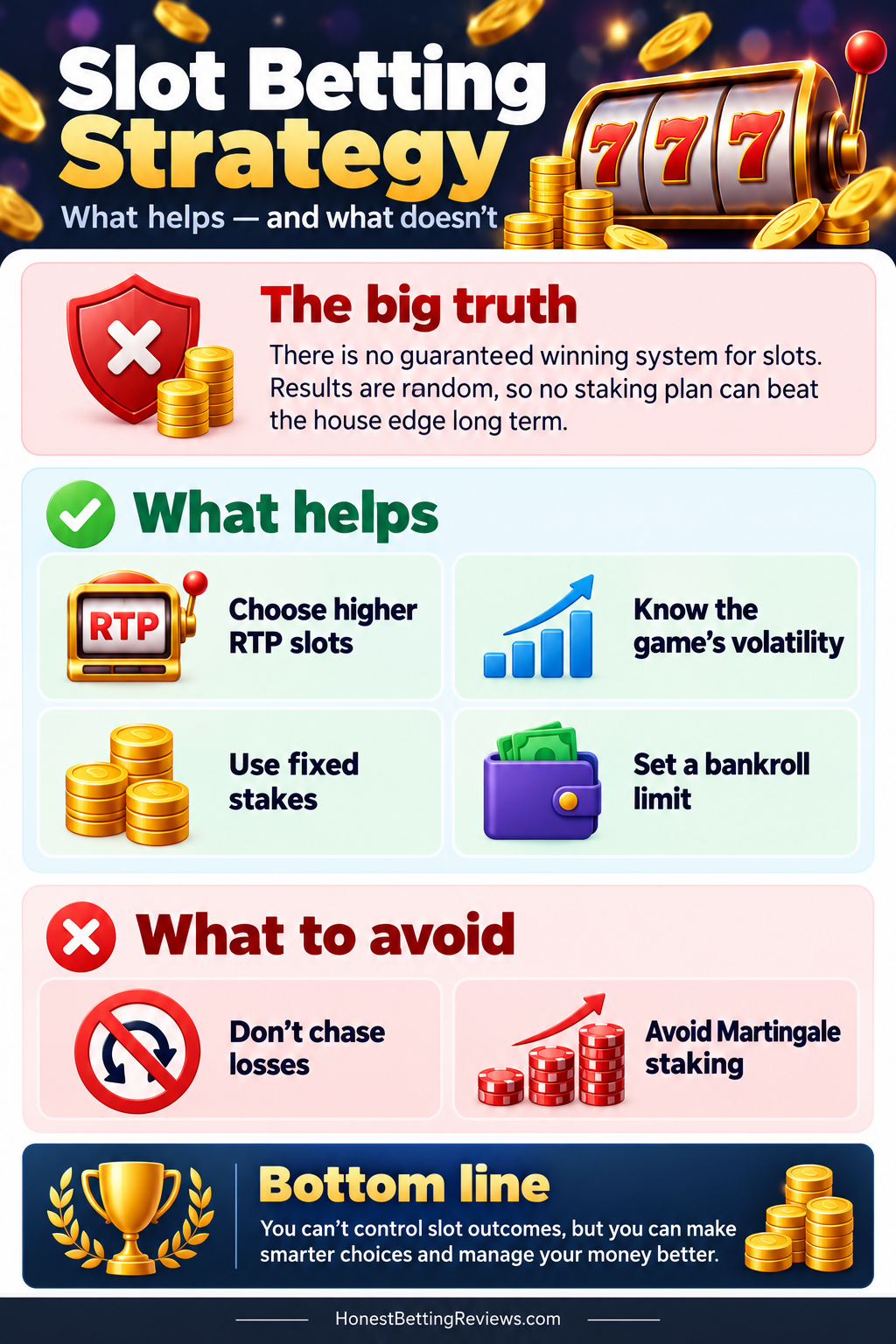
1. Choose Slots With a High RTP
If there’s one piece of advice we’d give anyone looking for a slot betting strategy, it’s to pay close attention to the Return to Player (RTP).
RTP represents the theoretical percentage of stakes that a slot machine returns to players over a very large number of spins.
For example:
- A slot with 94% RTP has a theoretical house edge of 6%.
- A slot with 96% RTP has a theoretical house edge of 4%.
- A slot with 98% RTP has a theoretical house edge of just 2%.
That might not sound like an enormous difference, but over thousands of spins it can become significant.
Imagine two players who each wager a total of £5,000.
One chooses a slot offering 94% RTP, while the other plays a game offering 98%.
The theoretical losses would be:
94% RTP: £300
98% RTP: £100
That’s a difference of £200 simply from choosing a game with more favourable mathematics.
Of course, these are theoretical figures. Actual results can differ enormously, particularly over shorter playing sessions.
You could win thousands on a 94% RTP slot or lose your entire bankroll on one offering 98%.
Nevertheless, higher RTP games provide a better theoretical return over the long run.
Our strategy: Look for slots offering RTPs of 96% or higher, ideally 97% or above when available.
One important consideration is that some slot developers release different RTP versions of the same game.
Check the payout percentage displayed in the actual game information rather than relying on a figure published elsewhere.
For more information, see our guide on how to win at casino slots.
2. Understand Slot Volatility
Another important factor when choosing slot machines is volatility, sometimes called variance.
This describes how frequently a slot is likely to produce payouts and how large those payouts might be.
Generally, slots fall into three broad categories.
Low-volatility slots
These tend to offer smaller, more frequent prizes.
They may appeal to players who prefer less dramatic fluctuations in their balances, although they’re still capable of producing substantial losses.
Medium-volatility slots
These offer a balance between smaller regular wins and occasional larger payouts.
They’re somewhere between the two extremes.
High-volatility slots
These typically offer the possibility of substantial prizes, but potentially with long periods between meaningful wins.
They can produce particularly sharp swings in your bankroll.
Which volatility is best?
That depends on what you’re looking for.
If your priority is to make a fixed entertainment budget last longer, lower-volatility games may be more suitable, although there’s no guarantee they will.
If you’re interested in the possibility of a much larger win and accept the risk of rapidly losing your bankroll, high-volatility slots offer that type of payout structure.
However, high volatility doesn’t mean better value.
A high-volatility game with 94% RTP still has a larger theoretical house edge than a low-volatility game offering 97%.
3. Use a Fixed-Stake Strategy
One of the simplest slot betting strategies involves using the same stake for every spin.
This is known as level staking and is common in other forms of gambling, particularly sports betting.
For example, imagine you have a £50 entertainment budget.
Rather than varying your stakes depending on your results, you could choose to play at 20p per spin.
This makes it easier to understand your exposure and avoid emotional decisions.
Compare that with a player who starts at 20p, increases to £1 after several losses and eventually begins placing £5 spins in an attempt to recover their money.
The second player is taking considerably more financial risk.
A fixed-stake strategy doesn’t improve the RTP or change your probability of winning.
However, it can help prevent uncontrolled increases in staking.
Our strategy: Decide your stake before playing and avoid increasing it to recover previous losses.

4. Set a Bankroll and Loss Limit
Bankroll management is probably the most important part of any responsible slot betting strategy.
Unlike sports betting, where we might allocate a fixed percentage of our betting bank to individual selections, slots have a built-in mathematical disadvantage.
Consequently, your bankroll should be treated as an entertainment budget rather than an investment fund.
For example, suppose you’ve allocated £100 for occasional casino entertainment.
You might divide this into four separate £25 sessions.
Once you’ve spent the £25 allocated to a particular session, you stop playing.
The important part is sticking to that limit, regardless of whether you think a big win might be around the corner.
It can also help to establish a time limit before starting.
Remember that even relatively small stakes can add up quickly.
At 50p per spin, 200 spins represent £100 in total wagering, even if you’ve recycled winnings to fund some of those spins.
That doesn’t necessarily mean you’ve lost £100, but it demonstrates how quickly your total betting turnover can increase.
5. Don’t Chase Your Losses
Chasing losses is one of the biggest mistakes casino players make.
Perhaps you’ve played 100 spins without a significant win.
You might start thinking that a bonus round must be approaching or that increasing your stake will help recover the money you’ve lost.
Unfortunately, neither assumption is justified.
On a conventional RNG-based online slot, the next spin doesn’t become more likely to win simply because the previous 100 were unsuccessful.
This is an example of the gambler’s fallacy: the mistaken belief that previous independent random outcomes influence future ones.
Consider flipping a fair coin.
Even if it lands on heads ten times consecutively, the probability of heads on the next flip remains 50%.
The same principle applies to independent slot outcomes.
Rather than increasing stakes after losing, the sensible approach is to respect your predetermined limits.
6. Be Careful With Slot Bonuses and Free Spins
Casino bonuses can sometimes provide additional playing opportunities without requiring you to fund every spin yourself.
However, not all bonuses offer good value.
Some come with demanding wagering requirements, game restrictions, maximum win limits or withdrawal conditions.
For example, imagine a casino offers a £20 bonus with a 35x wagering requirement.
If that requirement applies to the bonus amount alone, you would need to wager £700 before the bonus winnings became withdrawable.
And if the qualifying slots have a theoretical house edge of 4%, the expected loss on £700 of wagering would be £28.
That doesn’t automatically mean the offer is worthless. The precise value depends on the bonus rules, wagering contributions and other restrictions.
However, it demonstrates why a seemingly generous promotion isn’t necessarily as attractive as it first appears.
Before accepting any casino bonus, check:
- The wagering requirements and which balance they apply to.
- Which slots contribute towards wagering.
- Any maximum stake restrictions.
- Whether winnings are capped.
- When the bonus expires.
Avoid depositing additional money simply to unlock or complete a promotion.
7. Avoid the Martingale Slot Betting Strategy

The Martingale is probably one of the best-known betting systems.
It involves increasing your stake after a loss, traditionally doubling it, in the hope that an eventual win will recover previous losses.
It’s particularly associated with roulette, although some players attempt to apply similar systems to slots.
Unfortunately, it’s even less suitable for slot machines.
Unlike an even-money roulette bet, a slot spin can produce multiple possible outcomes, including payouts smaller than your stake.
Even if you doubled your stake after each completely losing spin, the amounts involved could escalate extremely quickly.
Starting with 20p, seven successive stake levels would be:
20p → 40p → 80p → £1.60 → £3.20 → £6.40 → £12.80
The total amount committed would already reach £25.40.
In addition, the later stakes would exceed the current limits for regulated online slots in Great Britain. This is why we strongly advise against using the Martingale strategy in betting.
Those limits are £2 per game cycle for adults aged 18–24 and £5 for those aged 25 or over, according to the UK Gambling Commission’s online slots stake guidance.
More importantly, doubling stakes doesn’t overcome the house edge.
Our verdict: The Martingale is not a viable long-term winning strategy for online slots.
8. Know When to Stop
One of the more useful slot strategies is also one of the simplest: decide when you’re going to stop before you start playing.
You might establish a maximum acceptable loss or a limit on how long a session lasts.
Some players also choose a profit target and end their session if they reach it.
For example, someone starting with £30 might decide to stop if their balance reaches £45.
That doesn’t make the slot more profitable mathematically, and it won’t guarantee the player finishes ahead.
It simply means they won’t continue playing after reaching their predetermined target.
It’s also worth remembering that winnings are not somehow separate from your own money.
If your balance increases from £30 to £60, the additional £30 is yours. Losing it back is still losing money.
The most important thing is not to allow your limits to shift because of excitement, frustration or the feeling that you’re about to win.
Popular Slot Betting Strategies That Don’t Work
Apart from the Martingale, there are several other commonly promoted systems worth questioning.
Playing slots at certain times
You might hear that slots pay out more frequently at night or during quieter periods.
There’s no reliable evidence that changing the time of day improves the probabilities on regulated RNG-based online slots.
Switching slots after a big win
Some players believe a machine becomes less generous immediately after awarding a large jackpot.
For an independent RNG-based game, previous payouts don’t change the probability of the next result.
Increasing stakes before a bonus round
There’s no reliable way to predict when a standard randomly triggered bonus round is about to appear.
Increasing your stake based on a feeling that a feature is imminent simply increases your financial exposure.
Using a fixed number of spins
Another approach involves playing exactly 50 or 100 spins before moving to a different slot.
This can be useful as a spending or time-management rule, but the number itself has no influence on your chances of winning.
What’s the Best Slot Betting Strategy?

Having examined the different approaches, what w