

Odds 5/2 Meaning: What Do These Betting Odds Really Tell You?
If you’ve ever placed a bet or scanned a racecard, you’ve probably come across odds like 5/2. But what exactly do odds of 5/2 mean?
How much could you win, and are these odds worth taking?
Whether you’re a beginner or just looking for a quick refresher, this guide will walk you through the meaning of 5/2 odds, how to calculate your potential returns, and what these odds really say about a selection’s chances of winning.
We’ll also take a look at some examples of 5/2 bets and strategies for betting on them.
Let’s break it all down in plain English.
🔢 What Does 5/2 Odds Mean?
In simple terms, 5/2 is a form of fractional odds, which are commonly used in the UK and Ireland. These odds are read as “five to two.”
Here’s how to interpret them:
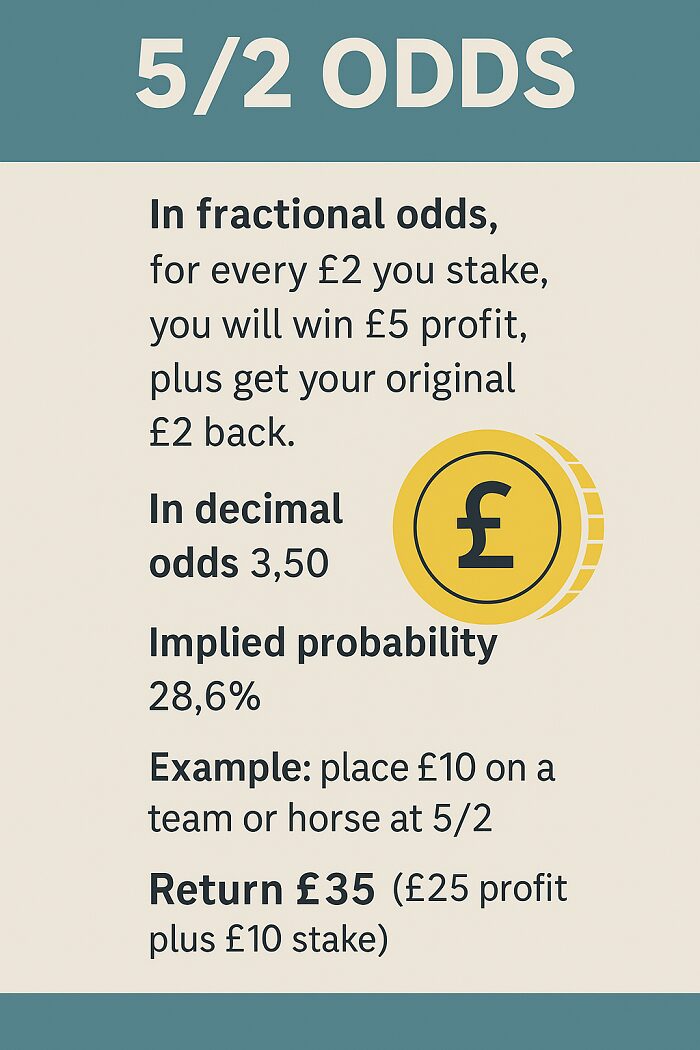
- For every £2 you stake, you’ll make £5 profit if your bet wins.
- You’ll also get your original £2 stake back, making your total return £7.
It’s a ratio of profit to stake, not total return. So in fractional odds, the number on the left (5) represents the profit, and the number on the right (2) is the stake required to win that amount.
💰 How Much Do You Win at 5/2 Odds?
Let’s look at some quick examples to see what kind of returns you can expect:
| Stake | Profit (at 5/2) | Total Return |
|---|---|---|
| £1 | £2.50 | £3.50 |
| £2 | £5.00 | £7.00 |
| £5 | £12.50 | £17.50 |
| £10 | £25.00 | £35.00 |
| £20 | £50.00 | £70.00 |
So if you bet £10 at 5/2 odds, you’ll make £25 in profit and get your tenner back too, making a total return of £35.
Here is 5/2 summarised then:
🧮 Converting 5/2 to Decimal or American Odds
If you’re used to other formats, you might prefer to see odds in decimal or American format. Here’s how 5/2 stacks up:
- Decimal odds: 5 ÷ 2 + 1 = 3.50
- American odds: Since it’s over even money, it’s positive: +250
So:
- 5/2 = 3.50 in decimal
- 5/2 = +250 in American odds
These are all just different ways of expressing the same thing — a potential £2.50 profit for every £1 staked.
🏟️ Examples of 5/2 Odds in Different Sports
To give you a clearer picture of how 5/2 odds show up in real-world betting, let’s look at some examples across a range of popular sports.
🐎 Horse Racing
This is where you’ll most commonly see 5/2 odds. A horse priced at 5/2 is typically one of the front-runners — maybe not the favourite, but certainly among the leading contenders.
Example:
You back “Midnight Runner” at 5/2 in the 3:30 at Cheltenham.
- Stake: £10
- Profit: £25
- Total return: £35
This kind of price often reflects a strong horse with decent form but maybe one question mark — like the ground, the distance, or a tough opponent.
⚽ Football
In football, you might come across 5/2 odds in correct score markets, first goalscorer bets, or even outright markets for a team to win a tournament.
Example:
You bet on Harry Kane to score first at 5/2 in a World Cup group match.
- Stake: £10
- Profit: £25
- Total return: £35
You might also see 5/2 offered for a team to win a game as an underdog — for example, a mid-table Premier League side away to a top-six club.
🎾 Tennis
In tennis, 5/2 odds are often given to players facing higher-ranked opponents, especially in early rounds of tournaments.
Example:
You fancy a rising star to beat a seeded player in a Grand Slam and they’re priced at 5/2.
- Stake: £20
- Profit: £50
- Total return: £70
This can represent good value if you’ve done your research and spotted a player in form or playing on a favourable surface.
🥊 Boxing & UFC
Combat sports are full of value bets, and 5/2 is a common price for fighters who are seen as dangerous but not the expected winner.
Example:
A challenger going up against a defending world champion might be offered at 5/2.
If you place £15, you’ll make £37.50 profit and receive £52.50 in total returns.
This is a great price point for underdogs with a real puncher’s chance.
🏆 Outright & Tournament Markets
5/2 odds are often seen in outright markets when there’s a clear favourite, but one other strong contender nipping at their heels.
Example:
- Team A to win the Six Nations – 5/2
- Golfer B to win The Masters – 5/2
In these cases, you’re betting on the second favourite — still very much in with a chance, but not the bookies’ pick.
Summary of 5/2 Examples
Odds of 5/2 crop up in many sports and markets. Whether you’re betting on a footballer to score first, a tennis player to pull off an upset, or a horse to romp home at Cheltenham, this price reflects a realistic yet profitable opportunity — the kind that savvy punters love.
When you see 5/2, always ask yourself: Do I believe the actual chance of winning is greater than 28.6%?
If yes — you might just have a value bet on your hands.
🤔 Are 5/2 Odds Good Value?
This really depends on whether you think the selection’s actual chances of winning are better than the implied probability (which is around 28.6%).
Let’s say you’re looking at a horse priced at 5/2. If you genuinely believe it has a 40% chance of winning, then you’ve got a value bet on your hands.
This is where value betting comes into play — spotting occasions when the odds underestimate the true probability of an outcome.
So while 5/2 might not be flashy like 20/1, it could still offer excellent value if the selection is strong.
🧙 Strategies for Betting on 5/2 Shots

Odds of 5/2 offer an appealing blend of risk and reward — not too short to be worthless, and not so long that you’re relying on miracles. But as with any price, success comes down to strategy and discipline.
Here are some smart betting strategies to consider when backing a selection at 5/2:
🎯 1. Look for Value, Not Just Potential
Just because something is priced at 5/2 doesn’t mean it’s a good bet. You should always ask:
Does the chance of winning exceed the implied probability of 28.6%?
If you believe the selection has a 35–40% chance or higher, then you’ve got a value bet. This is the cornerstone of any profitable long-term betting strategy.
📊 2. Do Your Homework
Whether it’s horse racing, football, tennis or another sport, make sure you dig into the data:
- Horse Racing: Look at the form, jockey/trainer stats, ground conditions, draw bias.
- Football: Analyse recent performances, injuries, head-to-heads, expected goals (xG).
- Tennis: Consider surface preference, head-to-head records, recent fatigue or travel.
Don’t just back a 5/2 shot because it “feels right” — back it because the evidence supports it.
🧮 3. Use a Staking Plan
Since 5/2 odds don’t hit as often as odds-on favourites, you’ll need to manage your bankroll carefully.
Consider one of these approaches:
- Level stakes: Bet the same amount on each 5/2 shot.
- Percentage staking: Wager a fixed % of your bankroll (e.g. 2–5%).
- Kelly Criterion: Advanced bettors might use this to calculate the “optimal” stake based on value.
Avoid chasing losses or lumping large stakes just because the potential return looks tasty.
🧾 4. Track Your Results
It’s easy to overestimate your success rate with 5/2 bets — especially after a big win.
Keep a simple spreadsheet of:
- Date
- Selection
- Sport/event
- Stake
- Odds
- Result
- Profit/loss
After 20, 50, or 100 bets, you’ll see whether you’re actually profitable at this price range — and which types of bets perform best.
🧠 5. Use Multiple Bookmakers
Not all bookies will offer the same price. One may have a selection at 5/2, while another has it at 9/4 or 11/5. Over time, getting the best price