

UK Gambling Statistics 2026: 50+ Facts About Betting in Britain
How many people gamble in the UK? How much money do bookmakers make? And is online betting taking over from traditional betting shops?
Gambling is a huge industry in Britain, generating billions of pounds in revenue every year. From the National Lottery and football betting to online slots, casinos and horse racing, millions of people regularly stake money on the chance of winning.
But the gambling industry is changing.
Online betting has become increasingly important, betting shops continue to disappear from high streets, and concerns about problem gambling remain firmly in the spotlight.
So, what do the numbers actually tell us?
We’ve brought together more than 50 UK gambling statistics and key findings for 2026, using official Gambling Commission figures and our own calculations to explore the size of the industry, the habits of British gamblers and the trends shaping its future.
Whether you’re researching the gambling industry, writing about betting or simply curious about how much money is involved, this guide contains the essential facts.
Last updated: 16 October 2026. Unless otherwise stated, industry financial figures cover Great Britain from April 2025 to March 2026.
Participation figures come from the Gambling Survey for Great Britain 2025. Northern Ireland is not included in these Great Britain statistics.
UK Gambling Statistics 2026: The Key Facts
£17.5bn
Annual gambling industry gross gambling yield
31m
Adults who gambled in the previous 12 months (estimated)
47%
Adults who gambled in the previous four weeks
£8.3bn
Remote casino, betting and bingo gross gambling yield
5,617
Betting shops across Great Britain
2.4%
Adults with a PGSI problem gambling score of 8 or higher
Sources: UK Gambling Commission, September 2026 industry statistics and July 2026 annual gambling participation survey.
The headline figures show an industry that continues to generate substantial revenue, even as the way people gamble changes.
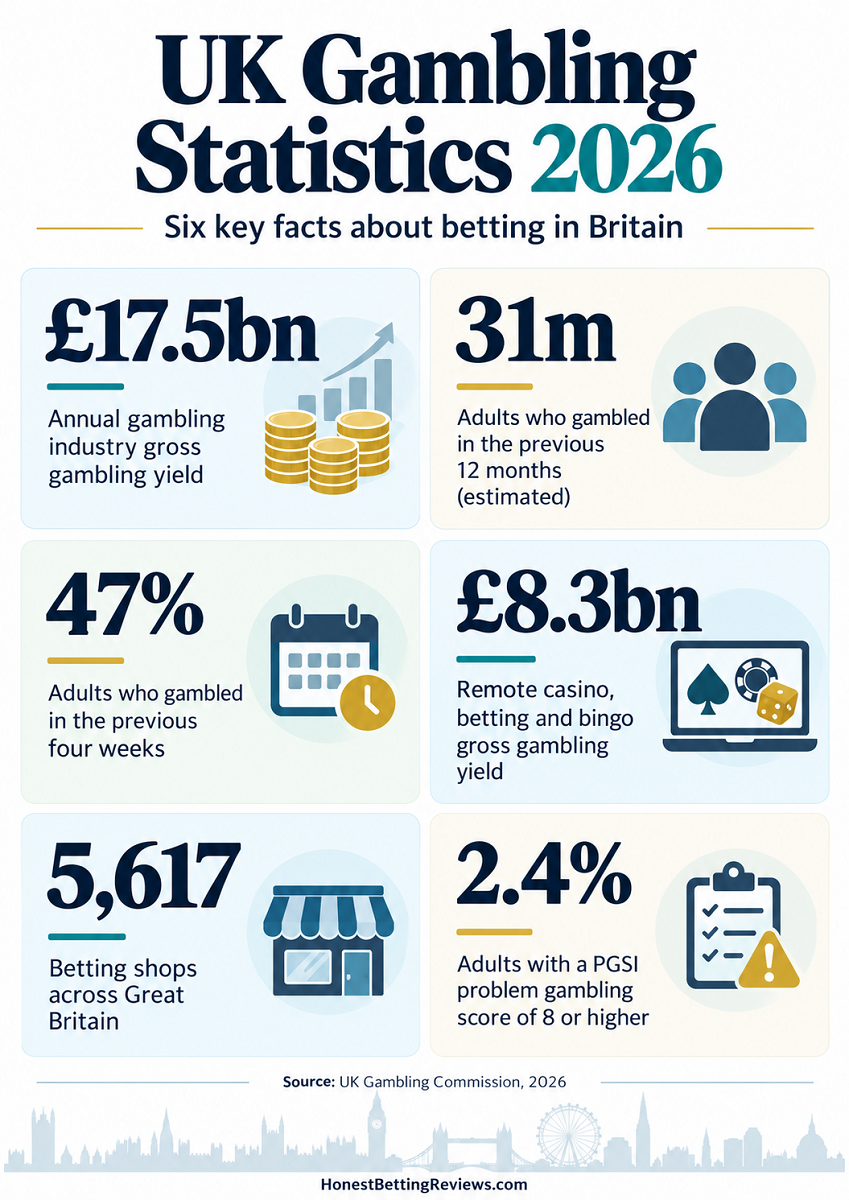
Here are the most important statistics, divided into the areas that matter.
1. How Big Is the UK Gambling Industry?
The British gambling industry is worth billions, but understanding its size requires distinguishing between the money people stake and the money operators retain.
The Gambling Commission measures the industry’s income using Gross Gambling Yield (GGY). Broadly speaking, this is the amount retained by gambling operators after winnings are paid out, before their operating costs and taxes are deducted.
It isn’t the same thing as total gambling turnover or bookmakers’ net profits.
According to the Gambling Commission’s September 2026 report:
-
The British gambling industry generated £17.5 billion in GGY during April 2025–March 2026.
-
Industry GGY increased by 4.4% compared with the previous financial year.
-
Excluding lotteries, gambling GGY totalled £13.2 billion.
-
Non-lottery gambling revenue increased by 4.7% year-on-year.
-
Online casino, betting and bingo generated approximately £8.3 billion in GGY.
-
Land-based gambling sectors generated approximately £4.9 billion.
-
Licensed lotteries generated approximately £4.3 billion in GGY.
-
There were 2,154 gambling operators in the British market as of 31 March 2026.
-
The number of operators fell by 1.1% compared with March 2025.
-
Operators held 3,097 gambling activity licences at the end of March 2026.
Where does gambling industry revenue come from?
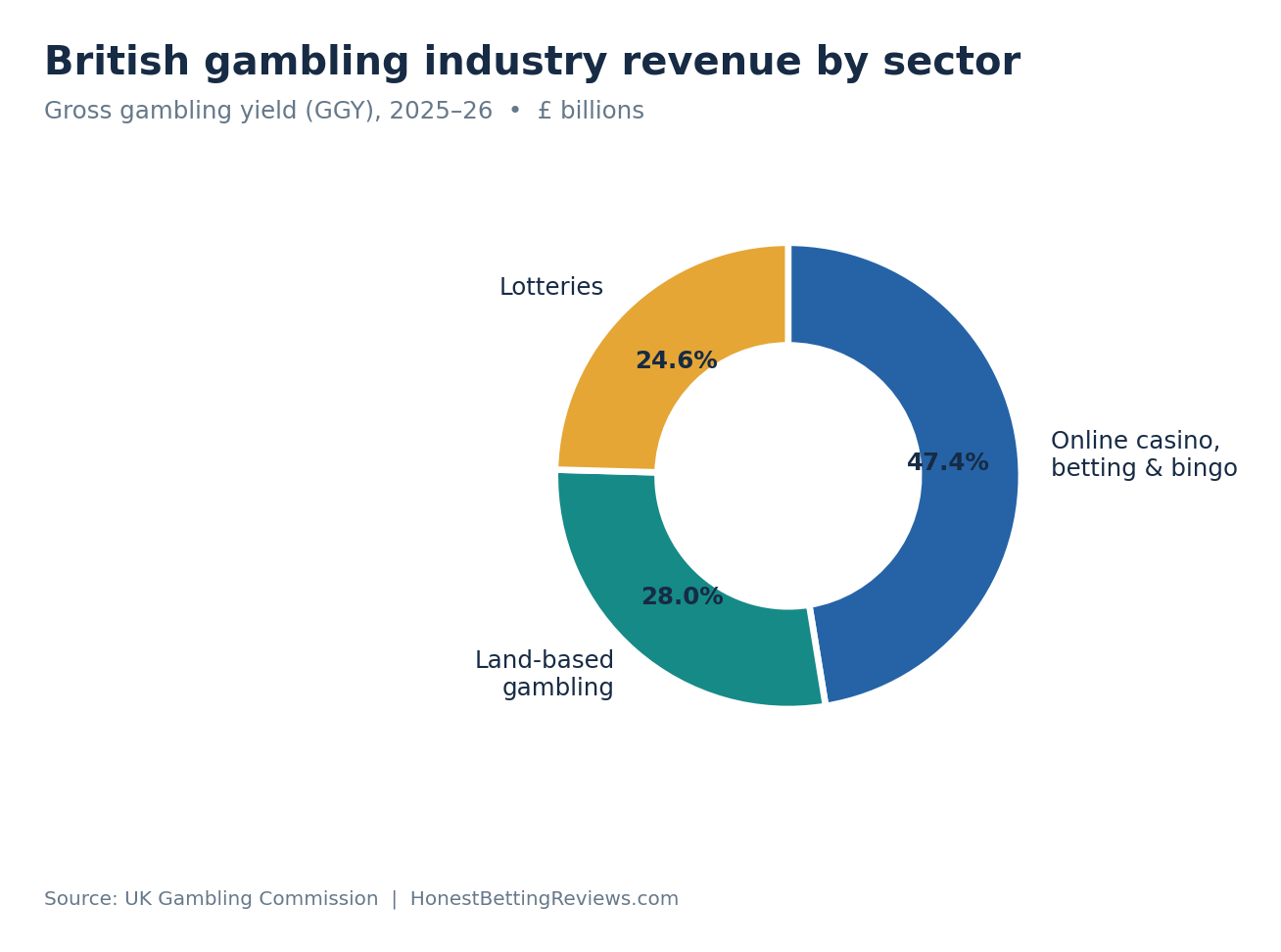
Online gambling now accounts for approximately 63% of non-lottery industry GGY, based on the Gambling Commission’s rounded sector figures.
That’s a substantial share, although it doesn’t mean 63% of all gambling activity takes place online. Revenue share and participation rates measure different things.
The figures also show how important lotteries remain, accounting for roughly a quarter of total industry GGY.
2. How Many People Gamble in Britain?
Gambling participation is widespread, especially when lottery tickets and scratchcards are included.
The latest complete annual Gambling Survey for Great Britain, published in July 2026, questioned 20,775 adults.
Its findings provide a detailed picture of how many people gamble and how frequently they take part.
-
59% of British adults gambled at least once during the previous 12 months.
-
This represents approximately 31 million adults.
-
47% of adults gambled during the previous four weeks.
-
That equates to approximately 25 million people.
-
Excluding people who only entered lottery draws, 12-month participation fell to 40%.
-
On the same basis, four-week participation was 27%.
-
51% of men had gambled during the previous four weeks.
-
The corresponding figure for women was 44%.
-
Excluding lottery-draw-only participants, four-week gambling participation was 30% among men, compared with 24% among women.
-
People who gambled during the previous four weeks participated in an average of 2.4 different types of gambling activity.
Gambling participation with and without lotteries
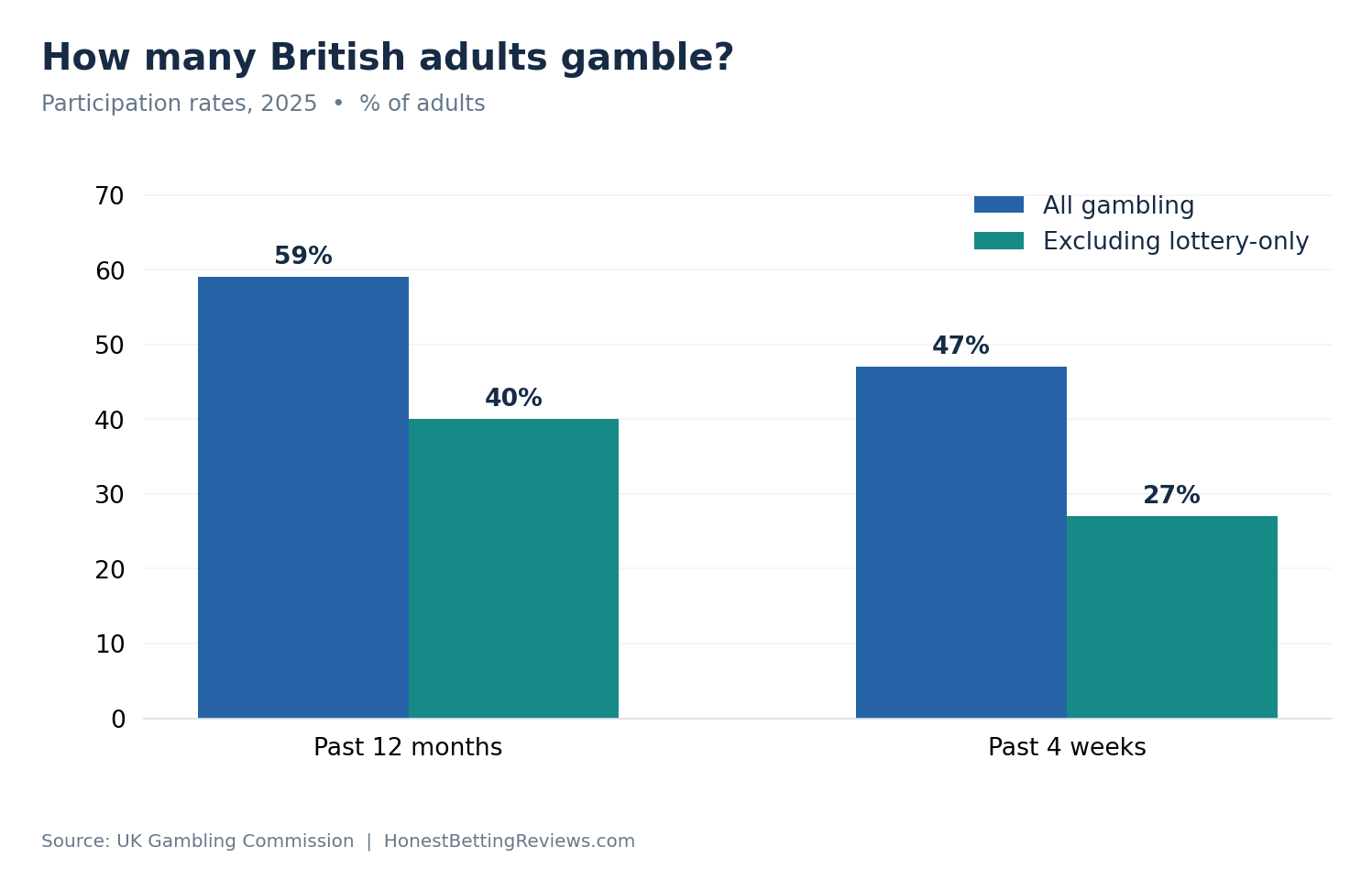
One of the most revealing statistics is the difference between participation figures that include lottery-only players and those that exclude them.
Saying nearly half of adults gamble every four weeks sounds dramatic. However, many of those people are simply buying lottery tickets.
That doesn’t make lottery participation irrelevant, but it does highlight why gambling statistics need to be examined carefully rather than taken at face value.
3. What Are the Most Popular Forms of Gambling?
The National Lottery remains one of Britain’s most popular gambling activities.
However, there are significant differences between age groups and between men and women.
According to the 2025 annual survey:
-
31% of British adults bought National Lottery tickets during the previous four weeks.
-
16% bought tickets for other charity lotteries.
-
12% bought scratchcards.
-
National Lottery tickets, charity lotteries and scratchcards were the three most common gambling activities overall.
-
Among men and adults aged 18–34, online sports and racing betting featured among the three most common activities instead of scratchcards.
-
Participants aged 18–24 took part in an average of 3.6 gambling activity types over four weeks.
-
Among participants aged 75 and over, that average was 1.7.
These figures suggest that lottery products appeal to a broad population, while younger gamblers tend to engage with a wider variety of betting and gaming products.
The distinction also matters when discussing risk. Someone buying one lottery ticket a week has a very different gambling pattern from someone regularly playing online casino games or placing several sports bets each day.
4. Online Gambling Statistics: How Big Is the Digital Market?
Online gambling has changed the industry dramatically.
For many customers, visiting a bookmaker is no longer necessary. Bets can be placed on mobile phones, live sports markets can be accessed during matches, and online casinos are available around the clock.
The latest industry statistics illustrate the scale of this market.
-
Online casino, betting and bingo generated £8.3 billion in GGY during 2025–26.
-
This was an increase of 6.9% compared with 2024–25.
-
Online casino games generated approximately £5.7 billion.
-
Of that, online slots contributed approximately £4.8 billion.
-
Remote betting generated approximately £2.4 billion.
-
Online football betting accounted for approximately £1.2 billion in GGY.
-
Online horse racing betting contributed approximately £769.3 million.
-
Remote bingo generated approximately £147.8 million.
-
Operators reported 32.4 million new account registrations during the year, down 3.0% year-on-year.
-
There were approximately 25.7 million active remote gambling accounts at the end of the final reporting quarter.
These account numbers are not equivalent to the number of individuals gambling. One customer may have accounts with several operators.
Online gambling revenue by activity
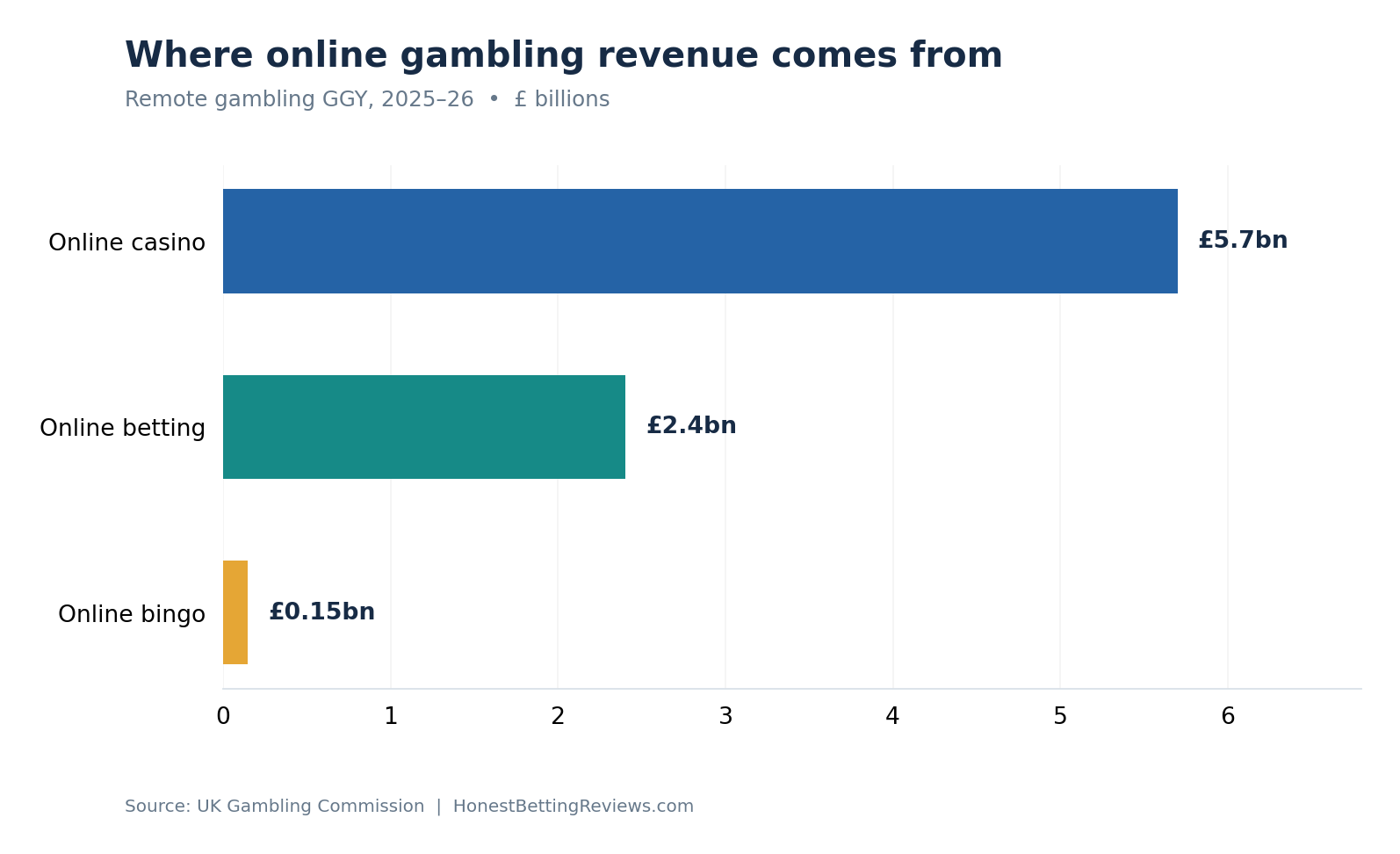
Online casino games generate more than twice the revenue of remote sports and other betting.
That is particularly interesting for a website such as Honest Betting Reviews, where sports betting is naturally one of our main areas of interest.
Despite the popularity of football, horse racing and other sports, casino products account for a much larger proportion of online gambling operators’ retained revenue.
5. Online vs In-Person Gambling: Which Is More Popular?
Although online gambling generates substantial revenue, participation figures tell a slightly different story.
The 2025 Gambling Survey found:
-
38% of adults had participated in online gambling during the previous four weeks.
-
28% had gambled in person.
-
Excluding lottery-draw-only players, online gambling participation was 16%.
-
On the same basis, in-person participation was 17%.
-
42% of men had gambled online, compared with 34% of women.
-
Excluding lottery-draw-only players, online participation was 20% for men and 12% for women.
These figures challenge the assumption that nearly all gambling has moved online.
Much of the apparent advantage enjoyed by online gambling comes from people purchasing lottery tickets digitally.
Once lottery-only participants are excluded, in-person gambling participation was marginally higher in the 2025 survey.
This distinction is important, particularly when assessing the changing popularity of betting shops, casinos and other traditional gambling venues.
6. Are Betting Shops Disappearing from British High Streets?
Despite the enormous growth of online gambling, traditional betting shops remain a familiar sight on British high streets.
However, their numbers are declining.
Gambling Commission figures show that there were 5,617 betting shops in Great Britain at the end of March 2026, representing another year of closures.
-
There were 8,081 licensed gambling premises in Great Britain during 2025–26.
-
This represented a 2.0% decrease compared with the previous financial year.
-
Of these, 5,617 were betting shops.
-
Betting shop numbers declined by 3.6% year-on-year.
-
The number of betting shops fell by 208 compared with March 2025.
-
Land-based betting generated approximately £2.4 billion in annual GGY.
-
Land-based betting GGY decreased by 3.3% compared with 2024–25.
-
Gaming machines accounted for 49.4% of non-remote betting GGY.
The decline of British betting shops
Betting shops in Great Britain
Number of premises at financial year-end
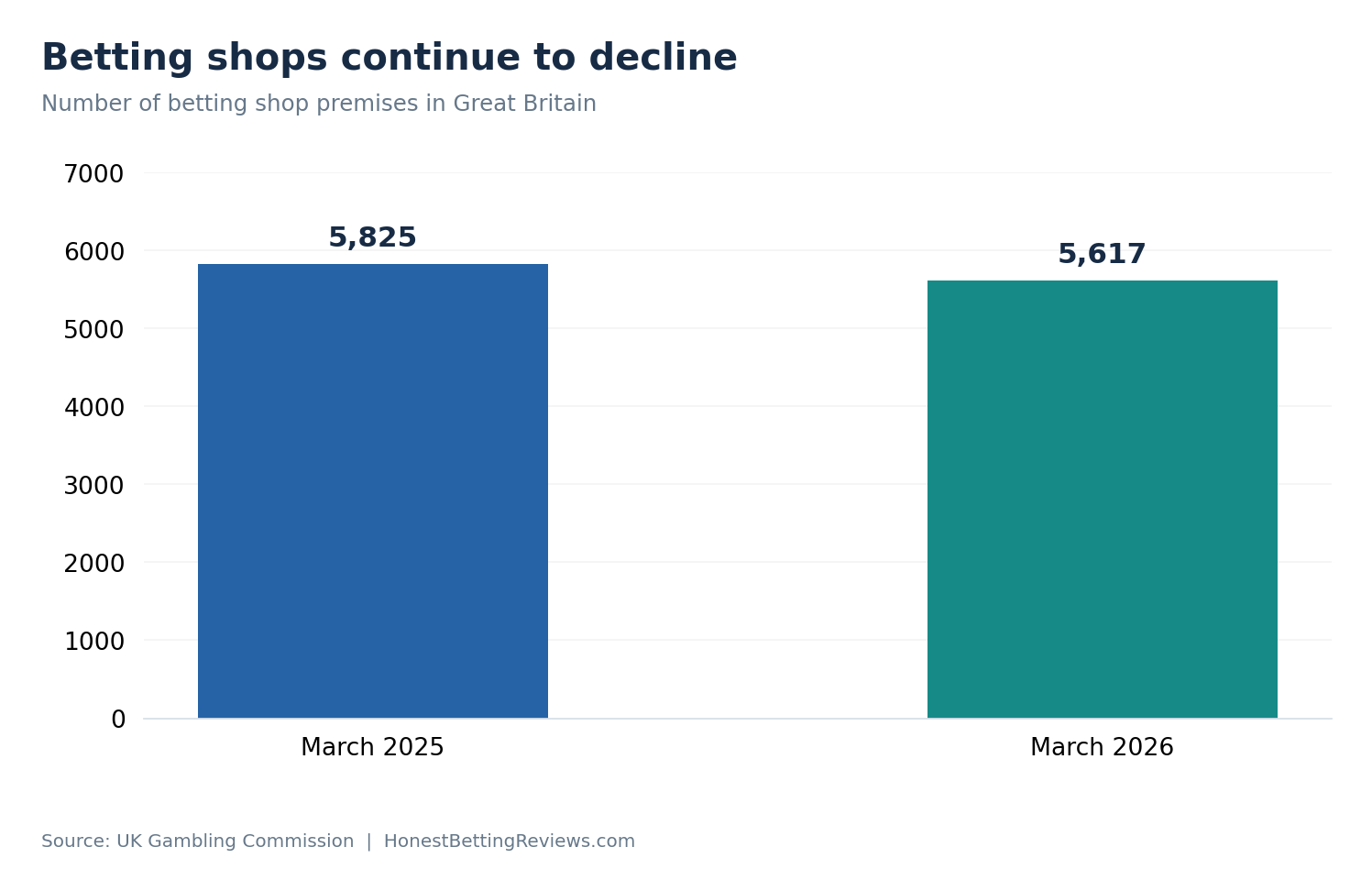
March 2025 is calculated from the Gambling Commission’s reported decline of 208 premises. March 2026 is the published count.
Based on these figures, Britain lost an average of four betting shops per week during the financial year.
The decline is hardly surprising given the convenience of online betting. Punters can now compare odds across dozens of bookmakers, access betting exchanges and place bets without leaving their homes.
However, the figures show that physical bookmakers are still generating substantial revenue.
One particularly interesting finding is that almost half of land-based betting GGY comes from gaming machines rather than traditional betting.
That illustrates how the modern high-street betting shop has evolved into something rather different from the bookmakers of previous generations.
7. UK Casino and Gaming Machine Statistics
Casinos and gaming machines are major contributors to gambling industry revenue.
Indeed, gaming machines across different land-based gambling sectors generate billions annually, while online slots have become one of the largest individual revenue sources in the entire industry.
According to the latest figures:
-
Gaming machines in Great Britain generated approximately £2.7 billion in GGY during 2025–26.
-
Gaming machine GGY increased by 4.3% year-on-year.
-
Land-based casinos generated £933.9 million in GGY.
-
Casino table and other non-machine games accounted for £695 million.