

To Win Each Half Bet Explained: How Does It Work in Football?
If you’ve ever looked through the football betting markets at your favourite bookmaker, you may have come across an option called “To Win Each Half” or “To Win Both Halves.”
At first glance, it sounds pretty straightforward. You’re backing a team to win the first half and go on to win the match, right?
Well, not quite.
There’s an important distinction between winning a match and winning both halves individually.
In fact, a team can win a game comfortably by three or four goals and still fail to win a “To Win Each Half” bet.
It’s a market that can offer some attractive odds, particularly when a strong favourite is playing against weaker opposition. However, it’s also one that catches plenty of punters out.
In this guide, we’ll explain exactly how the To Win Each Half bet works, look at some winning and losing examples, compare it with other popular football markets and consider whether there’s a sensible strategy for finding value.
What Does To Win Each Half Mean in Betting?
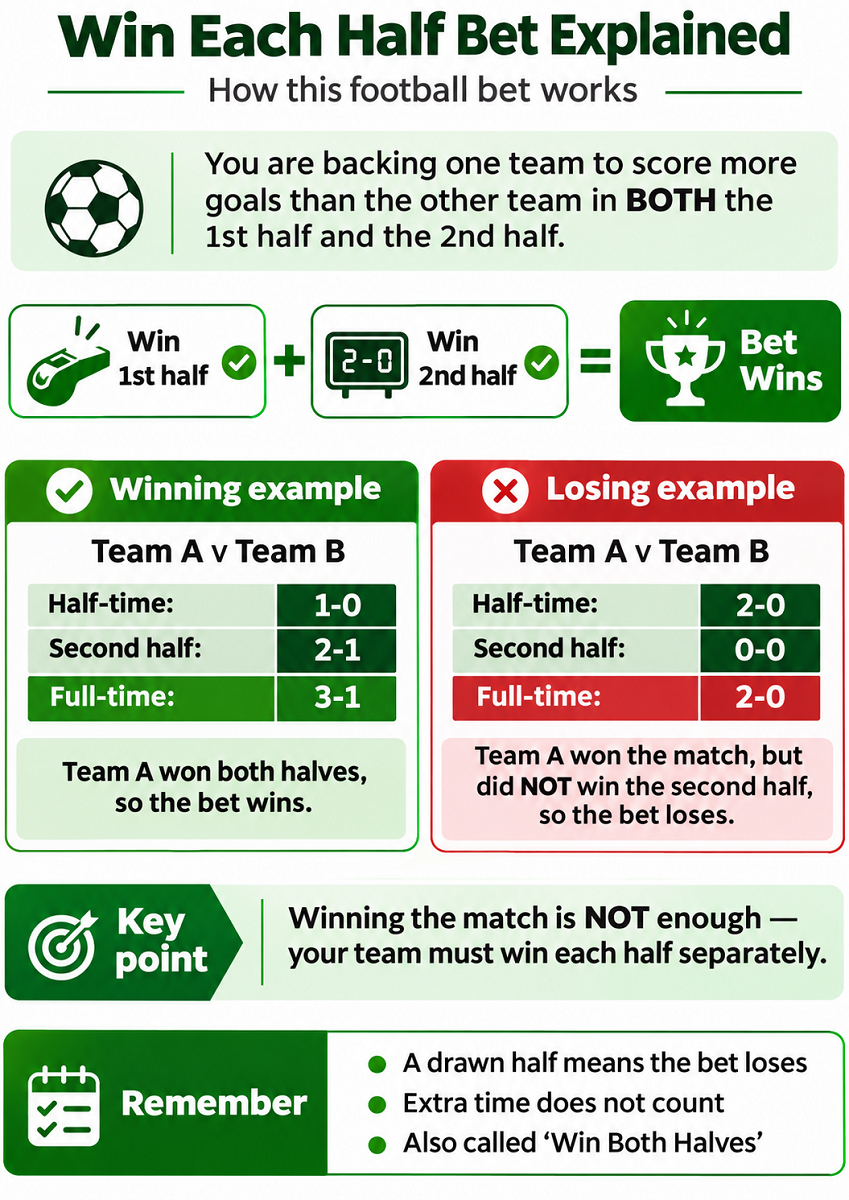
A To Win Each Half bet means you’re backing a football team to score more goals than their opponents in both the first half and the second half of a match.
Essentially, you’re treating the match as two separate 45-minute contests.
For your bet to win, your chosen team must:
- Win the first half by scoring more goals than their opponents.
- Win the second half by scoring more goals than their opponents.
Both conditions must be met for the bet to be successful.
For example, suppose Manchester City are playing Wolves and you back City to win each half.
The match unfolds as follows:
First half: Manchester City 2-0 Wolves
Second half: Manchester City 1-0 Wolves
Full-time result: Manchester City 3-0 Wolves
In this case, your bet wins because City have outscored Wolves in both halves.
Now consider a slightly different scenario.
First half: Manchester City 3-0 Wolves
Second half: Manchester City 0-0 Wolves
Full-time result: Manchester City 3-0 Wolves
Despite City’s comfortable victory, your bet loses.
That’s because the second half finished 0-0, meaning neither side won that particular half.
This is the key point to remember: winning the match isn’t enough. Your team must win each half separately.
To Win Each Half Bet Examples
Sometimes the easiest way to understand a betting market is to look at different results and see whether they would produce a winning bet.
Let’s imagine you’ve backed Arsenal to win each half against Everton.
Here are some hypothetical outcomes.
Swipe left to see the full table →
| Half-Time Score | Full-Time Score | Second-Half Score | Bet Result |
|---|---|---|---|
| Arsenal 1-0 Everton | Arsenal 2-0 Everton | 1-0 | ✓ Win |
| Arsenal 2-0 Everton | Arsenal 4-1 Everton | 2-1 | ✓ Win |
| Arsenal 1-0 Everton | Arsenal 3-0 Everton | 2-0 | ✓ Win |
| Arsenal 2-0 Everton | Arsenal 2-0 Everton | 0-0 | ✗ Lose |
| Arsenal 2-0 Everton | Arsenal 3-1 Everton | 1-1 | ✗ Lose |
| Arsenal 0-0 Everton | Arsenal 3-0 Everton | 3-0 | ✗ Lose |
| Arsenal 3-0 Everton | Arsenal 3-1 Everton | 0-1 | ✗ Lose |
Notice how Arsenal could win the match 3-0 and still lose your bet if all three goals arrived in the second half.
Likewise, they could be leading 3-0 at half-time but fail to win the second half.
The final score doesn’t tell you everything. What matters is how those goals were distributed between the two halves.
How Do You Calculate a To Win Each Half Bet?
Working out whether your bet has won is relatively simple once you know the half-time and full-time scores.
The first-half score is simply the score at half-time.
To calculate the second-half score, subtract the half-time goals from the full-time goals for each team.
For example:
Half-time: Liverpool 2-1 Tottenham
Full-time: Liverpool 4-2 Tottenham
Liverpool scored two additional goals after half-time, while Tottenham scored one.
That means:
- First half: Liverpool won 2-1.
- Second half: Liverpool won 2-1.
The To Win Each Half bet on Liverpool is therefore a winner.
However, if Liverpool had won 4-3, the second half would have finished 2-2, so the bet would have lost.
It’s worth checking these figures carefully rather than simply looking at the full-time score.
To Win Each Half vs Half-Time/Full-Time Betting
One of the most common mistakes punters make is confusing To Win Each Half with Half-Time/Full-Time betting.
Although these markets sound similar, they’re actually quite different.
With Half-Time/Full-Time betting, you’re predicting which team will be leading at half-time and which team will be winning at full-time.
For example, a Manchester United/Manchester United selection means United must be winning at both intervals.
However, they don’t necessarily have to win the second half.
Suppose United lead 2-0 at half-time and the match finishes 2-0.
A United/United Half-Time/Full-Time bet wins because they were ahead at both intervals.
But a United To Win Each Half bet loses because the second half finished 0-0.
Similarly, if United lead 2-0 at half-time and win 3-1, the Half-Time/Full-Time bet wins, but the To Win Each Half bet loses because the second half finished 1-1.
The distinction is that Half-Time/Full-Time betting concerns the score at two points in the match, while To Win Each Half requires two separate winning performances.
Consequently, To Win Each Half will generally offer higher odds than backing the same team to lead at half-time and full-time.
To Win Each Half vs To Score in Both Halves

Another market worth distinguishing is To Score in Both Halves.
This is a less demanding bet because your selected team only needs to score at least one goal in each half.
They don’t have to win either half.
Consider a match between Chelsea and Newcastle.
The first half finishes 1-1, and the second half also finishes 1-1.
The full-time result is 2-2.
If you’ve backed Chelsea to score in both halves, your bet wins because they scored in each period.
However, a bet on Chelsea to win each half loses because both halves finished level.
An important distinction is that a team winning both halves must necessarily score in both halves, but scoring in both halves doesn’t mean they’ve won them.
This makes To Score in Both Halves an interesting alternative for punters who expect an attacking performance but aren’t confident that their team will dominate throughout the match.
What Are the Odds for a To Win Each Half Bet?
The odds available depend on the relative strength of the two teams, expected goals and how likely the bookmaker considers it that one side will dominate both halves.
A major favourite playing a struggling team will usually have considerably shorter odds than two evenly matched opponents.
For example, imagine the following hypothetical prices:
Swipe left to see the full table →
| Betting Market | Decimal Odds | Fractional Odds |
|---|---|---|
| Manchester City to win | 1.25 | 1/4 |
| Manchester City HT/FT | 1.65 | 13/20 |
| Manchester City to score in both halves | 1.80 | 4/5 |
| Manchester City to win each half | 2.60 | 8/5 |
These are illustrative odds, not live bookmaker prices.
The To Win Each Half market offers the biggest potential return in this example because it requires the most specific outcome.
Let’s say you place a £20 bet at odds of 2.60.
If City win both halves, your return would be:
£20 × 2.60 = £52
That represents a profit of £32, plus your original £20 stake.
Of course, the higher odds reflect the additional difficulty of winning the bet.
A team can dominate possession, create numerous opportunities and win the match convincingly without necessarily winning each individual half.
Is There a Good To Win Each Half Betting Strategy?

As with most football betting markets, there isn’t a guaranteed winning strategy.
However, there are several factors worth considering when deciding whether a To Win Each Half selection represents value.
1. Look for Strong Favourites Against Weaker Opposition
Perhaps the most obvious starting point is matches involving a strong favourite against a significantly weaker opponent.
For example, a top Premier League side playing at home against a newly promoted team might have a realistic chance of controlling proceedings throughout the match.
However, simply backing the biggest favourites isn’t necessarily a profitable strategy.
Bookmakers already know these teams are strong and adjust their prices accordingly.
What matters is whether the available odds underestimate the team’s chances of winning both halves.
2. Study First-Half and Second-Half Form Separately
This is particularly important for this market.
Some teams are fast starters, regularly taking the lead before half-time. Others tend to improve after the break.
Ideally, you’re looking for a team that performs well in both periods.
Look at statistics such as:
- Percentage of first halves won.
- Percentage of second halves won.
- Average goals scored in each half.
- Average goals conceded in each half.
- Expected goals (xG) generated before and after half-time.
A team that regularly wins matches but struggles to establish an early lead may not be an ideal candidate.
Likewise, a side that frequently protects narrow leads by dropping deeper in the second half could be less suitable.
3. Consider the Opposition’s Defensive Record
It’s not just your selected team’s attacking quality that matters.
The opposition’s ability to defend throughout the match is equally important.
A team that regularly concedes early goals and struggles after half-time could be a promising opponent to target.
However, don’t focus exclusively on total goals conceded.
A team might have a poor defensive record overall but be particularly difficult to break down during the first 45 minutes.
This could make a To Win Each Half bet less attractive than the match odds initially suggest.
4. Be Careful With Teams That Ease Off
One of the biggest dangers with this market is a strong favourite establishing a comfortable lead and then reducing the tempo.
Imagine a team going 3-0 ahead before half-time.
Their manager might decide to rest key players, conserve energy or simply protect the advantage rather than push for more goals.
The second half could finish 0-0, leaving your bet unsuccessful despite the match being effectively over as a contest.
This is particularly relevant when teams have important fixtures coming up or are managing a congested schedule.
5. Focus on Value Rather Than Just Winning Selections
Ultimately, successful betting is about finding odds that are bigger than the true probability of an outcome.
Suppose a bookmaker offers odds of 3.00 for a team to win both halves.
Those odds imply a probability of approximately 33.3%, before allowing for the bookmaker’s margin.
If your research suggests the team actually has a 40% chance, the bet could represent value.
However, if you estimate their chances at just 25%, the odds aren’t particularly attractive.
The difficulty, of course, is estimating those probabilities accurately.
Past results alone aren’t enough to establish that a bet is good value, particularly when you’re dealing with relatively uncommon outcomes.
Common Mistakes to Avoid
There are several pitfalls worth watching out for when betting on a team to win each half.