

What Does No Clean Sheet Mean in Football Betting? A Complete Guide
If you’ve been looking through the football betting markets at your favourite bookmaker, you may have come across an option labelled “No Clean Sheet” or “Team to Keep a Clean Sheet – No”.
It’s a fairly straightforward bet once you understand how it works, but it’s also one that can cause a little confusion, particularly when compared with popular markets like Both Teams to Score (BTTS).
The good news is that you don’t need to predict who will win the match, how many goals will be scored overall, or even the final score.
All you need is for one particular team to concede a goal.
In this guide, we’ll explain what no clean sheet means in football betting, how the market works, some examples of winning and losing bets, and whether it’s a worthwhile strategy for making a profit.
What Does No Clean Sheet Mean?
In football betting, no clean sheet means you are betting on a particular team to concede at least one goal during the match.
A clean sheet is when a team finishes a game without conceding a goal.
So, if you bet on a team not to keep a clean sheet, you’re simply backing their opponents to score at least once.
For example, imagine Manchester City are playing Newcastle and you place a bet on:
Manchester City Clean Sheet – No
Your bet will win if Newcastle score at least one goal, regardless of the final result.
That means all of the following scorelines would be winners:
- Manchester City 3-1 Newcastle
- Manchester City 2-2 Newcastle
- Manchester City 0-1 Newcastle
- Manchester City 4-3 Newcastle
However, if Manchester City win 2-0, or the match finishes 0-0, your bet loses because City have kept a clean sheet.
It’s as simple as that.
The important thing to remember is that the result of the match doesn’t matter – only whether your selected team concedes a goal.
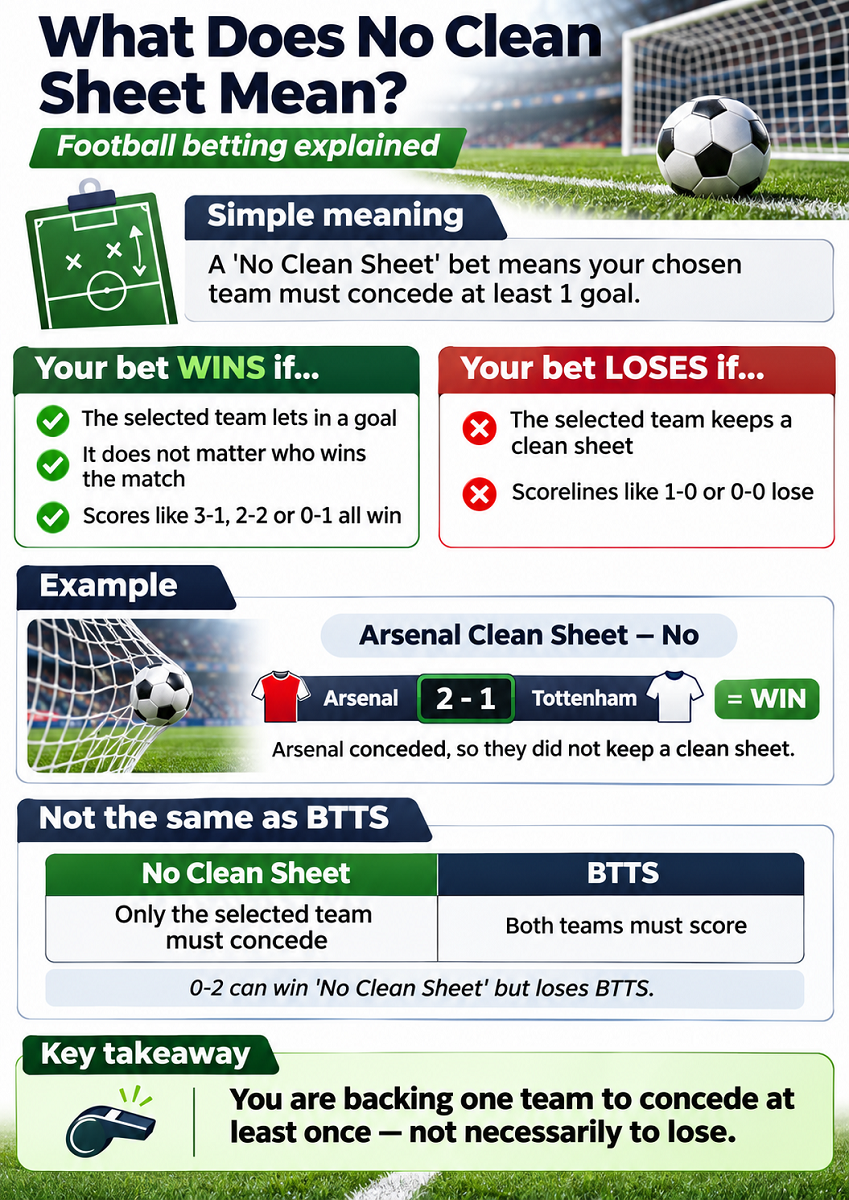
How Does a No Clean Sheet Bet Work?
Let’s look at another example to see how this market works in practice.
Suppose Arsenal are playing Tottenham in a Premier League match.
You believe Tottenham have a strong enough attack to score against Arsenal, but you’re not particularly confident they’ll win the game.
Rather than backing Tottenham to win or betting on Both Teams to Score, you could simply place a bet on Arsenal not to keep a clean sheet.
Example Bet: Arsenal Clean Sheet – No
Imagine Arsenal are playing Tottenham and you
believe Tottenham will score at least once.
You place the following bet:
Selection: Arsenal Clean Sheet – No
Odds: 1.50
Stake: £20
Potential Profit: £10
Total Return: £30
(including your £20 stake)
Swipe left to see the full table →
| Final Score | Bet Result |
|---|---|
| Arsenal 2-1 Tottenham | WIN |
| Arsenal 0-1 Tottenham | WIN |
| Arsenal 3-0 Tottenham | LOSE |
| Arsenal 0-0 Tottenham | LOSE |
Key point: Tottenham only need to score once for your bet to win, regardless of the final result.
They could lose 5-1 and you’d still collect your winnings.
That’s one of the main attractions of this market: you can back a team to score without worrying about what happens at the other end of the pitch.
No Clean Sheet vs Both Teams to Score – What’s the Difference?
This is probably where most of the confusion arises.
At first glance, a no clean sheet bet might seem almost identical to Both Teams to Score (BTTS), but there’s an important difference.
With BTTS, both teams must score at least one goal for your bet to win.
With a no clean sheet bet, only the opposition of your selected team needs to score.
Let’s use Liverpool versus Chelsea as an example.
You have two potential bets:
- Liverpool Clean Sheet – No
- Both Teams to Score – Yes
Here’s how those bets would perform with different final scores.
Liverpool vs Chelsea – Comparing the markets
📱 Swipe left to see the full table →
| Final Score (Liverpool v Chelsea) |
Liverpool No Clean Sheet | BTTS Yes |
|---|---|---|
| 2-1 | ✅ Win | ✅ Win |
| 1-1 | ✅ Win | ✅ Win |
| 0-2 | ✅ Win | ❌ Lose |
| 3-0 | ❌ Lose | ❌ Lose |
| 0-0 | ❌ Lose | ❌ Lose |
| 1-2 | ✅ Win | ✅ Win |
As you can see, if Chelsea win 2-0, the Liverpool no clean sheet bet wins, but the BTTS bet loses.
This distinction is particularly useful when you expect one side to score but aren’t convinced the other will manage to find the net.
For instance, a strong away favourite playing against a struggling home side might be a good candidate for a no clean sheet bet on the home team.
No Clean Sheet vs Other Football Betting Markets
There are several other markets that overlap with no clean sheet betting, so it’s worth understanding the differences.
Team to Score Over 0.5 Goals
This is essentially the same bet as backing the opposition to fail to keep a clean sheet.
If you’re betting on Arsenal Clean Sheet – No against Chelsea, that’s equivalent in outcome to betting on Chelsea Over 0.5 Team Goals.
In both cases, Chelsea need to score at least once.
However, the odds offered by bookmakers aren’t always identical, so it can be worth checking both markets before placing your bet.
Win to Nil
Win to Nil is effectively the opposite type of bet.
Here, you’re backing a team to win the match without conceding.
For example, Arsenal to Win to Nil would be successful if they won 1-0, 2-0 or 3-0, but would lose if they drew 0-0 or won 3-1.
It’s more restrictive than simply backing a clean sheet because the team must also win.
Over 1.5 Goals
An Over 1.5 Goals bet requires at least two goals in total, regardless of which team scores them.
A no clean sheet bet only requires one goal from a particular side.
So a 1-0 away victory would be enough for the home team’s no clean sheet bet to win, but not for Over 1.5 Goals.
How Are No Clean Sheet Bets Settled?

As with most football betting markets, there are a few rules worth knowing.
1. Normal time counts
No clean sheet bets usually cover 90 minutes plus stoppage time.
Extra time and penalty shoot-outs in cup competitions don’t normally count unless the bookmaker specifically states otherwise.
For example, if a Champions League knockout match finishes 0-0 after 90 minutes, but a goal is scored in extra time, a standard 90-minute no clean sheet bet would lose.
90 Minute Rule+1
2. Own goals count
An own goal can also result in a winning no clean sheet bet.
If a Manchester United defender accidentally puts the ball into his own net, United have conceded a goal, regardless of who scored it.
Consequently, a bet on Manchester United Clean Sheet – No would be a winner.
3. Abandoned matches
If a match is abandoned, settlement depends on the bookmaker’s rules and whether the outcome of the bet has already been determined.
For example, if the team you’ve backed not to keep a clean sheet has already conceded, some bookmakers will settle the bet as a winner.
If the game is abandoned at 0-0, bets will generally be void, subject to the relevant rules.
Always check the bookmaker’s football betting terms before placing your wager.
What Odds Can You Expect for No Clean Sheet Bets?
The odds available depend largely on how likely the bookmaker believes the opposition are to score.
If you’re betting against a team with a poor defensive record, the odds may be relatively short.
Conversely, backing a strong defensive side to concede could produce a much bigger price.
Here are some illustrative examples.
📱 Swipe left to see the full table →
| Decimal Odds | Fractional Odds | Implied Probability |
|---|---|---|
| 1.20 | 1/5 | 83.3% |
| 1.40 | 2/5 | 71.4% |
| 1.50 | 1/2 | 66.7% |
| 1.80 | 4/5 | 55.6% |
| 2.00 | Evens | 50.0% |
| 2.50 | 6/4 | 40.0% |
These are not current bookmaker prices, but they illustrate how the odds relate to the likelihood of a team conceding.
For instance, a no clean sheet selection priced at 1.50 implies a probability of approximately 66.7%.
To find a profitable bet, you’d need to believe that the true probability was higher than that, after allowing for the bookmaker’s margin.
Is No Clean Sheet a Good Betting Strategy?

Now we come to the important question.
Can backing teams not to keep clean sheets actually be profitable?
Potentially, yes, but it’s certainly not as simple as picking teams with poor defensive records.
The biggest mistake bettors make is assuming that because a particular outcome is likely, it’s automatically a good bet.
That’s not how profitable betting works.
What matters is whether the odds represent value.
For example, imagine a team has conceded in eight of its last ten matches.
That sounds like a strong candi