
What Does PU Mean in Horse Racing? A Complete Guide for Bettors
If you’ve ever scanned a set of horse racing results or form figures and seen “PU” next to a horse’s name, you’re not alone in wondering what it actually means.
For new bettors especially, racing abbreviations can feel confusing at first. But once you understand them, they become incredibly useful when analysing form and spotting betting value.
In this guide, we’ll explain what PU means in horse racing, why horses are pulled up, how it affects betting decisions, and how you should (and shouldn’t) use PU in your race analysis.
If you’re serious about improving your horse racing betting, understanding PU in horse racing is essential.
What Does PU Mean in Horse Racing?
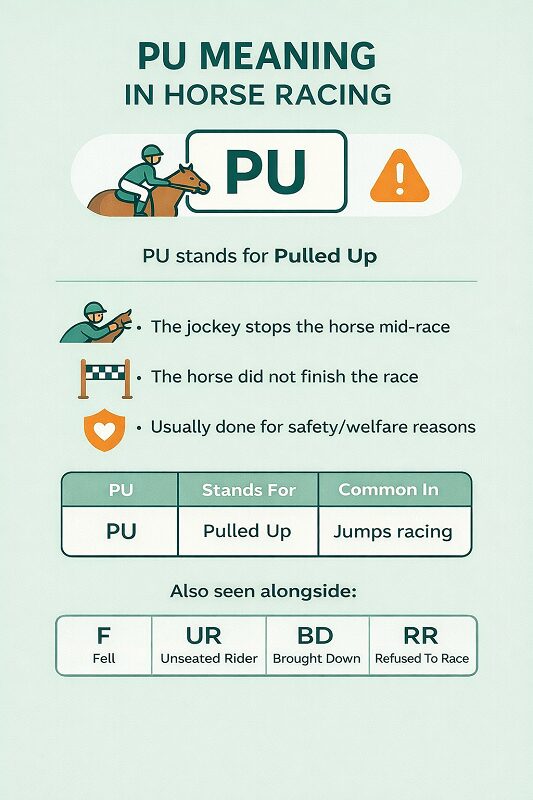
PU stands for Pulled Up.
In horse racing, PU means that the jockey stopped the horse during the race and did not complete it.
Instead of finishing, falling, or unseating the rider, the horse is deliberately eased out of the race by the jockey, usually for safety or welfare reasons.
You’ll most commonly see PU in horse racing form for:
- National Hunt racing (jumps)
- Chases
- Hurdles
- Point-to-points
It is much rarer on the Flat, where races are shorter and don’t involve obstacles.
What Does “Pulled Up” Actually Mean?
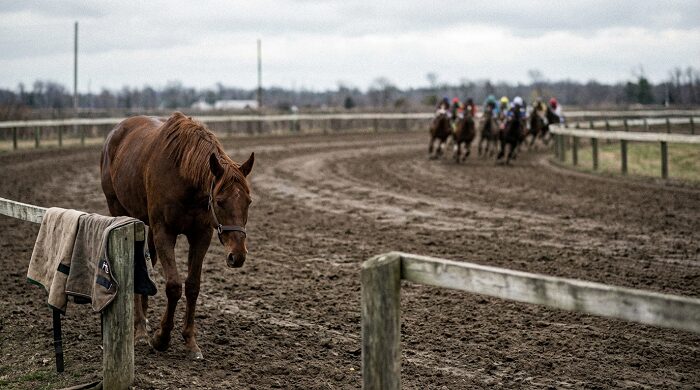
When a horse is pulled up, the jockey decides to stop riding competitively and brings the horse to a halt or canters back after the race.
This decision is made during the race, not afterwards, and is typically done when continuing would be unsafe or pointless.
A horse marked as PU:
- Did not finish the race
- Was not injured seriously enough to fall
- Was withdrawn mid-race for a specific reason
From a betting perspective, it counts as a non-finisher and therefore a losing bet.
Common Reasons Why a Horse Is Pulled Up
Understanding why a horse was pulled up is crucial. Not all PUs are bad, and some are far more forgivable than others.
Here are the most common reasons for PU in horse racing.
1. The Horse Is Tired or Struggling
This is the most frequent reason.
If a horse is:
- Clearly outpaced
- Dropping back rapidly
- No longer jumping fluently
…the jockey may pull the horse up to avoid unnecessary strain.
This often happens when:
- The distance is too far
- The ground is unsuitable
- The horse isn’t fully fit
From a form perspective, this kind of PU isn’t always a red flag, especially if conditions change next time.
2. The Horse Has a Physical Issue
Sometimes a jockey feels something isn’t right:
- An irregular stride
- Lameness
- Breathing issues
Pulling the horse up early can prevent a minor problem from becoming a serious injury.
In these cases, the horse may return quickly and perform well next time, particularly if the issue was minor or precautionary.
3. The Horse Has Lost Confidence
In jump racing, confidence is everything.
A horse might:
- Make repeated jumping errors
- Lose rhythm over fences
- Become hesitant approaching obstacles
Rather than risk a fall, the jockey may decide to pull up.
This type of PU can be more concerning for future runs, especially if it happens repeatedly.
4. Unsuitable Ground Conditions
Ground conditions play a huge role in National Hunt racing.
A horse that prefers:
- Soft ground may struggle on good or firm
- Faster ground horses can flounder in heavy conditions
If a horse clearly isn’t coping, the jockey may pull it up rather than let it slog through unsuitable ground.
This is one of the most forgivable PUs when assessing form.
5. The Horse Is Out of Its Depth
Sometimes horses are simply running in a race that’s too competitive.
Examples include:
- Stepping up in class too quickly
- Running in a strong handicap
- Facing more experienced rivals
In these situations, being pulled up doesn’t necessarily mean the horse is poor – just that it wasn’t ready for that level.
How Is PU Shown in Horse Racing Form?
In racecards and form lines, PU usually appears alongside other abbreviations such as:
- F – Fell
- UR – Unseated Rider
- BD – Brought Down
- RR – Refused to Race
A form line might look like this:
P-4-PU-2-1
This tells you:
- The horse pulled up two runs ago
- Has since finished second and first
This is a perfect example of why PU in horse racing form should never be viewed in isolation.
Is PU Bad in Horse Racing Betting?

Seeing PU in horse racing form often puts bettors off immediately, but it isn’t always a reason to avoid a horse.
Whether a pulled-up run is a negative depends entirely on the circumstances surrounding it.
A PU can sometimes indicate deeper issues such as stamina problems, lack of fitness, or physical fragility.
However, in many cases, it simply reflects unsuitable conditions on the day rather than a lack of ability. This is why experienced bettors rarely treat a PU as an automatic red flag.
The key is to look beyond the abbreviation and understand why the horse was pulled up in the first place.
When PU Is a Negative Sign
A pulled-up run becomes more concerning when it forms part of a wider pattern.
If a horse has been pulled up multiple times in recent races, especially without obvious excuses, it can suggest that the horse is unreliable or struggling to cope with the demands of racing.
Repeated PUs may point towards issues such as poor stamina, recurring physical problems, or a lack of enthusiasm for racing.
This is particularly worrying if the horse has been pulled up late in races, when others are still finishing strongly.
In these cases, backing the horse can feel like a gamble rather than a calculated bet.
For most bettors, horses with several recent PUs are best treated with caution unless there is a clear change in circumstances.
When PU Can Be Ignored (or Even Positive)
Not all pulled-up runs are bad news. In fact, many PUs are entirely forgivable once you dig into the detail.
A horse may have been pulled up because the ground was unsuitable, the trip was too far, or the race was simply too competitive.
In some cases, a horse is pulled up on its seasonal return when fitness is lacking, only to improve dramatically on its next run.
These scenarios often lead to a drop in the handicap or a bigger price next time out.
Bettors who focus on context rather than headline form can sometimes find excellent value in horses that were previously pulled up under the wrong conditions.
How Professional Bettors View PU
Professional and experienced bettors tend to be far less emotional about seeing PU in a horse’s form.
Instead of dismissing the horse, they ask practical questions about the race and today’s conditions.
They will look at whether the ground, distance, class level, or pace of the race played a part. If the reason for the PU no longer applies, the run is often discounted entirely.
In some cases, a pulled-up effort can even improve a betting opportunity by pushing the price higher than it should be.
This measured approach is one of the key differences between casual punters and long-term profitable bettors.
PU vs Fell vs Unseated Rider
While all three outcomes indicate that a horse did not finish, they are viewed very differently in form analysis.
A PU is a controlled decision by the jockey and is usually done to protect the horse.
A fall, on the other hand, can have a more lasting impact, especially in jump racing where confidence is crucial.
An unseated rider is often the result of bad luck rather than a problem with the horse itself.
Because a pulled-up horse has avoided a fall or serious incident, many bettors actually see PU as the least worrying of the common non-completion outcomes.
Can You Still Back a Horse That Was PU Last Time?
Yes, and in some cases it can be a smart move.
If a horse was pulled up due to unsuitable ground, an overly demanding trip, or lack of fitness, and those factors are no longer present, there is no reason it cannot bounce back.
Many horses produce winning performances immediately after a PU, particularly when conditions return in their favour.
As always, the key is understanding the reason behind the pulled-up run rather than focusing on the abbreviation itself.
Does PU Affect Each-Way Bets?
From a betting perspective, a horse that is pulled up is treated the same as any other non-finisher.
It does not place and therefore does not return any each-way payout.
This is why each-way bettors should pay particular attention to horses with a history of PUs, especially in staying races or on testing ground.
Horses that struggle to finish races can be costly if they repeatedly fail to complete.
Key Takeaways: PU in Horse Racing Explained

To summarise:
- PU means Pulled Up
- The jockey stopped the horse during the race
- It usually happens for safety or welfare reasons
- PU is most common in jumps racing
- Not all PUs are negative
- Context is everything when analysing form
Used correctly, understanding PU in horse racing can help you:
- Avoid unreliable horses
- Forgive the right ones
- Spot value others miss
Final Thoughts
Horse racing form is full of abbreviations, but few are as misunderstood as PU.
While it’s easy to see a pulled-up run as a negative, smart bettors dig deeper.
When you understand why a horse was pulled up – and whether conditions have changed – PU can become a powerful tool rather than a reason to avoid a bet.
As with all betting analysis, never judge a horse on one letter alone. Look at the bigger picture, trust the context, and use PU in horse racing as part of a wider, smarter betting strategy.




Leave a Reply
Want to join the discussion?Feel free to contribute!