

Roulette Strategies: What You Need to Know
Image by Greg Montani from Pixabay
Roulette is often considered a game of pure chance, but many players turn to strategy to feel more in control.
In this article, we break down the most common approaches, explain how they align with real odds, and why not all of them hold up.
Any strategy is best tested under minimal financial pressure, especially early on. One way to do that is by using Reveryplay no deposit bonus codes, which let you try roulette without using your own money.
It’s a simple way to see how a system performs in real conditions, without the risk.
Understanding the Odds: Why Roulette Is Hard to Beat
Roulette is built on fixed probabilities. Each spin is random, and the house edge ensures the casino always has a statistical advantage over time.
On an American wheel (with both 0 and 00), the house edge is 5.26%. European roulette, with a single zero, lowers that to 2.70%.
French roulette is even more favorable: thanks to rules like La Partage and En Prison (which return part of your bet on a zero), the edge drops to about 1.35%.
In practical terms, for every $100 wagered, the casino expects to keep $5.26 on an American wheel, $2.70 on a European one, and just $1.35 on a French table.
This margin doesn’t change, no matter what betting pattern you use. That’s why the first and simplest strategy is to choose the right variant.
Playing on a single-zero or French wheel doesn’t eliminate the edge, but it does reduce it, giving you better chances in the long run compared to double-zero games.
Another key point: every spin is independent. The ball doesn’t remember where it landed before.
Yet many players fall for the gambler’s fallacy, believing that if red has hit five times, black is now “due,” or that certain numbers are “hot.” But the odds don’t shift. If the chance of hitting red on a European wheel is 18 out of 37 (about 48.6%), it stays exactly the same on every spin.
Strategies built on tracking streaks or predicting what “should” come next ignore this reality. Unless the wheel is biased or rigged, no system can predict outcomes.
The best you can do is understand the odds and not fight them with false patterns.
The Truth About Popular Roulette Strategies
Roulette players have developed many betting systems over the years. Let’s explore a few well-known strategies and why they appear to work, as well as where they ultimately fall short.
Martingale
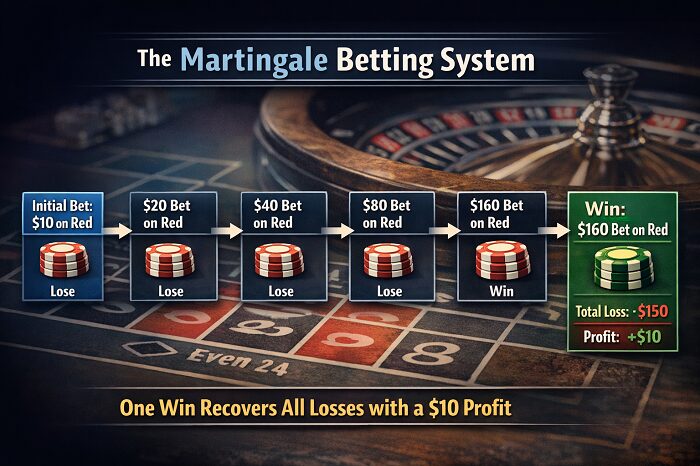
Martingale is the most well-known roulette system. It works like this: after every loss, you double your bet, usually on even-money options like red/black.
The idea is simple. When you eventually win, the payout covers all prior losses plus a small profit equal to your original stake.
For example, if you bet $10 on red and lose, you go to $20, then $40, then $80, and so on.
A single win resets the cycle and locks in $10 profit.
In theory, with unlimited money and no table limits, this would work every time. But in real life, that’s not how it goes.
Losing streaks happen, even on a European wheel, the chance of seven losses in a row is about 1%, or once every hundred spin sequences.
If that happens, your $10 bet turns into a required $1,280 wager on the eighth spin.
If you cannot cover the required wager due to betting limits or insufficient bankroll, you will have lost $2,550 while trying to win just $10.
Most Martingale players experience many small wins, then one heavy loss that wipes out everything.
Typical simulations show that with a bankroll covering six doubles, you’ll succeed close to 98% of the time. But the 2% of failed sessions cause such large losses that they cancel out all gains.
One bust costs 63 units, while the total profit from the 58 successful attempts before it is only 58 units. Net result: negative.
Martingale doesn’t beat the house edge. It hides it until it hits all at once. That’s why casinos set maximum bets: to stop players from doubling into safety.
This system can feel effective short-term, but long-term, the math always catches up.
Gentler Progressions: Labouchere, D’Alembert, Fibonacci
To mitigate the Martingale’s steep risk, many players turn to less aggressive negative progression systems.
These include the Labouchere (Cancellation) system, where you increase bets according to a preset sequence of numbers, or the D’Alembert system, which has you raise your bet one unit after a loss and lower it one unit after a win.
The Fibonacci system follows a similar idea, using the famous Fibonacci sequence (1, 1, 2, 3, 5, 8, …) to determine bet sizes after losses.
All these strategies aim for the same basic goal: gradually recouping losses with slightly larger bets, hoping that a run of wins will cover any preceding downturn.
Because their bet escalation is slower than Martingale’s doubling, they require a smaller bankroll and hit table limits less quickly.
This makes them feel safer. A D’Alembert progression doesn’t put your entire bankroll on the line after a handful of losses.
However, the fundamental flaw remains. No progression can overcome a protracted losing streak or the constant drain of zero.
A long series of losses will still result in very large bets or an unrecoverable drawdown. And even when losses and wins alternate more mildly (which these systems anticipate), the house edge ensures that, on average, you’ll pay a tax on each bet you place.
The end result is that over many spins, the expected value of these systems is just as negative as flat betting. They merely alter the variance and timing of wins and losses.
You might string together a moderate profit during a session where luck alternates favorably, but eventually an unlucky run or the accumulated 2.7% edge on each wager erodes your funds.
Paroli (Reverse Martingale)
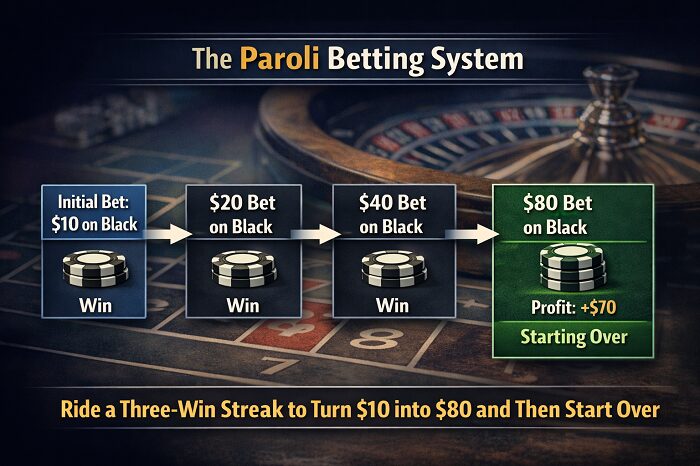
Paroli is a positive progression system. Unlike Martingale, it increases your bet after a win, not a loss. The idea is to ride short winning streaks while keeping losses small.
Let’s say you bet $10 on black and win. You then bet $20, win again, and go to $40. If you win three times in a row, you’ve turned $10 into $80.
You then start over at $10 and lock in the profit. If you lose at any stage, you simply return to your base bet.
That’s the appeal: you’re never chasing losses, and the most you risk per cycle is your original stake.
Many sessions end close to break-even or with a small loss, but when you hit that rare three-win streak, the payout can be significant relative to what you’ve risked.
Paroli helps you control the downside while letting you take full advantage of lucky streaks. But like all systems, it doesn’t change the odds.
The chance of winning a single even-money bet is about 48.6% on a European wheel.
What are the odds of winning three consecutive bets? Just 11.5%. Most of the time, you’ll lose before you get there.
Breakdowns of Paroli sessions show that the big +7 unit win is uncommon, while small wins or losses are more frequent.
The house edge is still there on every spin, it just doesn’t show up as steadily because you’re not increasing bets after losses.
Paroli is one of the safer systems out there. It won’t win long-term, but it can structure your play without putting your bankroll at serious risk.
Fixed Betting Combinations
Some roulette strategies don’t change bet size, but they focus on how bets are spread across the table.
A well-known example is the James Bond strategy, which splits a fixed stake between high numbers (19–36), a six-number line (13–18), and a single chip on zero.
This setup covers most of the wheel and results in frequent wins, but those wins are usually small.
When you land on one of the uncovered numbers, the loss is larger and wipes out several previous gains. Other players create their own fixed combinations, like covering two dozen numbers or placing multiple corner bets to boost their hit rate.
And while these setups do win more often, they don’t improve your actual odds. The more numbers you cover, the lower the payout on each win.
For example, covering 25 out of 37 numbers on a European wheel gives you a 67.6% chance of winning something on each spin.
But the payout is small, and the losses from the 12 uncovered numbers are much bigger.
You’re trading win frequency for lower returns, not changing the edge.
The James Bond system gives you about a roughly 66% chance to win each spin, but the other 34% of spins will often cancel several wins at once. Over time, the math catches up.
The house edge stays the same. Some players also bet on “hot” or “cold” numbers, thinking a number is either due or lucky.
This misconception doesn’t hold up. Roulette spins are independent, and modern wheels are highly accurate.
Any small bias is usually too minor to matter. As gaming analyst Michael Shackleford notes, fair casino wheels don’t leave exploitable patterns.
So systems based on number streaks or “due outcomes” are driven by the gambler’s fallacy – not fact. In a fair game, there’s no hidden logic to follow.
Just probability and the house edge.
Conclusion – Understanding Roulette Strategies
Understanding these strategies and the odds can help you play smarter.
In a sense, strategies that “actually work” are those that help you manage your bankroll and expectations, rather than those promising impossible guarantees.
For example, setting win and loss limits is a sound strategy: decide in advance that you’ll walk away after winning a certain amount or if you’ve lost a certain amount.
This doesn’t change the odds of each spin, but it can protect you from chasing losses in a downward spiral or from giving back a big win out of overconfidence.
Likewise, choosing European or French roulette whenever possible is a strategy that works to maximize your chances (by minimizing the house edge you face).
Using a moderate system like Paroli or a flat betting approach with discipline can provide structure to your play.
They ensure you don’t bet too big in the heat of the moment and can add to the fun when luck is on your side.



Leave a Reply
Want to join the discussion?Feel free to contribute!