
Odds 40/1 Meaning: What Do 40/1 Odds Mean in Betting?
Seeing odds of 40/1 can immediately catch your attention. They suggest a potentially huge return from a relatively small stake, but they also tell you that the bookmaker believes the outcome is unlikely to happen.
So, what does 40/1 mean in betting?
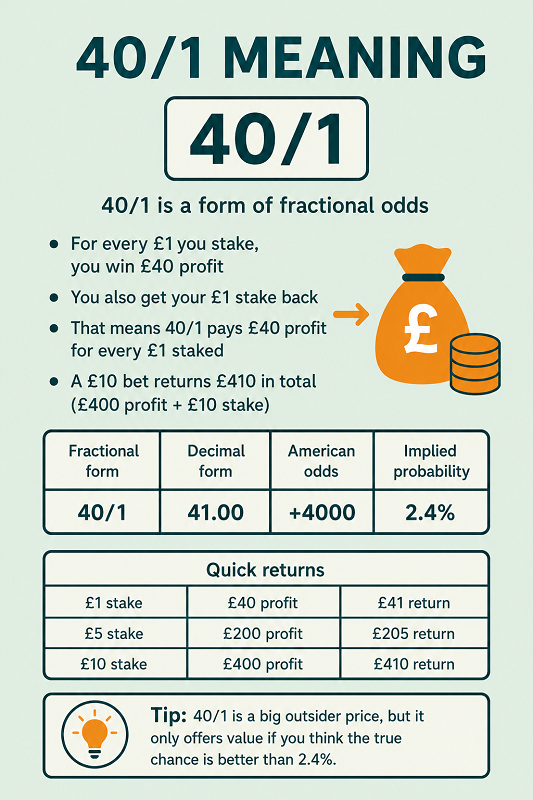
In simple terms, odds of 40/1 mean that for every £1 you stake, you could win £40 in profit. Your original £1 stake would also be returned, giving you a total payout of £41.
That means:
- A £1 bet at 40/1 returns £41
- A £5 bet at 40/1 returns £205
- A £10 bet at 40/1 returns £410
- A £20 bet at 40/1 returns £820
The potential rewards are certainly appealing, but odds this large are normally attached to outsiders.
Before placing a bet, it is therefore important to understand the difference between a big price and a genuinely good-value price.
In this guide, we explain exactly how 40/1 odds work, how much you could win and what probability they represent.
What Do 40/1 Odds Mean?
Odds of 40/1 are known as fractional odds, which remain the traditional format used by most UK bookmakers.
The number on the left tells you how much profit you could make, while the number on the right represents the stake required to generate that profit.
With odds of 40/1:
- The potential profit is £40
- The required stake is £1
- The total return is £41
The calculation is straightforward:
£1 stake × 40 = £40 profit
Your bookmaker then returns your original £1 stake, producing a total payout of £41.
It is important to distinguish between profit and total return. When a bookmaker advertises odds of 40/1, the £40 figure is your potential profit rather than the entire amount paid back into your account.
How Much Do You Win at 40/1?
The amount you can win at 40/1 depends entirely on how much you stake.
Here are some common examples:
| Stake | Profit at 40/1 | Total Return |
|---|---|---|
| £1 | £40 | £41 |
| £2 | £80 | £82 |
| £5 | £200 | £205 |
| £10 | £400 | £410 |
| £20 | £800 | £820 |
| £25 | £1,000 | £1,025 |
| £50 | £2,000 | £2,050 |
| £100 | £4,000 | £4,100 |
The formula is:
Stake × 40 = profit
Then:
Profit + stake = total return
For example, a £10 bet at 40/1 would make £400 profit. Once your £10 stake is added back, the total return would be £410.
What Is the Implied Probability of 40/1 Odds?
Betting odds can be converted into an implied probability. This shows how likely the outcome would need to be if the odds represented a completely fair market with no bookmaker margin.
The formula for fractional odds is:
1 ÷ (40 + 1) × 100
This gives an implied probability of approximately:
2.44%
In other words, odds of 40/1 suggest that the selection has around a 2.44% chance of winning.
Another way to look at it is that an outcome priced at 40/1 would theoretically win about once in every 41 attempts.
Of course, real betting markets are not perfectly fair. Bookmakers include a margin in their prices, while odds can also be influenced by public demand, market liquidity and late betting activity.
The true chance of winning may therefore be higher or lower than 2.44%.
What Are 40/1 Odds in Decimal Format?
Fractional odds of 40/1 are the equivalent of 41.00 in decimal odds.
Converting fractional odds to decimal is easy:
40 ÷ 1 + 1 = 41.00
Decimal odds include the returned stake, which is why the figure is 41.00 rather than 40.00.
To calculate your total payout using decimal odds, simply multiply the stake by the decimal price.
For example:
£10 × 41.00 = £410
This produces exactly the same return as a £10 bet at fractional odds of 40/1.
What Are 40/1 Odds in American Format?
Odds of 40/1 convert to +4000 in American odds.
Positive American odds show how much profit you could make from a $100 stake.
Therefore, odds of +4000 mean that a $100 bet would generate $4,000 profit, plus the return of the original $100 stake.
Although American odds are common in the United States, UK bettors are far more likely to encounter fractional or decimal prices.
Strategies for Betting on 40/1 Shots

Backing a 40/1 shot can be exciting, but it should rarely be treated as a simple case of picking an outsider and hoping for the best.
At these odds, most selections will lose, so the key is to look for situations where the bookmaker may have underestimated the true chance of success.
Look for Value, Not Just a Big Price
The most important principle is to separate high odds from good value.
A selection priced at 40/1 has an implied probability of around 2.44%. It may be worth backing if you believe its true chance of winning is higher than that.
However, if the selection realistically has less than a 1% chance, 40/1 would still be a poor price despite the attractive potential return.
Try to identify a clear reason why the odds may be too large. This could include overlooked form, unsuitable recent conditions, an encouraging return from injury or a strong record at the course.
Focus on Markets Where Outsiders Can Compete
Some betting markets are naturally more suitable for long-priced selections than others.
Golf tournaments often produce winners at 40/1 or bigger because the fields are large and several players may have a realistic chance.
Horse races with many runners can also offer opportunities, particularly when the favourite looks vulnerable.
By contrast, backing a major outsider in a heavily one-sided football match may be harder to justify unless there is a strong tactical or team-news angle.
Consider Betting Each-Way
An each-way bet can reduce the all-or-nothing nature of backing a 40/1 shot.
The bet is divided into a win portion and a place portion, meaning you can still receive a return if the selection finishes in one of the qualifying places.
This is particularly useful in horse racing and golf, where bookmakers may offer enhanced place terms on major events.
Always compare the available each-way terms. One bookmaker may offer five places at one-fifth of the odds, while another could pay six or seven places at a slightly smaller fraction.
The best option depends on the price, field size and strength of the offer.
Keep Stakes Sensible
Because a 40/1 selection is expected to lose far more often than it wins, stakes should usually be modest.
It can be tempting to increase the stake after several losing bets, but chasing losses is particularly dangerous when betting on outsiders. A long losing sequence can be completely normal, even if the bets offer reasonable value.
Using a fixed stake or a small percentage of your betting bank can help protect your balance and remove emotion from the decision.
Shop Around for the Best Odds
Price comparison is especially important when backing outsiders.
The difference between 33/1 and 40/1 may appear small when placing the bet, but it has a substantial effect on the eventual return.
A £10 win bet at 33/1 returns £340, while the same stake at 40/1 returns £410.
The difference becomes even more significant over a large number of bets. Taking the best available odds is one of the simplest ways to improve your long-term results.
Look Beyond Recent Results
A poor recent finishing position does not always tell the full story.
A horse may have raced over the wrong distance, encountered unsuitable ground or been given a difficult draw. A golfer may have played better than their final position suggests but struggled with putting. A football team may have lost despite creating the better chances.
Digging beneath the headline result can uncover selections the wider market has dismissed too quickly.
Avoid Forcing Long-Shot Bets
There is no need to include a 40/1 selection simply because you want the chance of a large payout.
The price should be supported by a genuine argument, rather than a vague feeling that anything can happen. Most outsiders are priced at long odds for a good reason, and many will have little realistic chance of winning.
Patience is important. A carefully researched 40/1 bet is very different from regularly backing unlikely outcomes simply because the returns look appealing.
Ultimately, the best strategy is to treat 40/1 shots as occasional value opportunities rather than lottery tickets.
Keep your stakes controlled, compare prices and make sure there is a strong reason to believe the bookmaker has underestimated the selection.
Where Might You See Odds of 40/1?
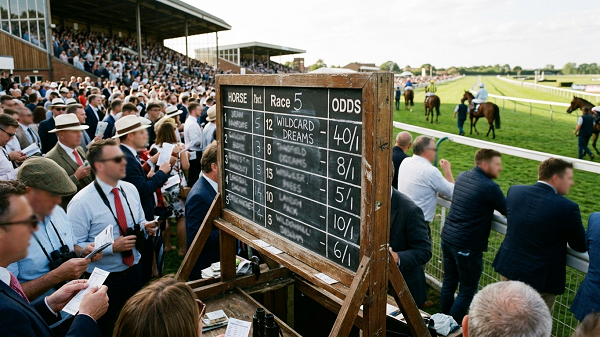
Odds of 40/1 can appear across many different betting markets.
In horse racing, a 40/1 runner will normally be considered an outsider.
It may be an inexperienced horse, one returning from a long absence or a runner whose recent form appears weaker than that of the market leaders.
In football, you might find 40/1 odds on an unlikely correct score, a player to score a hat-trick or an outsider to win a major tournament.
Golf betting also regularly produces selections at 40/1. Because golf tournaments can contain more than 100 players, even capable contenders may be available at big prices.
You may also see 40/1 odds in accumulator bets, particularly when several shorter-priced selections are combined.
Are 40/1 Odds Good Value?
Large odds do not automatically represent good value.
A 40/1 selection is only a value bet if you believe its true chance of winning is greater than the 2.44% probability suggested by the price.
For example, imagine you assess a horse as having a 4% chance of winning. Fair odds based on that probability would be around 24/1. If a bookmaker is offering 40/1, the price could represent value.
On the other hand, if the horse has only a 1% realistic chance of winning, even odds of 40/1 would be too short. Fair odds for a 1% chance would be around 99/1.
This is the key principle behind successful betting. The objective is not simply to back winners. It is to take odds that are bigger than the true probability of the outcome.
Naturally, working out that true probability is the difficult part.
Should You Bet Each-Way at 40/1?
An each-way bet can be worth considering when backing a selection at 40/1, particularly in horse racing or golf.
An each-way bet is made up of two separate wagers:
- One bet on the selection to win
- One bet on the selection to place
This means a £5 each-way bet costs £10 in total.
If the selection finishes in one of the qualifying places but does not win, the place portion of the bet can still produce a return.
The exact payout depends on the each-way terms. For example, a bookmaker may offer one-fifth of the odds for the first five places. At 40/1, one-fifth of the odds would be 8/1 for the place part of the bet.
Always check the number of places and the fraction of the odds before betting, as each-way terms can vary considerably between bookmakers.
Final Thoughts on the Meaning of 40/1 Odds
Odds of 40/1 mean that a successful £1 bet would generate £40 profit and a total return of £41.
They convert to decimal odds of 41.00, American odds of +4000 and an implied probability of approximately 2.44%.
The potential return is attractive, but 40/1 odds usually indicate that the selection has a relatively small chance of winning. That does not necessarily make it a bad bet. Outsiders can offer value when bookmakers have underestimated their prospects.
The important thing is to judge the price rather than focusing solely on the potential payout.
A winning 40/1 bet can be memorable, but long-term betting success comes from consistently finding selections whose odds are greater than their realistic chances suggest.


Leave a Reply
Want to join the discussion?Feel free to contribute!