
What Does Evens Mean in Betting?
If you are new to betting, evens is one of those terms you will come across almost immediately. Fortunately, it is also one of the easiest types of odds to understand.
Put simply, evens means that your potential profit is exactly the same as your stake.
So, if you bet £10 at evens and your bet wins, you make a £10 profit and receive £20 back in total — your £10 winnings plus the original £10 stake.
In fractional odds, evens is normally displayed as 1/1. In decimal odds, the equivalent is 2.00.
But what probability do evens represent, how do you calculate your returns, and does an evens bet necessarily have a 50% chance of winning? We explain everything below.
What Does Evens Mean in Betting?
Evens means you can win the same amount as you stake.
For example:
| Stake | Odds | Profit | Total Return |
|---|---|---|---|
| £5 | Evens | £5 | £10 |
| £10 | Evens | £10 | £20 |
| £20 | Evens | £20 | £40 |
| £50 | Evens | £50 | £100 |
| £100 | Evens | £100 | £200 |
The important point here is that your return includes your original stake.
If you place £20 on a horse at evens and it wins, you do not make £40 profit. You receive £40 back, consisting of:
- £20 original stake
- £20 profit
Your actual winnings are therefore £20.
Is Evens the Same as 1/1?
Yes.
Evens and 1/1 odds mean exactly the same thing.
Bookmakers in Britain and Ireland have traditionally used fractional odds, so you might see a selection priced at:
1/1
However, bookmakers will often simply write:
EVS
or occasionally:
Evens
All three mean the same thing.
The fraction 1/1 tells you precisely how the odds work. For every £1 you stake, you can win £1 in profit.
Therefore:
£10 at 1/1 = £10 profit
£25 at 1/1 = £25 profit
£100 at 1/1 = £100 profit
It is about as straightforward as fractional betting odds get.
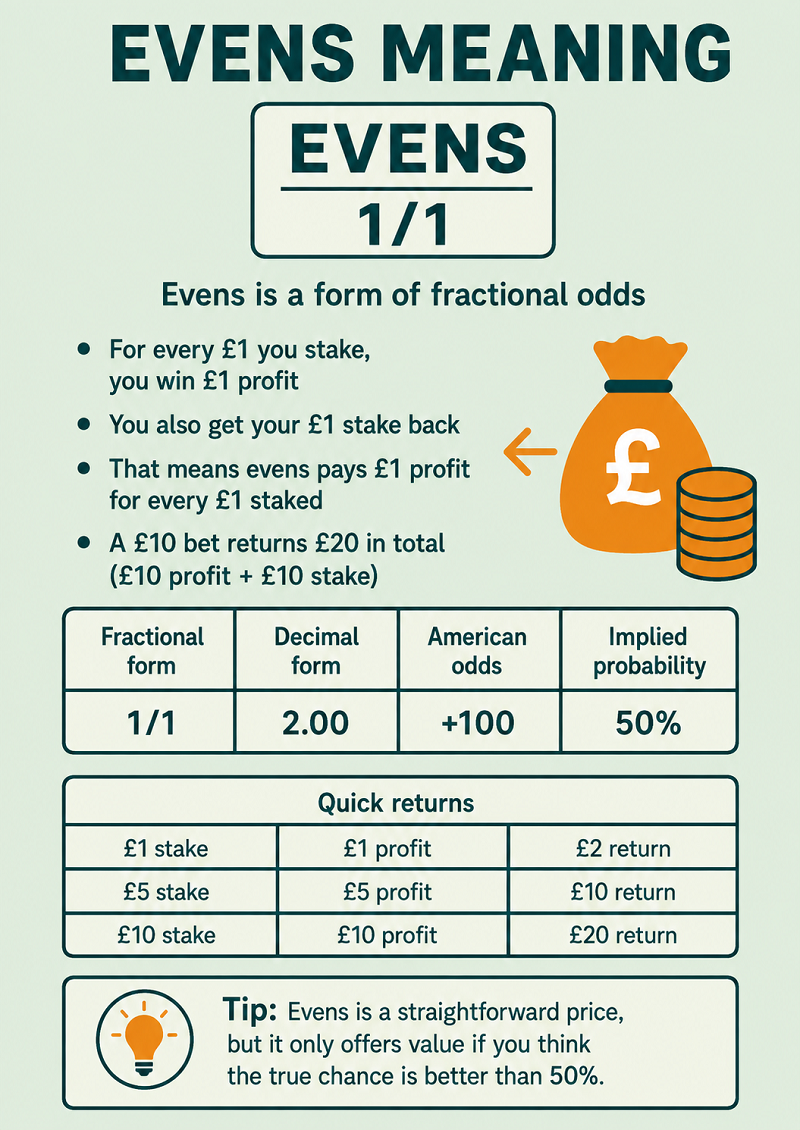
What Are Evens in Decimal Odds?
The decimal equivalent of evens is 2.00.
Decimal odds include the return of your stake, which can occasionally cause confusion for bettors who are accustomed to fractional prices.
For example, if you stake £10 at decimal odds of 2.00:
£10 × 2.00 = £20 total return
Your profit is therefore:
£20 − £10 stake = £10
That produces exactly the same result as betting £10 at evens or 1/1.
So the three common ways you might see evens displayed are:
| Odds Format | Evens |
|---|---|
| Fractional | 1/1 |
| Decimal | 2.00 |
| Traditional wording | Evens / EVS |
What Probability Are Evens Odds?
Evens represents an implied probability of 50%.
The easiest way to understand this is to imagine a perfectly fair coin toss.
There are two possible outcomes:
- Heads
- Tails
Assuming the coin is fair, each has a 50% chance.
The theoretically fair odds on either outcome would therefore be evens.
You can also calculate the probability from decimal odds:
1 ÷ 2.00 = 0.50
Multiply that by 100 and you get:
50%
So an evens price tells us that the odds correspond to a 50% implied probability.
However, there is an important distinction to make.
Does Evens Mean Something Has a 50% Chance of Winning?
Not necessarily.
Evens means the odds imply a probability of 50%. That does not guarantee that the true probability of the event happening is actually 50%.
This distinction is crucial if you want to become a successful bettor.
Bookmakers set their odds according to a combination of probability, market expectations, liabilities and their own profit margin.
Imagine you believe a horse has a 60% chance of winning, but a bookmaker offers evens.
The price implies only a 50% probability.
In that situation, you may consider the bet to offer value because your assessment of the horse’s chances is greater than the probability suggested by the odds.
Conversely, if you think the horse only has a 40% chance of winning, evens would not represent particularly attractive value even though the potential profit is equal to your stake.
Successful betting is therefore not simply about finding winners. It is about finding odds that are bigger than the true probability of the outcome suggests they should be.
How Much Do You Win on an Evens Bet?
Calculating winnings at evens is particularly easy:
Profit = stake
You then add the stake back to calculate your total return.
For example, suppose you place £30 at evens.
If the bet wins:
Profit = £30
Stake returned = £30
Total return = £60
If it loses, you lose your £30 stake.
Here are a few more examples.
£10 at Evens
Stake: £10
Profit: £10
Total return: £20
£25 at Evens
Stake: £25
Profit: £25
Total return: £50
£50 at Evens
Stake: £50
Profit: £50
Total return: £100
£100 at Evens
Stake: £100
Profit: £100
Total return: £200
This simplicity is one reason evens is often used as a reference point when discussing betting odds.
What Does Evens Favourite Mean?
You may also hear commentators describe a horse or team as an “evens favourite”.
This simply means that the selection is the favourite to win and is currently available at odds of evens.
For example, imagine the prices for a tennis match are:
- Player A – Evens
- Player B – 6/5
Player A is the favourite because evens represents the shorter price.
Likewise, you might hear that a horse has been “backed into evens”. This means its odds have shortened as money has entered the market.
Perhaps the horse opened at 2/1, shortened to 6/4 and eventually reached evens before the race.
Are Evens Good Odds?
There is no simple answer because whether evens represents good value depends on the underlying probability.
You shouldn’t automatically bet on something simply because you think it has a good chance of winning.
Instead, ask whether its chance of winning is greater than the probability suggested by the price.
Imagine two bets.
Bet A
Odds: Evens
Your estimated probability: 60%
Bet B
Odds: Evens
Your estimated probability: 40%
Both bets pay exactly the same amount if successful.
However, Bet A would theoretically be the better wager because you believe the true probability is substantially greater than the bookmaker’s implied 50%.
This is the basic idea behind value betting.
Of course, estimating probabilities accurately is the difficult part — and bookmakers are usually extremely good at pricing markets.
Examples of Evens Odds in Different Sports

Evens can appear in almost any betting market, although the type of selection priced at even money varies considerably between sports.
Here are some typical real-world examples using recognisable teams and players.
These are illustrative examples rather than current bookmaker prices, as odds will naturally change from event to event.
Football
Imagine Arsenal are at home to Newcastle United and a bookmaker prices an Arsenal win at evens.
A £20 bet on Arsenal would produce:
£20 stake + £20 profit = £40 return
Football is interesting because the match-result market has three possible outcomes — home win, draw and away win.
An evens favourite therefore does not mean the bookmaker thinks the other team also has a 50% chance, because some probability has to be allocated to the draw.
You can also find evens prices in markets such as both teams to score, over 2.5 goals and Asian handicaps.
For example, Liverpool v Manchester United – Over 2.5 Goals at evens would mean that a £10 bet returned £20 if the match contained at least three goals.
Tennis
Tennis frequently produces prices close to evens when two closely matched players meet.
Imagine Carlos Alcaraz v Jannik Sinner in the latter stages of a Grand Slam, with Alcaraz available at evens.
Because a completed tennis match has a winner and loser, the price effectively suggests Alcaraz has approximately a 50% implied chance before allowing for the bookmaker’s margin.
Bet £50 at evens and your return would be £100 if Alcaraz won.
This is quite different from football because there is no draw in the standard match-winner market.
Horse Racing
Evens is also a familiar horse-racing price.
Suppose a leading runner trained by Aidan O’Brien goes off as the evens favourite for a major race at Ascot.
A £25 win bet would produce £25 profit if the horse won, giving you £50 back.
An evens-priced horse is usually a strong market favourite, particularly in a race with numerous runners.
However, that does not make it a certainty. Even a horse with a true 50% chance of victory would statistically be expected to lose half of the time.
Golf
Outright golf tournament winners are rarely available at evens because there are so many competitors.
Instead, even-money prices are more likely to appear in head-to-head markets.
For example:
Rory McIlroy to beat Scottie Scheffler in a tournament match bet – Evens
If you staked £10 and McIlroy finished higher, you would receive £20 back.
Golf bookmakers also offer evens prices on markets such as a player making the cut, finishing inside the top 20 or beating a particular opponent.
Boxing
Boxing can produce even-money prices when bookmakers struggle to separate two fighters.
Imagine Anthony Joshua facing a similarly rated heavyweight and being priced at evens to win.
A £100 wager would generate £100 profit if Joshua won, for a £200 total return.
Alternatively, you might see evens on a method-of-victory market — for example, a boxer to win by KO/TKO at evens — even when their outright win price is considerably shorter.
Formula One
You can also find even-money prices in motorsport.
For e