

What Does Accept All Odds Movements Mean
If you have ever placed a bet online, you may have noticed a small option on the betslip saying “Accept All Odds Movements”.
It sounds fairly harmless, but it is actually an important betting setting. Turning it on can mean your bet is placed at different odds from the ones you originally saw, including lower odds.
So, what does accept all odds movements mean, and should you have the option switched on?
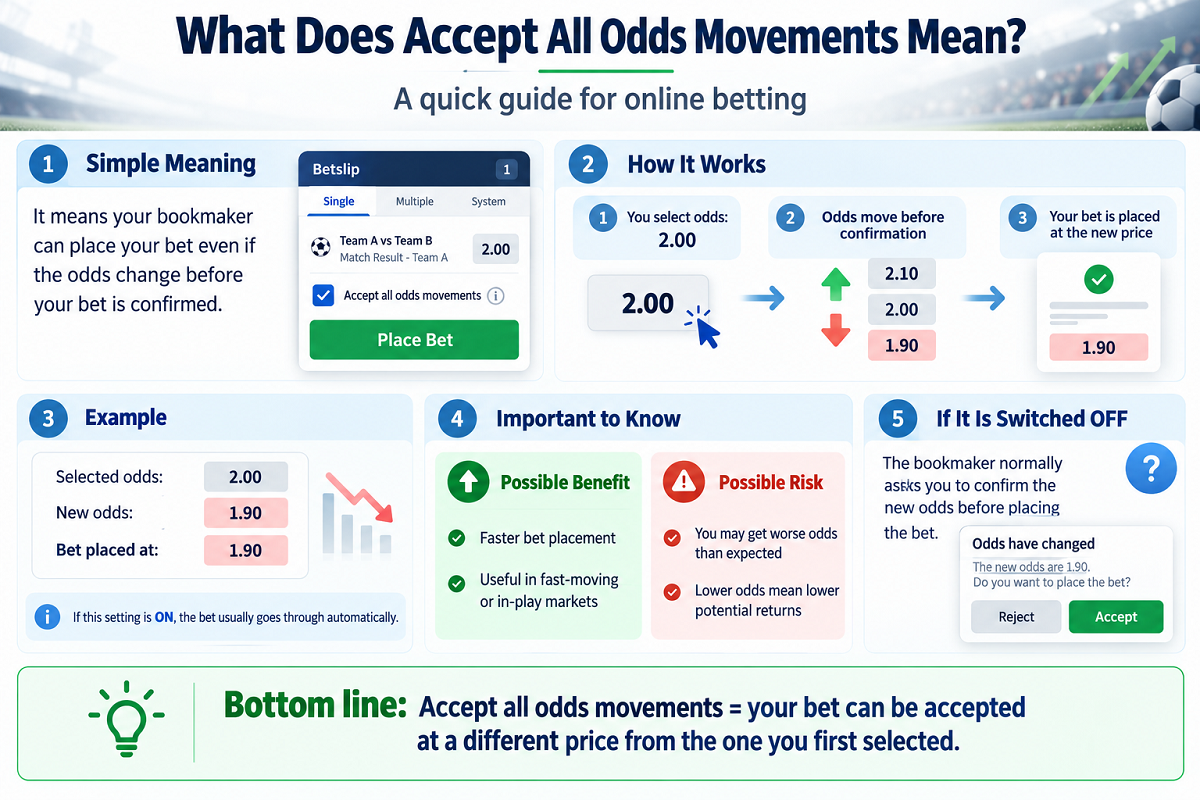
In simple terms, accepting all odds movements means you are giving the bookmaker permission to place your bet even if the odds change before the bet is confirmed. The new odds could be higher or lower than the price you originally selected.
For recreational bettors this might not seem particularly significant. But if you are trying to get good value from your bets, matched betting, following a tipster or placing larger multiples, even relatively small changes in price can matter.
Let’s look at exactly how it works.
What Does Accept All Odds Movements Mean in Betting?
Odds at bookmakers are constantly changing.
You might add Manchester City to your betslip at 2.00 (evens), for example, but by the time you press the button to confirm the bet, the bookmaker may have changed the price to 1.90.
If Accept All Odds Movements is switched off, the bookmaker will usually warn you that the price has changed and ask whether you still want to place the bet.
If it is switched on, the bet can simply go through at 1.90 without requiring you to approve the new price.
The same principle applies if the odds move in your favour.
For example:
| Stage | Odds |
|---|---|
| Selection added to betslip | 2.00 |
| Odds change | 2.10 |
| Bet confirmed | 2.10 |
With all odds movements accepted, the bet may be processed at the revised 2.10 price.
However, policies can vary between bookmakers, so it is worth checking exactly how your betting site handles price changes.
The important point is that this setting generally concerns the short period between selecting your bet and the bookmaker actually confirming it. It does not normally mean that your odds continue floating around until the match or race starts.
Why Do Betting Odds Move?
Bookmakers constantly adjust their odds according to what is happening in the market.
There are numerous reasons for this.
A large amount of money might suddenly be placed on one selection, prompting the bookmaker to shorten its odds.
Alternatively, important information might emerge.
For example:
- a key footballer is ruled out through injury;
- a horse is withdrawn from a race;
- weather conditions change;
- team news is announced;
- another bookmaker moves its price;
- heavy betting activity occurs;
- a market becomes more or less liquid.
Odds can therefore change several times in a relatively short period.
This is particularly common just before an event begins and in live betting markets, where circumstances can change extremely quickly.
It is also more noticeable when placing accumulators because several selections are sitting in your betslip at once. The more selections you add, the greater the chance that at least one price will move before you click Place Bet.
An Example of Accepting All Odds Movements
Suppose you want to bet £100 on a tennis player.
You add the player to your betslip at odds of:
2.20
At those odds, your potential return would be:
£100 × 2.20 = £220
But before the bookmaker processes your wager, the price shortens to:
2.00
If you have selected Accept All Odds Movements, your bet could still be placed automatically.
Your potential return is now:
£100 × 2.00 = £200
That seemingly small price movement has therefore reduced your potential return by £20.
If you hadn’t accepted all odds movements, the bookmaker would normally notify you that the odds had changed, allowing you to decide whether you still wanted the bet.
Why Do Bookmakers Offer the Setting?
The main benefit is convenience.
Without the setting, rapidly changing odds can make placing bets frustrating.
Imagine trying to place a five-team football accumulator.
You click Place Bet, but one selection changes from 1.80 to 1.79.
You confirm the change.
Then another selection moves from 2.10 to 2.08.
You confirm again.
By that point another price may have moved.
Accepting odds movements avoids this problem by allowing the bookmaker to process the bet at the latest available prices.
That can be particularly useful in fast-moving in-play markets.
But convenience comes with a potential downside: you may automatically accept a worse price.
Should You Accept All Odds Movements?
For bettors who care about getting the best possible price, there is a strong argument for leaving the setting switched off.
You can still place the bet if the price changes. The difference is simply that you get an opportunity to look at the new price first.
Suppose you were willing to back something at:
3.00
If the price suddenly falls to:
2.50
there might be a good reason for that movement.
Rather than automatically accepting the shorter odds, you might want to investigate what has happened or check whether another bookmaker is still offering a better price.
For casual £5 bets, the difference might not seem substantial.
For someone placing hundreds or thousands of bets over the course of a year, though, repeatedly accepting slightly poorer odds can make a significant difference to overall returns.
Why Price Matters More Than Many Bettors Think

One of the biggest misconceptions in betting is that finding the winner is all that matters.
It isn’t.
The price you get matters enormously.
Suppose you back 100 selections at odds of 2.00 and win exactly half of them.
With £10 stakes:
50 winners × £10 profit = £500
50 losers × £10 = -£500
Your overall result is:
£0
Now imagine you were taking 1.90 rather than 2.00 on exactly the same selections.
Each winner produces only £9 profit.
50 × £9 = £450
Your losing bets still cost £500.
Overall result:
-£50
You picked exactly the same winners, but poorer prices turned a break-even strategy into a losing one.
That is why serious bettors pay so much attention to odds movements.
Accept All Odds Movements vs Accept Higher Odds
Some bookmakers offer several settings rather than simply an on/off switch.
You might see something similar to:
Accept All Odds Changes
Accept Higher Odds Only
Do Not Accept Odds Changes
Of these, Accept Higher Odds Only is arguably the most bettor-friendly setting where available.
Imagine you select odds of 2.00.
If the odds rise to 2.10, your bet can automatically go through at the better price.
If they fall to 1.90, however, you are asked to approve the change.
This gives you much more control over the price you receive. Some bookmakers explicitly provide settings along these lines.
Does Accept All Odds Movements Mean Starting Price?
No.
This is a common misunderstanding, particularly with horse racing.
If you back a horse at 10/1 and select Accept All Odds Movements, this doesn’t normally mean you are agreeing to take whatever the horse’s Starting Price eventually becomes.
The setting relates to changes occurring while your bet is being submitted.
Once your bet has been successfully accepted at a particular price, that is normally the price attached to your bet, subject of course to the bookmaker’s normal rules.
If you specifically want to take Starting Price (SP) on a horse, you need to select the appropriate SP option when placing the bet.
Accept All Odds Movements and Matched Betting

Matched bettors should be particularly careful with this feature.
Matched betting calculations rely heavily on the relationship between the odds available at the bookmaker and the lay odds available at the betting exchange.
Suppose your calculation is based on backing something at:
3.00
but the bookmaker price suddenly falls to:
2.80
If the wager is automatically accepted, the figures you entered into your matched betting calculator are no longer correct.
Your expected profit may fall, or in some situations the bet could become a small loss.
For that reason, matched bettors will generally want much tighter control over odds changes and should recalculate their stakes whenever the price changes materially.
What About Following Betting Tipsters?
Price movement is also particularly important when following a betting tipster.
Imagine a tipster recommends:
Liverpool at 2.20
You don’t see the message immediately and add the selection to your betslip at 2.10.
While you are placing the wager, the odds move again to 1.95.
If you accept all odds movements, you could end up betting at 1.95 despite the original recommendation being based on 2.20.
The selection hasn’t changed, but the value of the bet has.
This is why we pay close attention to price availability when reviewing betting services at Honest Betting Reviews.
A profitable-looking tipster service is much less useful if followers consistently struggle to obtain anything close to the advised odds.
When Might Accepting All Odds Movements Be Useful?
There are circumstances where the setting can be convenient.
The obvious example is in-play betting.
Prices can move extremely quickly during a football match, tennis match or horse race. If you insist on manually approving every tiny movement, you may struggle to get the wager placed at all.
Similarly, someone placing a recreational accumulator may care more about getting the bet submitted quickly than whether one leg changes from 1.73 to 1.70.
It ultimately comes down to the trade-off between speed and price control.
Accept All Odds Movements: The Bottom Line
So, what does accept all odds movements mean?
It means you are allowing your bookmaker to process your wager even if the odds change between selecting the bet and the wager being confirmed.
The price could move higher or lower.
Switching the setting on makes betting quicker and prevents wagers being interrupted every time a price changes. However, it also means you could automatically accept lower odds than the ones you originally intended to take.
For occasional recreational betting, tiny movements may not make much practical difference.
For anyone taking betting more seriously, following tipsters, matched betting or simply trying to maximise value, it generally makes sense to check any downward price movement before accepting it.
After all, betting successfully isn’t just about backing winners.
Getting the right price matters too.



Leave a Reply
Want to join the discussion?Feel free to contribute!