
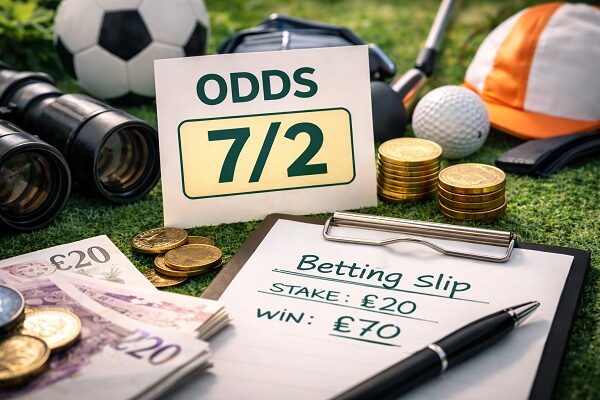
Odds 7/2 Explained: What This Betting Price Really Means
If you’ve ever looked at betting odds and paused at 7/2, wondering whether it’s a good price or what it actually means in real terms, you’re not alone.
Fractional odds can be confusing at first, especially if you’re more familiar with decimal prices.
In this guide, we’ll explain the odds 7/2 meaning in plain English.
You’ll learn how much you can win, what probability those odds imply, whether 7/2 represents good value, and how experienced bettors approach selections priced at this level.
By the end, you’ll be able to spot when 7/2 odds are worth backing — and when they’re best avoided.
What Does Odds 7/2 Mean?
Odds of 7/2 are fractional odds, the traditional odds format used by UK bookmakers. Read aloud, they’re pronounced “seven to two”.
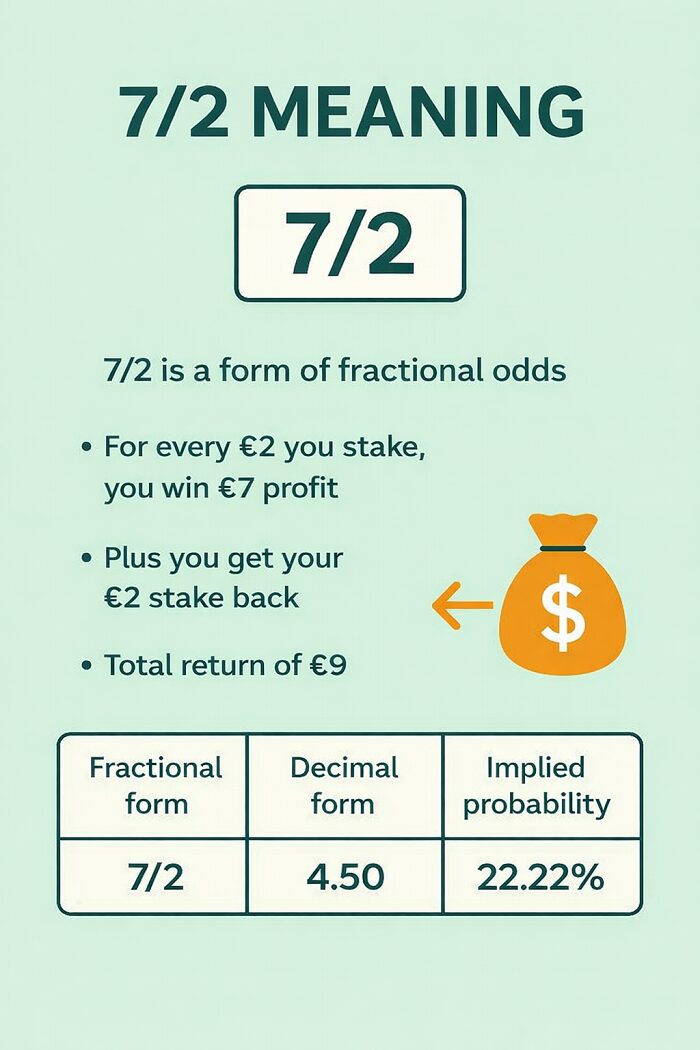
In simple terms, odds 7/2 mean:
So the odds tell you two things:
- The potential profit
- The bookmaker’s implied likelihood of the outcome happening
These odds suggest the selection has a realistic chance of winning, but it’s not expected to happen often.
It sits firmly in the “mid-price” range — not a favourite, but not a long shot either.
How Much Do You Win at 7/2 Odds?
Understanding the payout is usually the first thing bettors want to know.
Here are some simple examples to show exactly how much you could win at 7/2 odds:
| Stake | Profit (at 7/2) | Total Return |
|---|---|---|
| £1 | £3.50 | £4.50 |
| £4 | £14.00 | £18.00 |
| £5 | £17.50 | £22.50 |
| £10 | £35.00 | £45.00 |
| £20 | £70.00 | £90.00 |
It’s a solid payout that offers a good balance between risk and reward — one of the reasons these odds are so popular.
What Probability Do 7/2 Odds Represent?
Every set of odds implies a probability — in other words, how likely the bookmaker believes an outcome is.
Odds of 7/2 odds imply a probability of:
-
22.22%
This means the bookmaker believes the outcome will happen just over 22 times out of 100.
Importantly, this is not a prediction — it’s a pricing estimate that also includes the bookmaker’s margin.
Are 7/2 Odds Good Value?

Whether 7/2 odds are good value depends entirely on whether the implied probability matches reality.
Odds of 7/2 imply a 22.22% chance. If you believe the true chance is higher than that, the odds may offer value. If you believe it’s lower, they don’t.
A Simple Value Example
Let’s say:
- You believe a football team has a 30% chance of winning
- The bookmaker offers 7/2 (22.22%)
Because your estimate is higher than the bookmaker’s implied probability, this could be considered value betting.
However, if your research suggests the team only has a 15–20% chance, then 7/2 would actually be poor value — even though the payout looks attractive.
Value is never about how much you win; it’s about whether the odds are bigger than they should be.
Odds 7/2 in Decimal and American Formats
While fractional odds like 7/2 are the traditional format used by UK bookmakers, you’ll often see the same price displayed differently depending on the betting site or exchange you’re using.
Understanding how odds 7/2 convert into decimal and American formats makes it easier to compare prices and avoid confusion.
Decimal Odds
To convert fractional odds into decimal odds, you simply divide the top number by the bottom number and add one:
- 7 ÷ 2 = 3.5
- 3.5 + 1 = 4.50
So, 7/2 in decimal odds is 4.50.
This means that for every £1 you stake, your total return (including your stake) would be £4.50.
Decimal odds are popular because they make it quick and easy to calculate potential returns, especially when placing accumulator bets.
American Odds
American odds (also known as moneyline odds) are less common in the UK but are frequently used by US sportsbooks.
Because 7/2 represents an underdog price, it converts to positive American odds:
- 7/2 = +350
This means you would win $350 in profit for every $100 staked, with your original stake returned as well.
While the format looks very different, the implied probability and potential value of the bet remain exactly the same.
🏟️ Examples of 7/2 Odds in Different Sports

To give you a clearer idea of how 7/2 odds appear in real betting markets, let’s look at some practical examples across popular sports.
These examples show how bookmakers typically price selections at this level and what they usually represent in terms of risk and reward.
🐎 Horse Racing
In horse racing, 7/2 odds are often assigned to a horse that is well-fancied but not the outright favourite.
This might be a runner with strong recent form, but with one or two questions to answer — such as stepping up in distance, running on unfamiliar ground, or facing a particularly strong rival.
For example, a horse priced at 7/2 may be second or third in the betting, indicating that while it has a genuine chance of winning, bookmakers believe there are other runners more likely to prevail.
⚽ Football Betting
In football markets, odds of 7/2 commonly appear when an underdog has a realistic chance of causing an upset.
This could include:
- An away team playing well against a stronger home side
- A mid-table club facing a top team with injuries or rotation issues
- A motivated cup outsider playing against complacent opposition
At 7/2, the bookmaker is suggesting the team could win roughly one in five matches under similar conditions, making it an attractive price when circumstances point in their favour.
🎾 Tennis Betting
In tennis, 7/2 odds are often seen in matches where a lower-ranked player has the potential to challenge a favourite. This might occur when:
- A player is particularly strong on a specific surface
- Head-to-head records are closer than rankings suggest
- Conditions favour the underdog’s playing style
Set betting and match betting markets frequently feature prices around 7/2 when the contest is competitive but one player is still clearly favoured by the market.
⛳ Golf Betting
In golf betting, 7/2 odds are most commonly found in match bets, two-ball, or three-ball markets rather than outright tournament winners.
For example, a golfer priced at 7/2 to win a head-to-head match may be slightly less favoured than their opponent but still have a strong chance based on course history, current form, or weather conditions.
These odds suggest a competitive matchup rather than a one-sided contest.
🥊 Boxing & MMA
In boxing and MMA markets, 7/2 odds are typically offered on a fighter who is seen as a clear underdog but still poses a genuine threat.
This might include:
- A challenger with knockout power
- A fighter with a strong grappling advantage in MMA
- An experienced competitor facing a younger, hyped opponent
At 7/2, the bookmaker is acknowledging the underdog’s chance while still favouring the opposing fighter to win the bout more often than not.
🧮 Why Many Professionals Like Odds of Around 7/2 (Especially in Horse Racing)

Many professional bettors are drawn to odds of around 7/2 because they offer one of the best balances between strike rate and return, particularly in horse racing.
At this price point, selections still win often enough to avoid long losing runs, but the returns are strong enough to generate meaningful profit when value is present.
In horse racing, odds around 7/2 are frequently attached to horses that tick many of the right boxes — solid recent form, suitable conditions, and positive trainer or jockey signals — yet are not overbet by the public in the way short-priced favourites often are.
This makes them less vulnerable to market distortion and hype-driven price shortening.
Professionals also like 7/2 because these horses are often priced conservatively due to small perceived risks, such as an unfamiliar track or a slight step up in class. When those concerns are overstated by the market, value emerges.
Over time, consistently backing horses at around 7/2 that should realistically be closer to 5/2 or 3/1 can produce strong long-term returns.
Finally, from a bankroll management perspective, 7/2 allows professionals to maintain relatively stable staking plans.
The combination of a reasonable strike rate and healthy profit per winner makes it easier to absorb variance without needing aggressive staking or chasing losses — a key reason why this odds range remains so popular among experienced horse racing bettors.
🧠 Strategies for Betting on 7/2 Odds
Bets priced at 7/2 should never be placed blindly. Successful bettors usually apply a clear strategy when backing selections at this price point, focusing on value rather than just the potential payout.
📉 Backing Early Market Value
Early odds can sometimes underestimate a selection’s true chance. If a horse or team opens at 7/2 and later shortens due to strong support, it suggests the original price may have been generous.
For example, backing a horse at 7/2 that later starts at 5/2 means you’ve beaten the market — a key indicator of long-term profitability.
⚖️ Situational Football Opportunities
In football, 7/2 can be a strong price when situational factors are in play, such as fixture congestion, squad rotation, or differing motivations.
A typical example might be backing a home side at 7/2 against a stronger opponent who has a crucial European match days later.
While the favourite may be stronger on paper, circumstances can significantly narrow the gap.
🎯 Tennis Match-Up Angles
Some tennis players are priced at 7/2 purely due to ranking, despite having a playing style that causes problems for their opponent.
Big servers, aggressive baseliners, or players returning from injury but improving rapidly often fall into this category.
Spotting these mismatches can make 7/2 odds particularly appealing.
🔍 Identifying Mispriced Underdogs
Sometimes a selection is priced at 7/2 simply because it is unpopular with the betting public, not because it lacks a genuine chance.
Bookmakers often shade prices to attract money on favourites, leaving underdogs slightly overpriced.
This is common in sports like boxing, MMA, and golf match betting, where narrative, hype, or reputation can outweigh objective analysis. Spotting these mispriced underdogs can make 7/2 odds particularly attractive.
📋 Guidelines for Betting on 7/2 Shots

Before placing bets at 7/2 odds, it’s worth keeping a few key guidelines in mind to avoid common pitfalls.
✅ Don’t Focus on the Payout Alone
While 7/2 offers an attractive return, the selection will still lose more often than it wins. Always assess whether the odds fairly reflect the true chance of success.
🔍 Shop Around for the Best Price
Different bookmakers often disagree on pricing. One might offer 7/2, while another offers 4/1 or even 9/2.
Over time, consistently taking the best available odds can make a huge difference to profitability.
💷 Use Sensible Staking
Because 7/2 bets have a lower strike rate than shorter odds, flat staking or cautious proportional staking is usually the safest approach.
Avoid increasing stakes simply because the potential return looks tempting.
📊 Track Performance Over Time
If you regularly back selections at 7/2, keep records of your results. Monitoring win rates, returns, and whether you’re beating the closing odds can help determine whether your approach is genuinely working.
How 7/2 Compares to Other Popular Odds
Here’s where 7/2 sits in the wider odds landscape:
| Fractional Odds | Decimal Odds | Implied Probability |
|---|---|---|
| 2/1 | 3.00 | 33.33% |
| 5/2 | 3.50 | 28.57% |
| 7/2 | 4.50 | 22.22% |
| 4/1 | 5.00 | 20.00% |
| 5/1 | 6.00 | 16.67% |
As you can see, 7/2 offers a noticeable jump in payout compared to shorter prices, while still maintaining a realistic strike rate.
Final Thoughts on Odds 7/2
Understanding the odds 7/2 meaning gives you a clearer edge when betting.
These odds represent a balance between risk and reward, commonly used for selections that are competitive but not favoured.
To summarise:
- 7/2 means £7 profit for every £2 staked
- It implies a 22.22% chance
- In decimal odds, it’s 4.50
- It can offer excellent value — but only when priced incorrectly
Approach 7/2 shots with logic, discipline, and proper analysis, and they can become a useful part of a long-term betting strategy rather than a gamble.




Leave a Reply
Want to join the discussion?Feel free to contribute!