
Odds 5/4: What Do These Odds Really Mean in Betting?
If you’ve spent any time looking at betting markets — especially in the UK — you’ll have come across odds 5/4 sooner or later.
They sit in that interesting middle ground: not quite an odds-on favourite, but not a long shot either.
For many bettors, 5/4 raises the same questions every time:
- What do 5/4 odds actually mean?
- How much do you win at 5/4?
- Are 5/4 odds good value?
- When should (and shouldn’t) you back a 5/4 shot?
This guide answers all of that — clearly, practically, and without the usual bookmaker waffle.
What Does 5/4 Mean in Betting?
Odds 5/4 are fractional odds, the traditional format used by UK bookmakers.
Put simply:
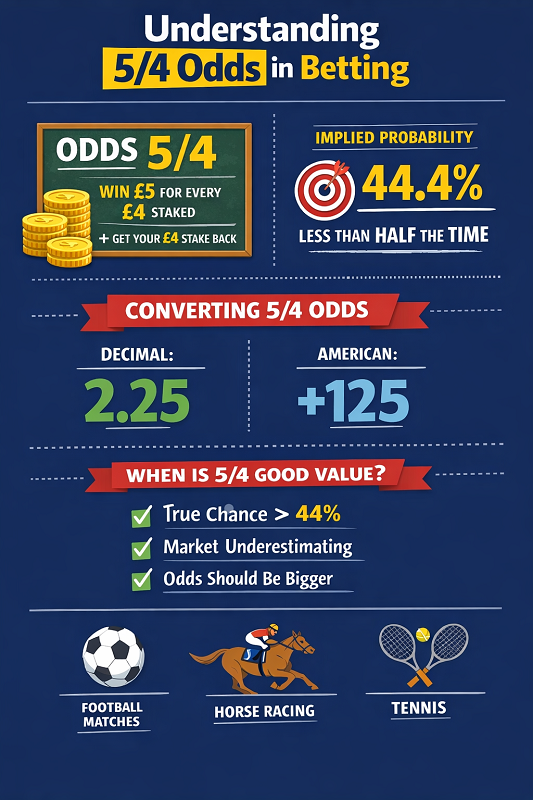
- You win £5 for every £4 you stake
- Plus you get your original stake back
So if you place a £4 bet at 5/4:
- You make £5 profit
- You receive £9 in total returns (£5 profit + £4 stake)
What 5/4 Tells You About Probability
Fractional odds also hint at how likely the bookmaker thinks an outcome is.
Odds of 5/4 imply a probability of around 44.4%.
That means:
- The event is expected to happen slightly less than half the time
- It’s considered competitive, but far from guaranteed
This is why 5/4 often appears on:
- Tight football matches
- Evenly matched tennis players
- Second favourites in horse racing
How Much Do You Win at 5/4 Odds?
Let’s break it down with some common stake sizes.
Returns at 5/4 Odds
| Stake | Profit | Total Return |
|---|---|---|
| £4 | £5 | £9 |
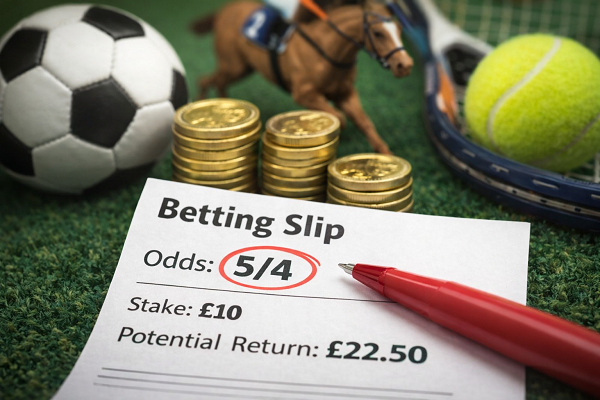
| £10 | £12.50 | £22.50 |
| £20 | £25 | £45 |
| £50 | £62.50 | £112.50 |
| £100 | £125 | £225 |
A handy shortcut:
Divide your stake by 4, then multiply by 5
So £40 ÷ 4 = £10
£10 × 5 = £50 profit
Converting 5/4 to Decimal or American Odds
Even if you mostly bet with UK bookmakers, it’s useful to understand other odds formats — especially if you use exchanges, odds comparison sites, or international books.
5/4 in Decimal Odds
To convert fractional odds to decimal:
- (5 ÷ 4) + 1 = 2.25
So:
-
5/4 = 2.25 decimal odds
This means a £10 bet returns £22.50 in total.
5/4 in American Odds
Because 5/4 is an underdog price (decimal odds above 2.00), it converts to positive American odds.
-
5/4 ≈ +125
In American terms:
-
Bet $100 to win $125
Are 5/4 Odds Good Value?
This is the most important question — and the answer is sometimes, but not always.
Odds alone don’t determine value. Value comes from probability, not price.
When 5/4 Can Be Good Value
5/4 odds are worth backing when:
- You believe the true probability is higher than 44%
- The market has slightly underestimated the selection
- The odds are bigger than they “should” be
For example:
- A football team priced at 5/4 that you rate closer to a 50% chance
- A tennis player returning from injury where the market overreacts
- A horse drifting slightly due to public money elsewhere
When 5/4 Is Poor Value
5/4 is bad value when:
- The outcome is closer to a 35–40% chance
- The price looks tempting but isn’t justified by form or data
- You’re backing it “because it’s not odds-on”
Plenty of losing bets happen at 5/4 because bettors mistake it for a safe middle ground.
Examples of 5/4 Odds in Different Sports

Football
Common 5/4 football markets include:
- Home win in a balanced fixture
- Both Teams To Score (Yes)
- Over 2.5 Goals in lower-scoring leagues
- Draw No Bet selections
Example:
A mid-table Premier League side at home to a similar opponent might be priced at 5/4 to win.
Horse Racing
In racing, 5/4 often appears on:
- Strong second favourites
- Short-priced runners in small fields
- Horses with solid form but one or two doubts
These are often “nearly favourites” rather than standout selections.
Tennis
In tennis betting, 5/4 is common when:
- Two players are closely matched
- Surface favours one player slightly
- Recent form conflicts with long-term rankings
Other Sports
You’ll also see 5/4 in:
- Boxing fight winners
- MMA bouts going the distance
- Golf outright betting (for top-ranked contenders rather than favourites)
Strategies for Betting on 5/4 Shots

Odds of 5/4 sit in a tricky but potentially lucrative zone. They’re short enough that many bettors feel comfortable backing them, yet long enough that mistakes get punished quickly.
The key with 5/4 betting is understanding why the market has landed there — and whether it’s right.
Below are some practical, real-world strategies for spotting value at 5/4, with clear examples across popular sports.
1. Back the Slightly Undervalued Favourite (Not the Public One)
One of the most common places you’ll see 5/4 is when two elite competitors face each other — and the market can’t fully commit to either being odds-on.
Tennis Example: Carlos Alcaraz vs Jannik Sinner
Imagine a hard-court match where:
- Sinner has won the last head-to-head
- Alcaraz is returning from a minor injury
- Public money leans towards Sinner
As a result, Alcaraz drifts to around 5/4.
This is where experienced bettors pause and ask:
- Is Alcaraz really a sub-45% chance?
- Are the market and public overreacting to recency?
- Does the surface, format, or fitness angle favour him more than the odds suggest?
If your analysis says Alcaraz wins closer to 50% of the time, then 5/4 is not “just acceptable” — it’s value.
2. Use 5/4 When the Market Overprices Uncertainty
Bookmakers hate uncertainty — and when doubt creeps in, prices often drift slightly beyond where they should.
This is a sweet spot for 5/4 bets.
Football Example: Tactical Uncertainty
A football team might be priced at 5/4 to win when:
- A key player is listed as “doubtful”
- The manager hints at rotation
- The opposition is on a decent run
Often, once line-ups are confirmed, you’ll see:
- Odds contract sharply
- 5/4 move into evens or shorter
Backing early at 5/4 — before uncertainty clears — is a classic closing-line value strategy.
3. Target 5/4 in “False 50/50” Matchups
Markets often treat certain contests as coin flips when they aren’t.
This happens frequently in:
- Tennis between differently styled players
- Boxing and MMA matchups
- Football derbies or rivalry games
Tennis Style Matchup Example
Player A:
- Big server
- Dominates fast courts
Player B:
- Better overall ranking
- Struggles against power servers
If the market prices Player A at 5/4 simply because of ranking differences, sharp bettors see opportunity.
Style mismatches are not 50/50 — but bookmakers often price them as if they are.
4. Avoid “Comfort Bets” at 5/4
One of the biggest psychological traps in betting is seeing 5/4 as a safe middle ground.
It isn’t.
At 5/4:
- The bet still loses more often than it wins
- You must be right more than 44% of the time just to break even
A disciplined strategy is to only back 5/4 when you can clearly articulate the edge:
- Tactical mismatch
- Market overreaction
- Statistical undervaluation
If the reasoning is vague, skip the bet.
5. Use 5/4 Selectively in Singles — Not Blind Accumulators
Because 5/4 looks “reasonable”, many bettors stack them into accumulators.
That’s usually a mistake.
Three 5/4 selections might look modest, but:
- Each one has a sub-50% chance
- The combined probability drops fast
A better approach:
- Use 5/4 selections as singles
- Or pair one strong 5/4 bet with a much shorter price if you must combine
Professional bettors tend to treat 5/4 as a standalone value price, not acca filler.
6. Compare Bookmakers Aggressively at 5/4
Small differences matter most around this price point.
Example:
- Bookmaker A: 5/4 (2.25)
- Bookmaker B: 6/5 (2.20)
- Bookmaker C: Evens (2.00)
Over time, consistently taking 5/4 instead of evens on the same selections has a massive impact on ROI.
If you bet regularly at this range, price shopping isn’t optional — it’s essential.
7. Stake Based on Confidence, Not the Odds
Another common mistake is staking more because 5/4 “feels right”.
Instead:
- Stake according to edge
- Not perceived safety
A strong 3/1 value bet is better than a weak 5/4 bet — every time.
Final Takeaway on Betting at 5/4
The smartest bettors don’t ask:
“Are 5/4 odds good?”
They ask:
“Why is this priced at 5/4 — and is that wrong?”
When the answer is clear, 5/4 can be one of the most profitable prices in betting.
When it isn’t, it’s often one of the most expensive mistakes.
Common Mistakes When Reading 5/4 Odds
❌ Assuming 5/4 Is “Nearly Certain”
It isn’t.
At 5/4, the selection loses more often than it wins.
❌ Ignoring Implied Probability
If you don’t think in probabilities, you’re guessing — not betting.
Always ask:
Does this really win more than 44 times out of 100?
❌ Overusing 5/4 in Accas
This is one of the fastest ways to drain a bankroll.
❌ Confusing Return With Profit
£22.50 return on a £10 stake sounds nice — but only £12.50 is profit.
Odds 5/4 vs Evens: What’s the Difference?
This is a common point of confusion.
- Evens (1/1) implies a 50% chance
- 5/4 implies a 44.4% chance
That difference is significant.
Backing 5/4 instead of evens means:
- You’re taking more risk
- You need a stronger edge to justify it
FAQs About 5/4 Odds 🙋
Is 5/4 Odds-On or Odds-Against?
5/4 is odds-against, because the profit is higher than the stake.
Is 5/4 Better Than 6/5?
Yes — 5/4 (2.25) is better than 6/5 (2.20).
Can You Make Money Backing 5/4 Regularly?
Yes — but only with value. Blindly backing 5/4 selections will lose over time.
Are 5/4 Bets Safe?
No bet is safe. 5/4 loses more often than it wins.
Final Thoughts: What Odds 5/4 Really Mean for Bettors
Odds 5/4 are one of the most misunderstood prices in betting.
They:
- Look reasonable
- Feel balanced
- Sit close to even money
But in reality, they demand discipline, analysis, and value-based thinking.
If you treat 5/4 as a “safe bet”, you’ll struggle.
If you treat it as a price that must justify itself, it can be a powerful tool.
As always, the odds don’t matter nearly as much as whether they’re wrong.




Leave a Reply
Want to join the discussion?Feel free to contribute!