
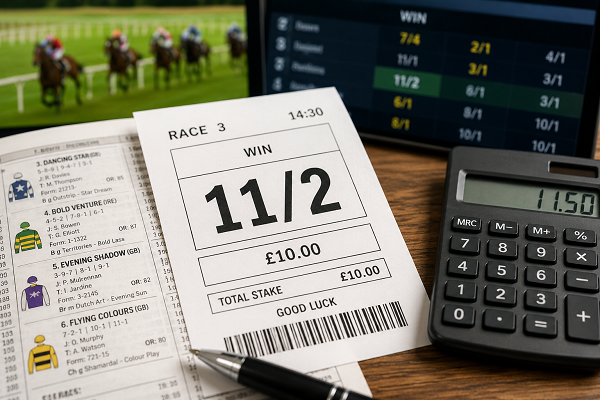
Odds 11/2 Meaning: What Do These Betting Odds Really Tell You?
/0 CommentsIf you’ve been browsing a racecard, football coupon or bookmaker market and spotted odds 11/2, you might be wondering exactly what that price means.
How much do you win? Is 11/2 a big price? What does it say about the chances of your bet landing?
The good news is that 11/2 is easy to understand once you break it down. It is a fractional price commonly used in UK betting, especially in horse racing, football, golf, tennis and outright markets.
In this guide, we’ll explain the odds 11/2 meaning in plain English, show you how to calculate your returns, convert 11/2 into decimal and American odds, and explain whether this type of price can offer value.
Let’s get into it.
What Does 11/2 Odds Mean?
11/2 odds are fractional odds, read as “eleven to two.”
In simple terms:
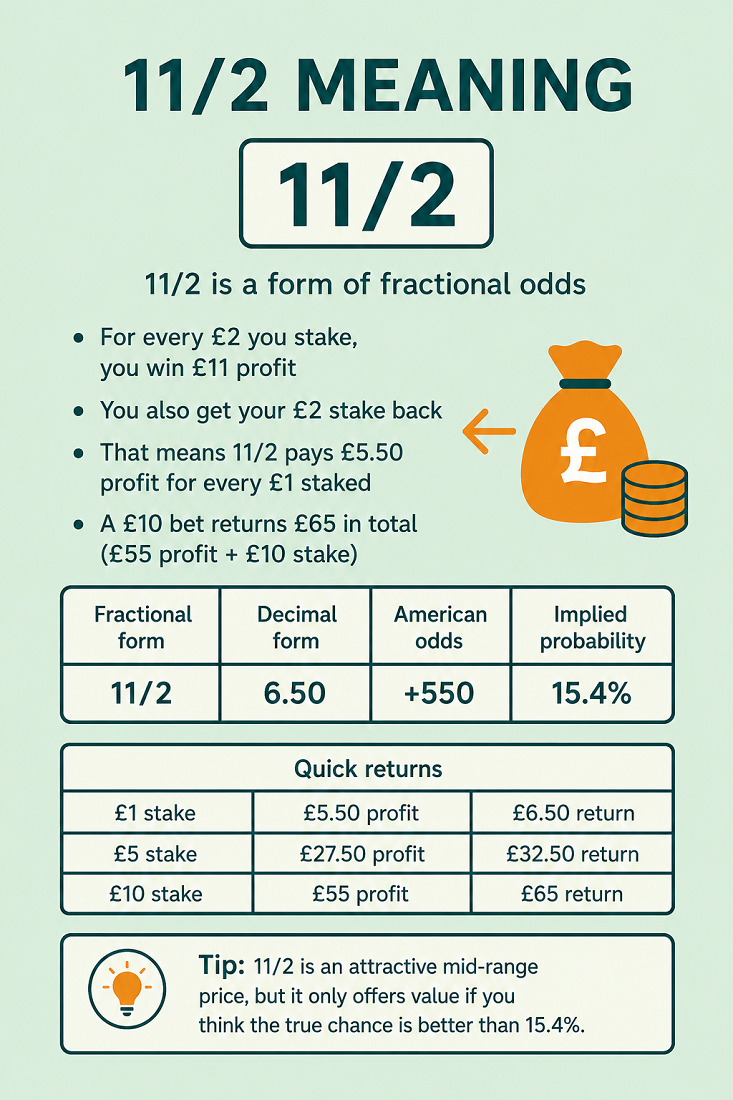
- For every £2 you stake, you make £11 profit if your bet wins.
- You also get your original £2 stake back.
- That means your total return would be £13 from a winning £2 bet.
So, if you see a horse, football team, tennis player or golfer priced at 11/2, the bookmaker is offering you £11 profit for every £2 you risk.
It’s important to remember that fractional odds show profit, not total return. The first number tells you the profit you can make, while the second number tells you the stake needed to win that profit.
So with 11/2:
- 11 = the profit
- 2 = the stake
- 13 = the total return, including your stake back
Another way to think of it is this: 11/2 odds pay £5.50 profit for every £1 staked.
How Much Do You Win at 11/2 Odds?
The easiest way to calculate your profit at 11/2 is to multiply your stake by 5.5.
That is because:
11 ÷ 2 = 5.5
So, a £10 bet at 11/2 would make:
£10 × 5.5 = £55 profit
You would also receive your original £10 stake back, giving you a total return of £65.
Here are some common stake examples:
| Stake | Profit at 11/2 | Total Return |
|---|---|---|
| £1 | £5.50 | £6.50 |
| £2 | £11.00 | £13.00 |
| £5 | £27.50 | £32.50 |
| £10 | £55.00 | £65.00 |
| £20 | £110.00 | £130.00 |
| £50 | £275.00 | £325.00 |
So if you place £20 at odds of 11/2, you would win £110 profit and receive £130 back in total.
That makes 11/2 an attractive price for many punters because the returns are meaningful without being in the extreme long-shot category.
Odds 11/2 as Decimal and American Odds
Not all betting sites display odds in the same way. In the UK, fractional odds are still very common, particularly in horse racing. But many online bookmakers also allow you to switch to decimal odds.
To convert 11/2 to decimal odds, you divide 11 by 2, then add 1 for your returned stake:
11 ÷ 2 = 5.5
5.5 + 1 = 6.50
So:
- 11/2 in fractional odds = 6.50 in decimal odds
- 11/2 in American odds = +550
These all mean the same thing.
If you bet £1 at decimal odds of 6.50, your total return is £6.50, made up of £5.50 profit plus your £1 stake.
In American odds, +550 means you would win £550 profit from a £100 stake. Scaled down, that is the same as £55 profit from a £10 stake.
Examples of 11/2 Odds in Different Sports

Odds of 11/2 can appear across lots of betting markets. They usually represent a selection with a realistic chance, but one that is certainly not expected to win most of the time.
Here are some examples.
Horse Racing
Horse racing is one of the most common places to see odds 11/2.
A horse priced at 11/2 may be a solid contender, but probably not the favourite. It might have shown promise in recent runs, be suited by the ground, or have a good trainer/jockey combination — but there may also be a few doubts.
For example:
You back a horse called Silver Approach at 11/2 in a 3:20 race at Newbury.
- Stake: £10
- Profit: £55
- Total return: £65
At this price, you are not backing a complete outsider. But you are taking on more risk than you would with a favourite at, say, 2/1 or 5/2.
That’s why form study matters. At 11/2, the question is not simply “can this horse win?” but “is this horse more likely to win than the price suggests?”
Football
In football, 11/2 odds can appear in several markets, including:
- Correct score betting
- First goalscorer markets
- Anytime goalscorer bets for less obvious players
- Away wins for underdogs
- Half-time/full-time markets
- Cup and tournament outrights
For example, a team away from home against a stronger opponent might be priced at 11/2 to win.
A £10 bet would return £65 if they pulled off the result.
You might also see 11/2 for a correct score, such as a 2-1 home win, depending on the teams involved.
Football prices like this can be tempting, but they require discipline. Many 11/2 football bets look plausible, but only a small percentage will land.
Tennis
In tennis, odds of 11/2 are often attached to underdogs facing much stronger or higher-ranked players.
For example, a young player might be 11/2 to beat a top seed at Wimbledon or the French Open.
A £10 bet at 11/2 would make £55 profit if the upset happens.
These prices can sometimes be interesting if there are factors the market may have underestimated, such as:
- Surface preference
- Injury concerns
- Fatigue from a previous long match
- A favourable head-to-head record
- A rising player improving quickly
However, there is usually a reason a tennis player is 11/2. You need a strong argument for why their real chances are better than the odds imply.
Golf and Outright Betting
Golf, snooker, darts and other outright markets often feature prices around 11/2.
For example, a golfer might be 11/2 to win a tournament going into the final round, especially if they are close to the lead but not in front.
In outright markets, 11/2 can represent a strong contender, but the bet may still involve plenty of uncertainty. In golf, even elite players can play brilliantly and still not win due to the number of competitors involved.
That said, 11/2 can be a powerful price when you genuinely believe the market has underestimated a player’s chance.
Are 11/2 Odds Good Value?
This is the key question.
Odds are only “good” if they offer value. A price can look appealing because of the potential return, but that does not automatically make it a smart bet.
At odds of 11/2, the implied probability is around 15.4%.
That means the bookmaker’s price suggests the selection has roughly a 15 in 100 chance of winning.
So, when looking at an 11/2 bet, ask yourself:
Do I believe this selection wins more often than 15.4% of the time?
If yes, it could be a value bet.
For example, if you believe a horse has a 20% chance of winning, but the bookmaker is offering 11/2, then the price may be bigger than it should be.
But if you think the real chance is closer to 10%, then 11/2 is not generous enough, even though the potential return looks attractive.
This is the heart of value betting: you are not simply trying to pick winners. You are trying to back selections at odds that are bigger than their true chance deserves.
What Do 11/2 Odds Say About Probability?
Betting odds are not just about payouts. They also give you an implied probability.
To calculate the implied probability of fractional odds, use this formula:
Denominator ÷ (Numerator + Denominator)
For 11/2, that means:
2 ÷ (11 + 2) = 2 ÷ 13 = 0.1538