
What Are the Odds for Winning the Lottery? The Shocking Truth Behind Your Chances

Imagine this: you’re holding a freshly printed lottery ticket, heart pounding as the numbers are drawn. One by one, you start matching them — could this be your life-changing moment?

The dream of waking up a millionaire is something that’s crossed almost everyone’s mind at some point. But here’s the question that few dare to ask: what are the odds of actually winning the lottery?

Spoiler alert — they’re not great. In fact, you’re statistically more likely to be struck by lightning, attacked by a shark, or become a movie star than to hit that elusive jackpot.

Still, millions of us play every week, fuelled by hope, excitement, and that tiny whisper of possibility.

In this guide, we’ll pull back the curtain on the numbers behind the dream — from the UK National Lottery and EuroMillions to the Postcode Lottery and even international draws like the US Powerball and Irish Lotto.

By the end, you’ll know exactly how slim your chances are… and why we can’t stop playing anyway.

The UK National Lottery: Lotto, Thunderball, Set for Life

Lotto (the flagship National Lottery game)

The classic UK Lotto (sometimes simply called “Lotto”) is the game most people think of when they think of the National Lottery. In the current format:

  • You must pick 6 numbers from a pool (currently 59) (or whatever the game rules are).
  • The odds of matching all six (i.e. winning the jackpot) are 1 in 45,057,474.
  • For the “5 numbers + bonus ball” tier, the odds are about 1 in 7,509,579.
  • Matching 5 (but not the bonus) is about 1 in 144,415
  • Matching 4 is roughly 1 in 2,180.
  • Matching 3 is about 1 in 97 (often a small prize). 
  • Matching 2 is about 1 in 10.3 (often a small “free ticket” or nominal prize). 

If you include any prize (i.e. from matching just 2 up to the jackpot), your overall chance is about 1 in 9.3 per ticket. 

So: winning something is not too bad (about 1 in 9), but winning the jackpot is extremely unlikely (around 1 in 45 million).

The “any prize” odds reflect that many people will at least get a small win, but of course those small wins are rarely life-changing.

Thunderball

Another National Lottery game is Thunderball, which tends to have better odds for the top prize (though the top prize is smaller than Lotto’s). Key figures:

  • Jackpot (match 5 + the Thunderball): 1 in 8,060,598.
  • For lower tier prizes, your odds are better (e.g. matching the Thunderball only gives you a small amount). One source reports a 1 in 29 chance of winning a small prize (by matching the Thunderball).

So compared to Lotto’s 1 in 45 million, Thunderball’s jackpot odds are much more favourable (though still very low) — about 5 to 6 times better, but the prize is correspondingly smaller.

Set for Life

Set for Life is a lottery in which the top prize is paid over time (for example, a fixed monthly payment over many years). Some important odds:

  • Jackpot (matching all required numbers): approx 1 in 15,347,470
  • Overall odds of winning any prize: about 1 in 12.4.

So again, better than Lotto jackpot odds, but the top prize is structured differently and smaller in expectation.

EuroMillions (UK and Pan-Europe)

EuroMillions is a transnational lottery played in several European countries, including the UK. Because it spans multiple countries and has more numbers, the odds are steeper.

  • Jackpot (5 numbers + 2 “Lucky Stars”): 1 in 139,838,160.
  • Overall odds of winning any prize: 1 in 13.

EuroMillions also has multiple prize tiers. For example:

Match Odds
5 + 1 ~1 in 6,991,908 EuroMillions+1
5 only ~1 in 3,107,515 EuroMillions+1
4 + 2 ~1 in 621,503 EuroMillions
etc.

Because the jackpot pool is huge (across many countries), EuroMillions draws more attention — but the trade-off is that your chance of winning the top prize is vanishingly small.

On top of that, in the UK there is often a supplementary “Millionaire Maker” raffle (or code-based draw) tied to EuroMillions tickets.

The odds of winning that will depend on the number of tickets sold, but one reference reports a chance of around 1 in 3,570,000 for the Millionaire Maker game on a Tuesday. 

People’s Postcode Lottery (UK)

The People’s Postcode Lottery works differently. It’s technically more a series of raffles than a traditional lottery. Your ticket is tied to your postcode, and part of your subscription fee goes to charities.

Some key odds:

  • On average, the chance of winning any prize is better than 1 in 5.
  • The odds of winning one of the bigger prizes (e.g. Postcode Millions, large “street prizes”) is better than 1 in 250,000
  • The odds of winning a £1,000 prize are better than 1 in 2,000.
  • In 2024, 87% of players won some prize (which includes small prizes). 

So compared to national lotteries, the Postcode Lottery offers relatively high odds of winning something — but the big prizes are much more modest, and prizes are shared among people in the same postcode sometimes.

Comparison with Other National Lotteries

To get a broader perspective, let’s glance at some other national lotteries and compare.

Ireland (Irish Lotto)

Ireland’s national lotto tends to have more favourable jackpot odds than EuroMillions but still fairly steep. One source states that the Irish Lotto jackpot odds are 1 in 10,737,573 (for their local game).

That’s much more favourable (i.e. better) than EuroMillions’ 1 in 139 million, though of course the jackpots are smaller.

United States (Powerball, Mega Millions, etc.)

US lotteries are huge in scale, with enormous jackpots, so the odds tend to be extremely low:

  • Powerball (in many jurisdictions) has jackpot odds in the realm of 1 in 292 million (depending on the version).
  • Mega Millions has odds of roughly 1 in 302 million (again, depending on the rules and drawing).

Those huge numbers reflect the huge pools and many, many possible combinations.

Because the US lotteries vary by state and by the exact rules, you’ll see some differences. But the point is: big jackpots, huge odds.

Putting Lottery Odds into Context

Numbers like “1 in 45 million” and “1 in 139 million” are so big they’re hard to grasp. To make that more intuitive, it helps to compare with other rare events. Here are a few comparisons (numbers approximate and illustrative):

  • The odds of being struck by lightning in your lifetime are often quoted in the range of 1 in 10,000 to 1 in 100,000 (depending on location, behaviour, and time span).
  • Some sources list rarer events like the chance of a fatal shark attack, being attacked by a severe tornado, or winning high-stakes gambling events as more likely than winning a lottery jackpot.
  • A popular (though general) list of things more likely than winning the lottery includes: being hit by an asteroid, becoming a movie star, finding true love, etc. Save the Student
  • To take one example: in the UK, the long-term odds of being struck by lightning are often given as something like 1 in 500,000 (though that depends on many factors) — much more likely than winning a large lottery jackpot.

So while lottery jackpots are tantalising, they are extremely improbable.

Why Are Lottery Odds So Low?

A few reasons:

  1. Combinatorics: The more numbers you must match (from a larger pool), the more possible combinations there are. For example, matching 6 numbers out of 59 results in tens of millions of possible combinations.
  2. Pooling across many entries: Big lotteries like EuroMillions pool players across many countries, so one ticket is competing in a massive set.
  3. Prize structure: To fund large jackpots, lotteries must maintain very low odds of winning, so that the vast majority of tickets are losing or small winners.
  4. Rollover and rollover: When no ticket wins the jackpot in one draw, it rolls over (i.e. the prize is carried forward), making jackpots larger — which draws in more tickets — but doesn’t change the per-ticket odds.

It’s also worth emphasising: buying more tickets slightly increases your chance (e.g. buying 2 tickets gives you 2 chances), but it doesn’t alter the structure or the improbability greatly — and your return on investment is still overwhelmingly negative in expectation.

So, What Are the Odds for Winning the Lottery?

To summarise some of the key numbers:

  • UK Lotto jackpot: ~ 1 in 45,057,474
  • UK Lotto any prize: ~ 1 in 9.3
  • Thunderball jackpot: ~ 1 in 8,060,598
  • Set for Life jackpot: ~ 1 in 15,347,470
  • EuroMillions jackpot: ~ 1 in 139,838,160
  • EuroMillions any prize: ~ 1 in 13
  • People’s Postcode Lottery (any prize): better than ~ 1 in 5
  • People’s Postcode Lottery (big prize): better than ~ 1 in 250,000
  • Irish Lotto jackpot (local game): ~ 1 in 10,737,573 (as per one source)
  • US lotteries: often in the realm of 1 in many hundreds of millions (for jackpots)

When someone asks “what are the odds for winning the lottery?”, it depends very much on which lottery, which prize tier, and which country. But even for the “best” jackpots among major national lotteries, the odds remain astronomically low.

Final Thoughts: Play Responsibly, Dream Wisely

Lotteries are designed to offer hope, excitement, and the possibility (however slim) of a life-changing win. But the math is clear: the odds are against you, especially for the top prizes. Most players will never win a jackpot.

If you enjoy playing the lottery, it can be a harmless entertainment, provided you treat it as what it is: a low-probability gamble.

Don’t spend what you can’t afford. Keep expectations realistic. And remember: you’re far more likely to meet other rare events (being struck by lightning, etc.) than winning a multi-million jackpot.

That said, understanding “what are the odds for winning the lottery” helps ground the dreaming in reality. And that balance — dreaming plus realism — is a healthier approach to participating in lotteries.

 

Odds 7/4 Meaning: What Do These Betting Odds Really Tell You?

If you’ve ever glanced at a betting slip, a horse racing programme or odds board and seen 7/4, you may have paused and thought: What on earth does that mean?

You’re not alone. But once you break it down, it’s far less mysterious than it first seems.

Let’s walk through what odds 7/4 mean — how to interpret them, what they imply in terms of probability, and how to use them in real betting decisions.

What Does 7/4 Odds Mean?

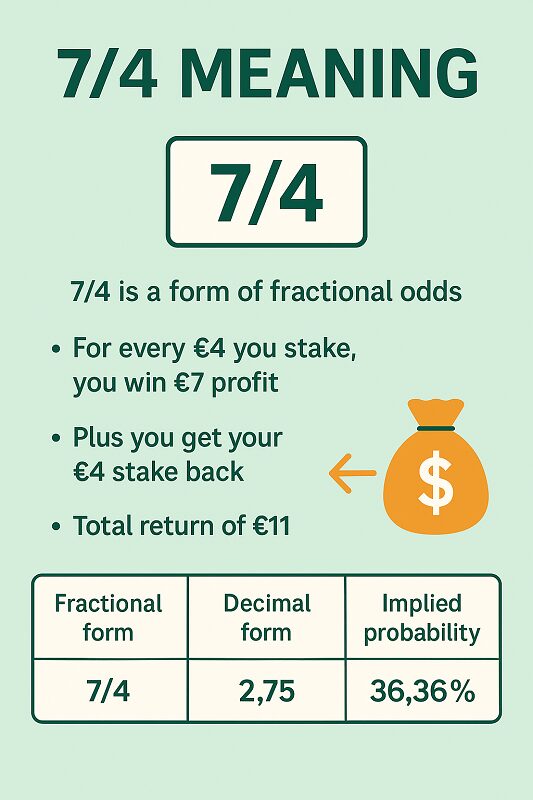
In simple terms, 7/4 is a form of fractional odds, which are most commonly used in the UK and Ireland. These odds are read as “seven to four.”

Here’s how to interpret them:

  • For every £4 you stake, you’ll make £7 profit if your bet wins.
  • You’ll also get your original £4 stake back, making your total return £11.
  • It’s a ratio of profit to stake, not the total return. So in fractional odds, the number on the left (7) represents the profit, while the number on the right (4) is the stake needed to win that amount.

So if you stake £4 at 7/4, you’ll end up with £11 in total (£7 profit + £4 stake) if the bet is successful.

💰 How Much Do You Win at 7/4 Odds?

Let’s look at some quick examples to see what kind of returns you can expect:

Stake Profit (at 7/4) Total Return
£1 £1.75 £2.75
£2 £3.50 £5.50
£5 £8.75 £13.75
£10 £17.50 £27.50
£20 £35.00 £55.00

So if you bet £10 at 7/4 odds, you’ll make £17.50 profit and get your tenner back too, making a total return of £27.50.

Converting 7/4 to Decimal or American Odds

If you prefer other formats, you might want to see 7/4 odds in decimal or American style. Here’s how it works:

  • Decimal odds:
  • American odds: Since the odds are above even money, they’re positive: +175

So:

  • 7/4 = 2.75 in decimal
  • 7/4 = +175 in American odds

All three formats express the same thing: a potential £1.75 profit for every £1 staked.

🏟️ Examples of 7/4 Odds in Different Sports

To make this clearer, let’s explore how 7/4 shows up in real-world betting markets.

🐎 Horse Racing

Horse racing is where fractional odds like 7/4 are most common. A horse priced at 7/4 is usually seen as a strong contender — perhaps not the outright favourite, but among the leading chances.

Example:
You back “Silver Arrow” at 7/4 in the 2:15 at Ascot.

  • Stake: £10
  • Profit: £17.50
  • Total return: £27.50

This price often reflects a horse with solid form, but maybe a small question mark, such as the going or the quality of the opposition.

⚽ Football

In football betting, 7/4 odds are often found in markets like the match winner, correct score, or goalscorer markets.

Example:
You bet on Brighton to beat Arsenal away from home at 7/4.

  • Stake: £20
  • Profit: £35
  • Total return: £55

These odds suggest Brighton have a decent shot but are still underdogs compared to the opposition.

🎾 Tennis

In tennis, 7/4 is a common price for a lower-ranked player facing a seeded opponent, especially in the early rounds of tournaments.

Example:
You fancy an up-and-coming player to beat a top-10 seed and they’re offered at 7/4.

  • Stake: £15
  • Profit: £26.25
  • Total return: £41.25

This price can be great if you’ve spotted factors like surface advantage, fitness, or recent form.

🥊 Boxing & UFC

Combat sports often throw up 7/4 odds for fighters who are competitive but not the bookies’ pick to win.

Example:
A challenger faces a defending champion and is priced at 7/4.

  • Stake: £25
  • Profit: £43.75
  • Total return: £68.75

This reflects an underdog with a realistic chance, especially if they’re known for knockout power.

🏆 Outright & Tournament Markets

You’ll also see 7/4 odds in outright markets when there’s a clear favourite but another team or player is still strongly fancied.

Examples:

  • England to win a Six Nations match at home – 7/4
  • A golfer priced at 7/4 to win their group in a major tournament

These are often selections that the bookmakers see as second-favourites or evenly matched competitors.

Summary of 7/4 Examples

Odds of 7/4 appear across a wide range of sports. Whether you’re betting on a horse in a big race, a football team in a tricky fixture, or a tennis player looking to cause an upset, 7/4 is a price that reflects an approximate 36% chance of winning.

🤔 Are 7/4 Odds Good Value?

That depends on whether you think the selection’s real chances are better than the bookmaker’s implied probability.

  • Implied probability of 7/4 = 36.36%
  • If your research suggests a true chance of 40% or more, you may be onto a profitable bet.

This is where value betting comes in — spotting when the odds underestimate the true likelihood of an outcome.

🧙 Strategies for Betting on 7/4 Shots

Odds of 7/4 strike a nice balance between risk and reward — not as short as odds-on favourites, but not as speculative as big outsiders.

To maximise your returns, consider these strategies:

🎯 1. Look for Value, Not Just the Price

Ask yourself: Does the selection’s chance of winning exceed 36.36%?
If you think so, 7/4 could be good value.

📊 2. Do Your Homework

Research is everything:

  • Horse Racing: Check form, trainer/jockey stats, and conditions.
  • Football: Analyse injuries, xG stats, home/away form.
  • Tennis: Look at surface records, fatigue, and head-to-heads.

💷 3. Use a Staking Plan

Since 7/4 shots won’t land every time, bankroll management is vital:

  • Level stakes: Same amount each bet.
  • Percentage staking: Risk a fixed % of your bankroll.
  • Kelly Criterion: For more advanced staking.

🧾 4. Track Your Results

Log your bets to see patterns — which sports or markets you do best in at 7/4.

📈 5. Shop Around for Best Odds

One bookmaker might have 7/4, another 15/8. Over time, those differences add up. Use odds comparison sites or betting exchanges.

⏳ 6. Be Selective

Don’t back every 7/4 you see. Focus on situations where your analysis gives you an edge.

🧠 Strategy Summary

Tip Key Takeaway
🎯 Look for value Only back 7/4 shots if you think their chance is >36.36%
📊 Do your research Use stats and context, not gut feeling
💷 Use a staking plan Protect your bankroll
🧾 Track results Learn what works for you
📈 Shop for odds Always get the best available price
⏳ Be selective Patience pays off

By applying these strategies, you can make the most of 7/4 bets and avoid common traps casual punters fall into.

Common Questions & Misconceptions

Q: Does 7/4 mean 7 wins for every 4 losses (or vice versa)?

A: No — that’s a misunderstanding. 7/4 is a ratio of profit to stake, not head-to-head wins vs losses. The implied probability is 36.36%, not 7 wins to 4 losses in a direct head-to-head sense.

However, you might see phrasing (e.g. marketing) that suggests “out of 11 outcomes, your bet would win 4 times,” which is a rephrasing of implied probability.

Q: Can odds change after you place your bet?

A: Generally no — once your bet is confirmed, the odds are locked in for your bet – unless you have best odds guaranteed in horse racing for example.

But before betting, the odds you see may shift if the bookmaker adjusts markets in response to incoming bets or new information.

Q: Why do different bookies give different odds near 7/4 (e.g. 13/8 or 15/8)?

A: Bookmakers will adjust the price slightly to balance their liabilities and manage risk. Also, they try to build in margin (overround), so slightly different odds reflect different risk appetite and market response.

Q: Is 7/4 “strictly better” than 2/1?

A: Not exactly — 2/1 offers higher payout (you’d win £2 for every £1 stake) but with lower implied probability (33.33%). 7/4 is less generous in payout but suggests a higher perceived likelihood. Which is “better” depends on which side has true value.

🔚 Conclusion: Making Sense of 7/4 Odds

At first glance, 7/4 odds might look confusing, but once you break them down, they’re easy to understand.

They simply mean that for every £4 you stake, you’ll win £7 in profit — plus your stake back — giving a total return of £11. In decimal terms, that’s 2.75, with an implied probability of 36.36%.

These odds crop up across a wide variety of sports — from horse racing to football, tennis, boxing, and outright tournament markets — and they often reflect a selection that’s seen as a strong contender but not the outright favourite.

The real key to betting at 7/4, though, is value. If you believe the chance of success is greater than the bookmaker’s implied 36.36%, then 7/4 could represent a smart, profitable bet.

Combine that with solid research, disciplined bankroll management, and shopping around for the best prices, and you’ll give yourself the best chance of long-term success.

So next time you spot 7/4 on the board, you’ll know exactly what it means — and more importantly, whether it’s worth backing.


The 2nd Favourite Horse Racing System: A Proven Approach for Picking Winners

Horse racing systems have been around for as long as people have been placing bets on the sport.

Punters love a theory that gives them a potential edge, whether it’s following trends, trainer stats, or race conditions.

Among the simplest — and surprisingly popular — is the 2nd favourite horse racing system.

But here’s the thing: not all second favourite systems are created equal. Some are too broad to work, while others, when applied with discipline and filters, can uncover genuine value.

In this article, we’ll break down how often second favourites win, what their returns looks like, and how smart filters can transform a simple system into a more effective betting strategy for backing second favourites.

What Is the 2nd Favourite Horse Racing System?

The concept is straightforward: instead of blindly backing the favourite in every race, you focus on the second favourite in the betting market.

This is the horse with the second-shortest odds, judged by bookmakers and punters to be the next most likely winner.

Why does this make sense? Because favourites are often “over-backed.” Bookmakers know the average bettor loves siding with the top pick, so odds are squeezed down.

That leaves the second favourite in a sweet spot — still fancied to win, but often at a price that offers better long-term value.

The logic for the second favourite horse racing system is simple:

  • The favourite is often “over-backed” by casual punters.
  • The second favourite, meanwhile, may offer better value because its odds are longer than the favourite’s but it still has a strong chance of winning.
  • By targeting the second favourite systematically, you might be able to find a sweet spot between probability and price.

This idea has been around for decades and still appeals to bettors today because of its simplicity.

Why Focus on the Second Favourite?

To understand why the 2nd favourite horse racing system has such appeal, it’s worth looking at the dynamics of betting markets.

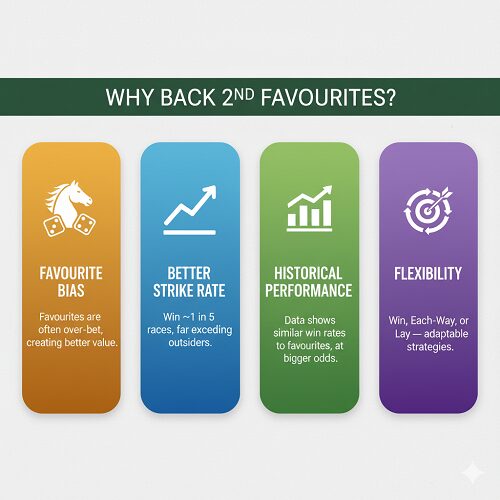
  1. The favourite bias – Bookmakers know that the average punter loves to back favourites. This often means that favourites’ odds are shorter than they should be, reducing long-term profitability.
  2. Better strike rate than outsiders – While backing long shots can bring huge wins, their strike rate is low. The second favourite sits in a sweet spot: not as risky as a 20/1 shot, but not as over-bet as the odds-on favourite.
  3. Historical performance – Studies of past races suggest that second favourites win more often than most punters realise. In fact, in many race types, they perform nearly as well as favourites but at more attractive odds.
  4. Flexibility – You can approach second favourites in different ways: backing them to win, each-way betting, or even laying them if you think the favourite is too strong.

How Often Do Second Favourites Win?

The first step in evaluating any system is to understand the baseline figures. How do second favourites perform in the long run?

  • Strike rate: Second favourites win around 19–22% of races in the UK. That’s roughly one in five.
  • Comparison: Favourites win closer to 30–35% of races, while long shots land far less often.
  • Combined power: Between them, favourites and second favourites account for about half of all winners.

So second favourites clearly do win their fair share — but what about the bottom line?

The Returns for Backing Second Favourites Blindly

This is where reality bites. The return on investment (ROI) of backing all second favourites blindly is not so good. 

  • At Starting Price (SP): Backing every second favourite produces a negative ROI of 10-12%. This means for every £100 you bet, you would lose around £10-£12, on average, from backing all second favourites. The bookmaker’s margin (the “overround”) makes it impossible to make a profit from backing all second favourites blindly.
  • At Betfair SP (BSP): The hit is smaller, but still not enough to be profitable without filters.

In short: the 2nd favourite horse racing system doesn’t work if you simply back every single one. But with the right tweaks, it becomes much more interesting.

A Tested Strategy: Backing Second Favourites in Handicaps

Whilst there is a certain attraction to backing second favourites, we don’t want to just be backing them blindly. This will lead to losses over time, as the stats above show. 

What we want to do is find a method that identifies value second favourites, where their true chances of winning a race are higher than the odds suggest. 

Below we will detail a strategy that could be used for backing second favourites, concentrating on certain conditions that can put the odds in our favour.

This second favourites horse racing system focuses on handicap races with medium-sized fields. Here’s how it works.

The Rules

  1. Race type: Stick to handicaps. These races are designed to even out ability by assigning weights, making favourites less dominant.
  2. Field size: Look for 8–14 runners. Too few horses and the favourite is usually strong; too many and results get chaotic.
  3. Favourite’s odds: Avoid races where the favourite is odds-on. When the market is that confident, the second favourite is usually second-best for a reason.
  4. Second favourite’s odds: Aim for the 2.75–5.50 (11/8 to 9/2) range. This “sweet spot” avoids very short-priced seconds (little value) and long shots (low strike rate).
  5. Market moves: Avoid second favourites that have been heavily backed (big “steamers”). Data shows these often underperform at the off.
  6. Execution: Place bets at Betfair SP or with a bookmaker offering Best Odds Guaranteed (BOG) to capture late drifts.

Why These Rules Improve the System

Each rule trims away conditions where the market is at its most efficient:

  • Handicaps & 8–14 runners: More competitive, less market certainty.
  • Avoiding odds-on favs: Stops you from opposing horses that genuinely dominate.
  • Price band discipline: Keeps you in the zone where the favourite–longshot bias is smaller.
  • Skipping steamers: Protects you from following hype-driven plunges that historically lose money.
  • BFSP/BOG: Ensures you don’t lock in poor odds.

Example of the System in Action

Imagine three qualifying races in an afternoon:

  • Race 1: 10-runner handicap. Favourite 7/4, second favourite 3/1. You back the 3/1 shot — it wins. Profit: +£30 (to £10 stakes).
  • Race 2: 12-runner handicap. Favourite 2/1, second favourite 4/1. You back the 4/1 shot — it finishes 3rd. Loss: -£10.
  • Race 3: 9-runner handicap. Favourite 9/4, second favourite 10/3. You back it — it wins. Profit: +£33.

Staked £30, returned £73. A nice net profit of £43.

Of course, not every day will look like that. But over time, this filtered system tends to give a much stronger return profile than simply backing every second favourite.


Find out who the Best Horse Racing Tipsters are here.

Improving Returns Further: Extra Filters to Test

Even after applying the core rules of the 2nd favourite horse racing system (handicaps, 8–14 runners, avoiding odds-on favourites, and using BFSP/BOG), there’s still room to sharpen your edge.

By layering in additional filters, you can weed out poor-value selections and home in on the most promising ones.

Here are some of the most effective refinements, with examples.

Trainer/Jockey Stats

Not all trainers and jockeys perform the same when it comes to winning with second favourites. Some stables excel at landing gambles with horses that aren’t the market leader.

  • Example: A top flat trainer like William Haggas might have a strong record with second favourites in competitive handicaps, showing “wins above expected” compared to the market. On the other hand, a smaller yard might consistently underperform when their horses are second favourite, suggesting they’re overbet.
  • How to use it: Keep a simple database or spreadsheet of trainer/jockey combinations and track ROI specifically for second favourites. Over time, you’ll spot which partnerships are worth following and which to avoid.

Race Type Splits

The performance of second favourites varies depending on whether the race is flat, all-weather, or jumps.

  • Example: Second favourites in flat turf handicaps with 10+ runners may offer better value than in small-field novice hurdles, where the favourite often dominates.
  • How to use it: Analyse your own betting records by code and distance. You might find that second favourites are more profitable in sprint handicaps, or perhaps in middle-distance flat races where tactical riding plays a bigger role.

Avoid Maidens and Novices

In races where most horses are inexperienced (maidens, novices, bumpers), the market often overestimates the ability of unproven runners. Favourites can be especially strong in these conditions, making second favourites weaker value.

  • Example: In a novice hurdle with six runners, the favourite from a top yard may have been heavily schooled and is expected to win. The second favourite might be shorter than it should be, based only on potential, not proven form.
  • How to use it: Stick to handicaps where horses have already shown their level of ability, and the weights even things out.

Ground Conditions

The going (firm, good, soft, heavy) is one of the most overlooked factors in market prices. A second favourite with proven form on the day’s going may be better value than a favourite who is untested on the surface.

  • Example: On soft ground at Ascot, the favourite might be a flashy winner on good-to-firm but has never run on soft. The second favourite, meanwhile, has two wins on similar going. Here, the market may have mispriced their chances, and siding with the second favourite gives you an edge.
  • How to use it: Always check a horse’s record on the going. You can filter bets to only back second favourites with at least one prior win or placed run on the surface.

Speed Figures

Time-based ratings (speed figures) can highlight horses that have already run to a higher level than the market suggests.

  • Example: A second favourite might have recently clocked the fastest time of any runner in the field over the same distance, yet the market has priced it slightly longer than the favourite based on reputation or stable strength.
  • How to use it: Services like Timeform, Topspeed, or other racing databases provide speed figures. If a second favourite is top-rated or close to it, that’s often a sign the market may have undervalued it.

Putting It All Together

By applying these filters, you can transform the 2nd favourite horse racing system from a blunt instrument into a sharp betting tool. For example:

  • Race selection: 12-runner flat turf handicap
  • Favourite odds: 2/1 (unproven on today’s soft ground)
  • Second favourite odds: 7/2 (two wins on soft ground, strong speed figure last run)
  • Trainer/jockey: Yard with a positive ROI on second favourites in similar races

That’s a scenario where all your filters align — and where the second favourite might represent genuine value.

An Alternative System: Laying Second Favourites in Small Fields

Not every punter wants to back horses. Some prefer laying them (betting against them). A neat variation is:

  • Only in races with 5–7 runners.
  • Favourite odds ≤ 2.20.
  • Lay the second favourite.

The logic is simple: in small fields with a strong favourite, the second favourite is often overestimated by the market. By laying it, you profit when it doesn’t win — which is most of the time.

Caution: laying carries higher risk if your selection does win, so always control liability (e.g. 1% of bankroll per lay).

Bankroll Management for the 2nd Favourite System

No system works without discipline.

  • Stake size: Bet 1–2% of your bankroll per selection.
  • Keep records: Track strike rate, average odds, profit/loss.
  • Stick to the rules: Don’t chase losses by bending filters.

Over the long run, discipline matters just as much as picking the right horses.

Final Thoughts

The 2nd favourite horse racing system is a classic for a reason. On a raw basis, second favourites win about 20% of the time — but without filters, they return a negative ROI, meaning they will lose you money over time.

By focusing on handicaps with 8–14 runners, avoiding odds-on favourites, and sticking to the right odds ranges, you can turn those numbers closer to break-even — or even into profit, with additional research to pinpoint value second favourites. 

For more adventurous punters, laying second favourites in small fields is an intriguing alternative, though higher risk.

At the end of the day, the system won’t make you rich overnight, but it can give you structure, focus, and a sharper angle than simply following the crowd onto favourites. And in horse racing betting, small edges are exactly what you’re looking for.


What Is a Prop Bet in Sports? Rules, Examples, and Strategy

Breaking Down What Is a Prop Bet in Sports and Why Fans Love Them

Prop Bets Give Everyone Something to Cheer About

When people talk about what is a prop bet in sports, they’re really just talking about the fun side of betting. Instead of sweating who wins or loses, you’re putting money on the little moments, like if the coin toss in the Super Bowl comes up heads, or whether a running back breaks 100 yards. 

The reason prob bets have blown up in recent years is that they make every snap, pitch, or possession feel like its own mini-game. And with sportsbooks now offering easy tools to build prop bets, it’s no wonder fans keep asking about them.

Unlike traditional wagers that revolve around the final score, props take you deeper into the action. You might bet on whether an NBA guard hits over 3.5 threes, if an NFL wideout scores a touchdown, or even if the coin toss in the Super Bowl lands on heads. 

So if you’ve ever wondered, What is a prop in sports betting, it’s basically your chance to bet on the storylines inside the game.

Why Prop Bets Took Over the Game

So why do these side bets matter anyway? Traditional betting has always been about wins and losses, but props cracked things open for the rest of us. They keep fans hooked, even if the scoreboard doesn’t matter. 

In football, you might be sweating an NFL prop bet on whether a quarterback clears 250 yards or how many field goals a kicker nails. 

Over in the NBA, props shift to rebounds, assists, or which guy gets to double digits first. And baseball fans eat up MLB player prop bets—strikeouts, homers, and all the stat lines that make nine innings worth watching.

Props are popular because they bring excitement to moments you’d usually overlook. A meaningless fourth-quarter three-pointer suddenly is exhilarating. A ninth-inning strikeout feels like the World Series because it just cashed your ticket.

Common Types of Prop Bets

If you’re still wondering what a prop bet is in sports, it helps to see the categories they fall into:

  • Player Props: Individual performance stats, like LeBron’s total points or Patrick Mahomes’ passing touchdowns.
  • Team Props: How many total runs a baseball team scores, or whether a football team covers their first-half spread.
  • Game Props: The first team to score, if the game goes into overtime, or even exact score outcomes.
  • Exotic Props: These show up in events like the Super Bowl—everything from the length of the national anthem to halftime show antics.

The variety is what makes props so appealing. They cater to casual fans, stat geeks, and entertainment seekers all at once.

Strategy Behind Prop Betting

Of course, fun doesn’t mean reckless. Smart bettors use props strategically. First, know your sport. Someone who is dialed into player usage patterns has an edge when betting NFL prop bets or NBA prop bets

A baseball bettor tracking bullpen fatigue can gain value on MLB player prop bets, such as strikeout totals.

Second, shop around. Odds can vary significantly between sportsbooks, so it’s essential to compare.

Finally, understand the risk. Props often carry more juice (house edge), so discipline matters. It’s tempting to fire off ten different props in one night, but treating them like “lottery tickets” can eat a bankroll fast.

Prop Bet Payout

Prop bets pay out in the same way as any other wager—you win if your prediction is correct, and you lose if it’s wrong—but the odds are where things get interesting. 

For straightforward props, like betting if a quarterback throws over 2.5 touchdowns, you’ll see moneyline-style odds (say -110 or +150) that dictate how much you’ll profit relative to your stake. 

Some props, especially exotic ones like Super Bowl specials, can carry longer odds because they’re harder to hit, meaning a small bet could lead to a surprisingly large return. 

Just remember, sportsbooks build in more juice on props compared to standard bets, so while the payouts can feel rewarding, the house edge is usually higher. 

Why Bettors Keep Coming Back

The reason new bettors are wondering what is a prop bet in sports is that these wagers make every play fun and meaningful. They don’t just tie you to the scoreboard; they tie you to the drama. 

Maybe you’re sweating for one last baseball strikeout, or perhaps you’re praying for one more rebound, or maybe you’re laughing because you bet on the color of the Gatorade bath.

At the end of the day, prop bets are the perfect mix of skill, luck, and entertainment. They’re not just about gambling; they’re about being part of every little heartbeat of the game. 

And that’s why, whether you’re new to betting or a seasoned fan, understanding props might be the most fun lesson you learn in sports wagering.


Why Live Dealer Casinos Deserve Serious Attention

Online casinos once relied almost entirely on RNG engines and static user interfaces. More recently, live dealer tables emerged as eye-catching novelties – the kind of feature you show off in marketing.

Over time, though, these formats have evolved beyond showmanship: they now deliver real strategic, psychological, and business value.

While many pick slots to unwind, like chicken road demo, the live dealer format offers something different: interaction, transparency, and pressure. That shift is attracting serious players who demand more than flashing graphics and spinning reels.

Industry momentum supports that shift. The global online gambling market in 2024 hit about $95.3 billion, with projections reaching over $185 billion by 2033.

Let’s take a look at how the live dealer model now carries concrete advantages (and particular challenges), why many players prefer it, and how operators build around it.

The Solid Case for Live Dealer Superiority

Stripping away marketing hype, live dealer casinos succeed because they combine human presence, structural flexibility, and performance metrics in ways that pure RNG tables can’t match.

Visible Fairness Builds Trust

When you join a live table, you watch a real dealer shuffle, deal, spin, and interact. That visual clarity eases suspicion.

For many players, seeing a hand dealt by a real person feels more “fair” than trusting code behind the curtain.

Some top providers even incorporate multiple video angles or real-time audit overlays to reassure clients. In dispute situations, dealers or support staff can refer to the same video feed you see.

Social Cues and Psychological Pressure

Humans respond differently when another person is present. In these games:

  • You know others are watching (dealer and other players).
  • You must make decisions in real time, with the dealer waiting.
  • Chat or basic interaction adds a social dimension.

That tension makes losses sting more and wins feel more earned. Many players say live dealers “feel more real,” especially when stakes are meaningful.

Faster Iteration, Better Rulesets

Live studios can roll out variant tables, side bets, or customized promotions more rapidly than traditional casinos retool physical floors. They can cater regionally, test new mixes, and adapt to trends.

Some live versions even provide more player-friendly rules. For example, many live blackjack tables stick with 3:2 payouts rather than the worse 6:5, which is common in some RNG or brick floors.

Scalable Access, Lower Per-Seat Cost

Although studios carry setup and operational costs (cameras, staff, bandwidth), they avoid large land, security, and physical infrastructure expenses. Streaming allows many users to join the same table remotely, lowering per-seat cost.

Because of that, operators can offer lower minimums, making dealer play accessible to casual and serious bettors.

Real Constraints and How Operators Work Around Them

Live dealer is not flawless. Its challenges are real, and success requires overcoming them.

  • A poor connection kills experience instantly. Studios often deploy redundant links, adaptive streaming, and buffer strategies to reduce lag.
  • Dealers need breaks, training, rotation. Studio management must schedule around time zones.
  • Collusion, card marking, or tampering risk exists. High-end studios use surveillance, multi-angle cameras, strict dealer rotation, and random audits.
  • Running a live studio often needs compliance per jurisdiction (video, data, anti-tampering).
  • High initial expense in equipment, space, and setup limits entry for smaller operators.

Yet, many of these issues scale down with maturity. Large providers amortize cost across many operators and geographies, pushing technology and process improvements.

Where Live Dealer Truly Outpaces RNG

Here’s a table comparing key dimensions where live dealer formats tend to outperform traditional RNG tables.

Metric Live Dealer RNG Table
Perceived transparency High (visible dealing) Moderate (relies on audits and RNG certification)
Behavioral pressure Stronger (live waiting) Minimal (instant results)
Ability to customize rules and promos Flexible Often fixed or limited
Barrier to entry (for providers) High setup cost Low
Technical fragility Sensitive (video, latency) More robust
Social interaction Real-time Minimal or simulated

That comparison highlights where live dealer really brings value, not just spectacle.

What Kinds of Players Prefer Live Dealer Games

Not every gambler shifts to live dealer. But certain segments gravitate toward it:

  • Mid-to-high stakes players who value perceived fairness.
  • Skill-oriented players in games like blackjack, baccarat, or poker variants.
  • Social gamblers who enjoy minimal interaction, livestream chat, and pace.
  • Skeptical or regulated-market players who demand visible dealing over opaque RNGs.

Many new players begin with slots for ease. Over time, as they grow confident and seek more credibility, live dealer becomes a natural upgrade.

What to Watch as Live Dealer Evolves

The live dealer format is no longer standing still. One clear direction is the shift toward hybrid game shows that merge entertainment and gambling. Evolution Gaming, the largest live dealer provider, has set the pace here, creating games that stream to tens of thousands of participants simultaneously rather than a handful of players at a single blackjack table.

Technology is pushing another transformation. Companies like GR8 Tech have highlighted the need for regional edge servers, ensuring players in Europe, Asia, and North America receive smooth feeds with minimal lag. This is a technical improvement and a safeguard against one of the few real weaknesses of live dealer play: when a feed freezes, trust erodes quickly.

Regulation and compliance also shape the sector’s future. Instead of scattering small studios in multiple jurisdictions, many operators are building centralized hubs in regulated markets such as Malta, Gibraltar, and certain Canadian provinces. These hubs allow providers to meet local licensing demands while distributing content across borders.

These changes suggest that live dealer casinos are moving into a more mature stage. Hybrid formats bring spectacle, mobile infrastructure solves technical barriers, and regulatory hubs provide stability.


From Naira to Winnings: the Local Logic Behind 1win

The online betting landscape in Nigeria is evolving rapidly, and platforms that truly understand local needs are gaining popularity.

One such standout is 1win.ng — a modern, user-oriented betting site that has made clear efforts to cater specifically to Nigerian players.

From the very first interaction, the platform demonstrates its commitment to providing a seamless experience that reflects both international quality and regional familiarity.

The Official site of 1win Nigeria is not just a mirror of its global counterpart; it’s a localized solution crafted with Nigerian users in mind.

This is evident in the way the platform integrates the Nigerian naira (NGN) as the base currency, eliminating the confusion of exchange rates and foreign fees. Whether you’re depositing or withdrawing, everything is calculated in naira, ensuring transparency and ease of use.

Beyond currency integration, 1win.ng supports a variety of payment options popular among Nigerian users.

These include traditional bank cards, modern cryptocurrency options, and MyBux — a convenient local e-wallet that many bettors trust.

Minimum deposit and withdrawal thresholds are also tailored to suit the local economy, starting as low as ₦370 for deposits and ₦2,500 for withdrawals.

With its localized interface, region-friendly financial tools, and respect for user preferences, 1win.ng positions itself not just as another betting site, but as a platform built for Nigerians.

This thoughtful approach is part of what makes it a growing favorite in the country’s digital gaming and betting space.

Understanding bonus terms: how 1win is perfectly aligned with Nigerian players’ needs

Choosing the right bonus offer can make a significant difference in a player’s experience, especially when every detail — from deposit limits to wagering requirements — is aligned with local preferences.

On 1win.ng, these aspects are thoughtfully adapted to suit the Nigerian market. Whether you’re a new user exploring your first promo or a regular looking for ongoing rewards, the platform ensures bonuses feel relevant, accessible, and beneficial.

A key part of this bonus appeal is how deeply the site has been tailored for Nigerian users. From the moment you land on 1win.ng, you’re met with an interface designed to be intuitive for local audiences.

Beyond language and design, the functionality itself — including how bonuses are displayed, calculated, and redeemed — takes into account regional norms and expectations, offering a seamless journey for bettors in Nigeria.

Key local adaptations of 1win

  • Localized currency (NGN): all transactions, including bonuses, are processed in Nigerian naira, removing any confusion caused by foreign exchange rates.
  • Intuitive user interface: the platform’s layout is simplified for mobile and desktop users, with localized icons, terms, and onboarding instructions suitable for Nigerian audiences.
  • Regional customer support: dedicated support channels — including WhatsApp and email — are optimized for quick responses to Nigerian users in appropriate time zones and dialects.
  • Personalized bonus structures: many offers on the site reflect local deposit habits, with promotions tailored to match smaller stakes that align with the financial norms of the Nigerian economy.
  • Culturally aware messaging: all communications, including bonus notifications and terms, are worded in a way that feels familiar and straightforward to Nigerian users.
  • Platform speed and access: the website is optimized for Nigeria’s average mobile internet speed, ensuring that loading times are minimal even with limited bandwidth.
  • Secure local payment gateways: 1win.ng supports local banking networks and methods such as MyBux, making deposits and withdrawals both fast and trustworthy.

These thoughtful adaptations contribute to a betting experience that feels authentic and user-friendly, not forced or generic.

For Nigerian users, this attention to detail reinforces a sense of belonging and trust on the platform — especially when exploring and unlocking bonuses tailored specifically for them.

In the world of online betting, relevance is everything. By embedding Nigerian-specific features into its design and bonus strategy, 1win.ng not only speaks the language of its users — it understands their habits, limitations, and goals.

Payment made easy: exploring 1win transaction methods and localized financial terms

For Nigerian users, the ease of moving money in and out of a betting platform can be just as important as the games or odds themselves. 1win.ng clearly understands this reality and has built a payment infrastructure that prioritizes flexibility, speed, and accessibility.

By integrating both traditional and modern financial tools, the platform caters to a broad spectrum of users — from casual bettors to crypto-savvy players.

What makes 1win.ng stand out is its attention to localized details, such as minimum deposit and withdrawal limits that match regional income levels.

No excessive thresholds or hidden fees — just straightforward rules that users can count on.

Whether you prefer the reliability of a bank card or the privacy of cryptocurrency, the platform makes sure your transaction is quick and secure.

Payment method Deposit available Withdrawal available Minimum deposit Minimum withdrawal Processing time
Bank Cards (Visa/Mastercard) Yes Yes ₦370 ₦2,500 Instant – 24 hours
Cryptocurrency (BTC, ETH, USDT, etc.) Yes Yes ₦370 (equivalent) ₦2,500 (equivalent) 15 min – 1 hour
MyBux (Local E-Wallet) Yes Yes ₦370 ₦2,500 Instant

This diverse selection of payment options ensures that users across Nigeria — whether in urban centers or remote areas — can find a method that suits them best.

MyBux, for example, offers a convenient local alternative with instant processing and no additional setup, while crypto allows for decentralized, borderless transactions.

Moreover, 1win.ng ensures that all deposit and withdrawal processes are transparent. Users are always informed of any processing timeframes or system checks, creating a smooth financial experience free from frustration or unexpected delays.

With such clear structures and local relevance, the platform proves it’s more than just user-friendly — it’s Nigeria-friendly.

Final thoughts: why 1win feels built for nigeria’s bettors

Over the course of our exploration, one thing has become clear: 1win.ng is more than a betting platform — it’s a tailored digital experience for Nigerian players.

From the very structure of the website to the smallest financial detail, every element reflects an understanding of the local market.

Whether you’re a seasoned punter or a curious newcomer, 1win.ng makes the onboarding process seamless and user-friendly.

The platform’s localized currency system, thoughtful support options, and versatile payment methods like MyBux and crypto integration show a deep awareness of what Nigerian users need.

This isn’t a generic betting site simply accepting naira — it’s a system built around the lifestyle, habits, and preferences of Nigerian users.

Equally important is the strategic depth 1win.ng allows users to explore. With flexible bonus conditions, support for high-RTP games, and clearly defined wagering paths, it invites players to engage thoughtfully rather than blindly.

It gives room for tactics, patience, and smarter decision-making — all while keeping entertainment front and center.

Ultimately, 1win.ng earns its place as a trusted and intelligent platform in Nigeria’s rapidly growing online betting space.

With localized features that go beyond the surface and bonuses designed with purpose, it offers more than just games — it offers a betting ecosystem where Nigerian users can feel truly at home.


Demographics and Generational Changes in Nigerian Currency Trading

Nigeria’s population makeup creates distinct patterns in forex participation unlike developed economies.

With 200+ million people and a median age around 18, the nation has among the world’s youngest populations.

This age structure influences technology use, risk appetite, and investment choices in currency markets.

Digital natives versus traditional investors create different approaches to forex education, platform usage, and market analysis.

Young Nigerians raised with mobile technology handle currency trading differently than older generations who learned finance through conventional banking.

Demographic analysis explains why Nigerian forex participation doesn’t match patterns in developed countries with aging populations.

Young Population and Technology Use

Nigerians under 30 make up roughly 70% of the population – a huge group of potential forex traders comfortable with smartphone financial services. This demographic adopts mobile trading apps and social media education faster than older groups.

Students and recent graduates often see forex as income opportunities while job hunting. High youth unemployment drives interest in alternative earning methods, though sometimes creating unrealistic profit expectations.

Social media heavily influences how young Nigerians discover forex. Instagram, TikTok, and YouTube creators promoting trading attract followers, but educational quality varies widely.

Gaming culture gives Nigerian youth familiarity with digital interfaces and risk-taking that carries over to forex platforms. However, gaming skills don’t automatically mean financial risk management knowledge.

Education and Market Entry

Nigeria has massive numbers of university graduates who grasp basic economics – providing a foundation for sophisticated forex participation.

Engineering and computer science graduates often prefer algorithmic trading and technical analysis. These graduates may build automated systems or pursue quantitative strategies.

Business and economics students get formal international finance education, though practical trading remains absent from most university programs.

English proficiency lets educated Nigerians access international forex resources unavailable in local languages, enabling participation in global trading communities.

Income Levels and Trading Capital

Nigeria’s wealth gap determines who trades forex and with what amounts. Wealthy Nigerians access international private banking while lower-income individuals use local banks.

Middle-class professionals – doctors, lawyers, engineers, government workers – have steady incomes supporting forex activities. These professionals might use salary-based loans for trading accounts or choose reliable international brokers like fbs.com for their currency trading needs.

Informal economy workers have irregular income affecting consistent trading. Small business owners may integrate forex with existing operations.

Diaspora remittances provide capital for some traders. Family abroad may fund relatives’ forex accounts in Nigeria.

Regional Demographic Differences

Lagos, Nigeria’s commercial hub, concentrates educated, wealthy residents accessing sophisticated financial services. Demographics favor forex participation there.

Abuja attracts government employees and international workers with stable incomes and higher education. Political status creates different patterns than commercial centers.

Northern Nigeria shows different demographics than southern regions – varying education, income, and technology adoption affecting forex participation.

Niger Delta oil regions have unique characteristics from energy employment and environmental challenges affecting economic opportunities.

Gender Participation Gaps

Nigerian women face cultural and economic barriers to financial markets varying by region and education. Urban educated women typically have more freedom for forex than rural women.

Women’s savings cooperatives sometimes explore forex as group investments, providing capital access while sharing knowledge and reducing individual risk.

Male-dominated trading communities may exclude women from informal education networks. This creates parallel communities and limits female trader development.

Professional women in banking, law, and academia often have necessary capital and knowledge but face time constraints from family duties.

Religious and Cultural Factors

Nigeria’s religious diversity creates different forex attitudes based on Christian and Islamic views.

Some religious groups see speculative trading as gambling while others view it as legitimate business.

Islamic finance principles influence Muslim traders’ approaches, particularly regarding interest transactions and leverage. These considerations may limit conventional forex participation.

Traditional values emphasizing community and family affect individual trading decisions. Traders may feel pressure to share profits or seek family approval.

Prosperity gospel in some Christian communities promotes wealth-building including forex, though emphasis on quick riches can create unrealistic expectations.

Professional Networks

Banking professionals form networks facilitating forex education and capital access. These professionals often have insider knowledge about market conditions and regulations.

Tech workers may approach forex through quantitative and algorithmic angles, developing automated systems or analytical tools.

Medical professionals and lawyers have high incomes supporting forex but may lack active trading time, preferring longer-term strategies.

Government employees may face foreign financial restrictions but have stable employment supporting conservative approaches.

Migration and Diaspora Effects

Nigerian diaspora maintains strong home connections, creating channels for forex knowledge transfer and capital flows.

International students often return with financial market knowledge shared locally. Returnees may introduce new trading concepts and strategies.

Brain drain affects potential trader demographics as educated young Nigerians emigrate for opportunities, reducing the local sophisticated trader pool.

Circular migration brings Nigerians back from international work with capital and knowledge supporting forex activities.

Technology Access Across Groups

Smartphone adoption varies significantly by age, with young Nigerians having much higher rates than older generations. This gap affects mobile platform access.

Internet costs represent larger income percentages for lower-income Nigerians, potentially limiting data-intensive trading.

Computer ownership remains low outside urban middle class, though shared facilities provide some demographic access.

Digital literacy varies significantly across groups, affecting sophisticated platform use and complex instrument understanding.

Future Population Trends

Nigeria’s population continues rapid growth, with projections showing it becoming the world’s third-largest by 2050. This creates an even larger potential trader pool.

Urbanization concentrates more Nigerians in cities where financial infrastructure and education support forex participation.

Educational expansion may increase the percentage with necessary financial knowledge, though employment opportunities must also grow.

Technology adoption will likely accelerate across all groups, potentially democratizing forex platform and educational access.

Nigeria’s unique population structure creates forex participation patterns reflecting youth demographics, educational achievements, income distribution, and cultural diversity.

These demographic influences provide context for market development and regulatory considerations.


Where the ball rolls, the bet follows: Africa’s digital football awakening with 1win

Football in Africa is more than just a game — it’s a rhythm, a pulse, a unifying force that resonates across borders, languages, and generations.

From dusty village pitches to roaring national stadiums, the sport stirs raw emotion and unshakable loyalty.

In recent years, this passion has found a new digital partner in the growing world of online sports betting.

Enter 1win, a dynamic platform that has become a go-to hub for sports fans across the continent. Seamlessly merging entertainment and opportunity, 1win enables users to turn their match predictions into engaging experiences.

Whether it’s a local derby or a continental tournament, the platform offers a front-row seat to the action — with a chance to win, too.

What makes this trend particularly exciting is how it strengthens the connection between local leagues and their communities.

Online betting isn’t just about odds; it’s about people investing in the clubs they believe in, celebrating wins together, and sharing stories of heartbreak and triumph — just like the game itself.

As Africa’s football culture continues to flourish, platforms like 1win are not just following the wave — they’re helping shape it. The future of fandom on the continent may very well be digital, but the spirit behind it remains vividly human.

The rise of football and smart betting in Africa

Across the African continent, football has grown far beyond its traditional boundaries. No longer confined to local matches and weekend tournaments, the sport has become a cornerstone of identity and pride in many communities.

With this cultural growth comes a digital revolution — one that is redefining how fans engage with the game they love.

Platforms like 1win have harnessed this energy by offering exciting betting opportunities that combine passion for football with the thrill of prediction.

Today, more Africans than ever are placing bets on domestic leagues such as the South African Premier Division, the Nigerian Professional Football League, and the Ghana Premier League.

Mobile internet access has made it incredibly easy to follow matches, track odds, and place wagers in real time.

Top things to сonsider when choosing a bonus on 1win

  • Bonus amount and percentage: look for offers that give a high return on your deposit — some promotions double your funds instantly. 
  • Wagering requirements: understand how many times you need to bet the bonus amount before you can withdraw any winnings. 
  • Validity period: check how long the bonus is active; expired offers can lead to missed opportunities. 
  • Minimum deposit: some bonuses only activate with a certain deposit amount — always verify the threshold. 
  • Game or sport restrictions: certain bonuses apply only to football bets or specific leagues; knowing this helps target your strategy. 
  • Withdrawal limits: learn whether the bonus comes with a cap on how much you can cash out after meeting the requirements. 
  • Eligibility: promotions may be available only to new users or to specific countries within Africa.

As the demand for online betting grows, understanding bonus conditions becomes essential. Many new users are attracted by flashy promotions but fail to maximize their value due to unfamiliar terms and conditions.

By taking the time to compare offers wisely, bettors can enhance their chances of long-term success and enjoyment.

In this evolving landscape, knowledge is power. With the right approach and a trusted platform like 1win, African football fans are not only watching the game — they’re becoming active participants in a digital sports revolution.

1win Africa: a digital stadium for passionate football fans

In the ever-growing digital football ecosystem of Africa, 1win Africa has emerged not just as a betting site but as a hub for real-time fan engagement. It offers far more than just odds and outcomes — it delivers an immersive sports experience.

For millions of users across the continent, the platform has become a second home for following favorite teams, analyzing match statistics, and participating in the excitement of football at every level.

The platform’s interface is designed to be intuitive and emotionally engaging. From seamless live betting to insightful pre-match analytics, 1win Africa bridges the gap between traditional fandom and modern interactivity.

Its tools are crafted to turn casual viewers into deeply involved participants. The emotional stakes rise alongside the financial ones, as fans live every pass, goal, and upset with intensified passion.

Feature Description
Live betting mode allows real-time predictions while watching matches, increasing emotional involvement
Match statistics & analytics gives bettors in-depth insights into team form, performance trends, and key player stats
Mobile-optimized interface ensures fast, easy access for users across Africa, even with lower internet speeds
Tailored bonuses for football offers promotions specific to major African leagues and international tournaments
Community-oriented tools includes social features like chatrooms and leaderboards to connect fans and tipsters
Multilingual support available in multiple African languages, expanding accessibility and user comfort
Secure transactions uses encrypted payment gateways that support local currencies and mobile wallets

Through this holistic approach, 1win Africa doesn’t just serve as a betting platform — it cultivates a sense of belonging. Fans aren’t only placing bets; they’re exchanging opinions, celebrating wins together, and forming meaningful digital communities.

This shared space nurtures a collective energy that transcends borders. Whether cheering for a local club or placing a live bet on a continental derby, users on 1win Africa find themselves part of a vibrant ecosystem where football isn’t watched from the sidelines — it’s experienced, predicted, and lived together.

Closing thoughts: 1win as Africa’s home for football and community

As football continues to flourish across Africa, the ways in which fans engage with the sport are rapidly evolving.

Platforms like 1win Africa are at the heart of this transformation, creating more than just a space for betting — they are crafting an immersive, digital-first experience that unites passion, community, and opportunity.

From offering localized football-focused bonuses to providing real-time analytics and live betting features, 1win is bridging the gap between tradition and technology.

It empowers fans not only to watch the games but to feel more invested, involved, and informed than ever before.

The excitement of the sport becomes even more personal when users have a stake in the outcome — both emotionally and competitively.

Crucially, this movement has been supported by the growing accessibility of mobile internet across the continent.

What was once limited to city centers and elite fans is now available to a broad demographic, allowing millions to connect, bet, and celebrate their teams through a single, streamlined platform.

In the end, 1win Africa stands as more than just a betting site — it is a digital stadium where emotions run high, decisions matter, and every user is part of something bigger than themselves.

This is not just the future of betting — it’s the future of football fandom in Africa.


Europa League Odds at the Start of the Season – A Complete Guide

At the beginning of every Europa League season, bookmakers publish odds for who will win the trophy, which teams are favourites, and which long shots might defy expectations.

Looking back at these odds tells us not only what people expected, but also allows us to measure surprises, over- or under-performers, and where value was missed.

In this article, we’ll revisit what the Europa League odds at start of season looked like, see which teams were fancied from the off, how the market shifted, and what lessons bettors might draw from hindsight.

Why Review the Early Odds?

Before diving into numbers, it’s worth asking: why do we care what the Europa League odds were at the start of the season?

  • They capture initial expectations from bookmakers & betting markets (who bring together data, history, squad strength, transfers) before the competition really begins.
  • We can compare those expectations with how the season actually unfolded—were the favourites justified? Did any ‘outsider’ go far?
  • For bettors, it helps understand where value was early; often, the best returns came from backing teams that were underrated.

Typical Favourites at the Start of the Europa League

Although the exact teams change year by year, certain profiles are nearly always at the top of the betting market when the odds are released.

  • Big-name clubs who miss out on the Champions League: Think of sides like Liverpool (in 2023/24), Manchester United (previously), or AC Milan. When such giants are in the Europa League, they tend to be instant favourites.
  • Spanish sides: La Liga clubs have historically dominated this competition, with Sevilla being the standout (a record number of titles). Bettors know Spanish teams often take the tournament seriously, so bookies adjust their odds accordingly.
  • Bundesliga and Serie A contenders: German and Italian teams also regularly feature in the latter stages, adding depth to the favourites list.

At the start of the season, the market usually has three or four standout clubs priced below 10/1, with a cluster of others between 12/1 and 25/1.

What the Odds Looked Like at Season Start

The Europa League, whilst not being prized quite as much as the Champions League, does still have its own lore and prestige – and of course for the winners it’s a path into the Champions League itself for the following season.

Every year the Europa League is very competitive and most of the teams in the competition will be going all out to win it. 

Here were the odds at the start of the season on 19th September 2025, after the qualifying rounds were completed but before the Europa League proper kicked off on 24th September 2025 (best odds available from more than one bookie):

  • Aston Villa: 13/2 (or 7.5 in decimal odds)
  • Roma: 10/1 (11.0)
  • Porto: 11/1 (12.0)
  • Nottingham Forest: 11/1 (12.0)
  • Bologna: 11/1 (12.0)
  • Real Betis: 14/1 (15.0)
  • Lyon: 16/1 (17.0)
  • Celta Vigo: 16/1 (17.0)
  • Lille: 22/1 (23.0)
  • Stuttgart: 25/1 (26.0)
  • SC Freiburg: 25/1 (26.0)
  • Nice: 28/1 (29.0)
  • Basel: 30/1 (31.0)
  • Fenerbahce: 33/1 (34.0)
  • Celtic: 33/1 (34.0)
  • Feyenoord: 35/1 (36.0)
  • Salzburg: 40/1 (41.0)
  • Braga: 40/1 (41.0)
  • Utrecht: 50/1 (51.0)
  • Panathinaikos: 70/1 (71.0)
  • Rangers: 70/1 (71.0)

So it’s an open betting market this season, as you would expect. The Premier League’s Aston Villa were starting favourites at 13/2, perhaps to be expected given Unai Emery’s formidable record in the competition.

After that a host of teams were available at around the 10/1 mark, including Roma, Porto, Nottingham Forest and Bologna. 

As ever there are constant changes to the odds as the league phase develops and some teams dominate whilst others struggle.

And of course, the competition is always shaken up by the entrance of teams dropping out of the Champions League, which we delve into further below.

The Impact of Champions League Dropouts

One of the quirks of the Europa League is that teams knocked out of the Champions League group stage join the competition in the knockout rounds. This can dramatically shift the betting landscape.

Punters looking at Europa League odds at start of season should bear this in mind: the initial favourites might not remain so if a European heavyweight like Barcelona, Atletico Madrid, or Juventus falls into the mix later.

Because of this, some bettors prefer to wait until after the Champions League groups conclude before committing heavily. Others, however, see opportunity in backing a team early, knowing their odds will shorten if they qualify smoothly from the Europa League groups.

Value Missed / Value Found

From reviewing past odds, several themes emerge for bettors trying to spot value early in the season:

  • Ignore name alone: Some clubs with big names but weaker squads or managerial / transitional issues were over-valued in early odds. Betting purely on prestige often led to disappointment.
  • Undervalued depth: Clubs with deeper benches and better rotation often performed better than many anticipated. Those were sometimes priced more generously (i.e., their odds were longer) and offered value.
  • Momentum & form matters: Those teams coming off good domestic seasons, or making smart transfers, often improved over the odds. In contrast, clubs going through managerial changes or selling key players sometimes underperformed.
  • Monitor shifts after early rounds: Once group stages, early knockout draws, or Champions League dropouts occur, odds move fast. Those who act early or hedge are often rewarded.

Lessons from Past Europa League Odds at Start of Season

If you’re someone searching “Europa League odds at the start of the season” now, hoping to compare or use historical data, here are some key takeaways drawn from looking back:

  1. Opening odds are more optimistic for big clubs, but they carry risk. A big club at, say, 8/1 is not a guarantee — the odds reflect expectation, not certainty.
  2. Long shots sometimes win more often than many assume. While it’s rare for a 30/1+ team to lift the trophy, it’s not rare for such teams to reach the last 8 or last 16.
  3. Prize of dropping from Champions League is huge. The dynamics shift significantly once Champions League teams join in the knockout phase. The odds of other teams shorten or lengthen accordingly.
  4. It pays to track shifts. Comparing how odds were at start vs mid-season gives clues about momentum, upsets, value, and where the market misjudged.
  5. Spanish dominance: as mentioned above, Spanish sides have dominated this competition over the years, although English clubs have started to turn the tide – for example with the 2024/25 final being contested between Tottenham and Man Utd.

Case Study: Sevilla’s Dominance

To illustrate why looking at Europa League odds at start of season can be rewarding, consider Sevilla. Over the last two decades, they’ve won the competition an incredible seven times.

Yet, at the start of many of those seasons, Sevilla were not favourites. Their odds were often in the mid-range, reflecting the presence of larger clubs. Punters who spotted their pedigree and backed them early would have landed some handsome wins.

Popular Betting Markets Beyond Outright Winner

When we talk about Europa League odds at start of season, most people think of the outright winner market. But there are other ways to get involved:

  • To reach the final: Offers longer-term interest without needing your team to win it all.
  • Top goalscorer: Early odds on prolific strikers can represent value, especially if you spot a forward who will start regularly against weaker group opponents.
  • Group winners: Early group stage betting often offers opportunities, particularly if you believe a seeded side might stumble.
  • Nationality of winner: Some bookies price up markets like “Winning nation” (e.g., Spain, England, Germany). Given the dominance of Spanish clubs historically, this can be a shrewd angle.

Summary: What the Early Odds Tell Us

  • The odds at the start of a Europa League season show which teams are expected to dominate, but they also leave room for surprises.
  • Favourites are almost invariably big clubs with good European experience. But they don’t always win.
  • The middle tier of teams (odds ~10-25/1) are often where the best value lies for bettors.
  • Historical data shows that some teams outperform based on depth, cup pedigree, and momentum, which may be under-estimated at the start.

So when you look back at the Europa League odds at the start of the season, treat them as a map rather than a verdict.

Use them to spot mispriced contenders early and to learn where the market was right or wrong—then try to spot any value there might be at this stage based on past trends, or carry those lessons into the next campaign.


Betting Popularity at an All-Time High: What It Means for New Online Casinos

Betting has long been a key part of the sports experience. Countless people flock to online casinos to enjoy a diverse range of games, from slots and poker to blackjack, dice, roulette, and many other unique or familiar games offered by well-known online brands.

In the modern age, with the rise of online casinos and sportsbooks, betting has become virtually ubiquitous. Interestingly, the regulatory side of online gambling has become simultaneously stricter in some jurisdictions and more liberalized in others.

As online gambling giants enter the U.S. market after recent legalization, the question of what the future holds for the market has become increasingly mainstream and a hot topic among industry insiders and regulators alike. 

Why Betting is Surging in Popularity

The increasing popularity of online betting is not an isolated incident, but rather may be attributed to changing demographics, broader social acceptance, and the globalization of sports.

As the Millennial and Gen Z generations become the primary consumption base globally, the acceptance of online betting is also rising. Younger people find the idea of many new casinos providing access without verification very appealing, and increasingly view betting as a conscious choice that is not misaligned with their ethics.

The rise to prominence of crypto casinos has greatly boosted the popularity of online betting, providing an added benefit of privacy and speed to an otherwise scrutinized industry. 

How Hybrid Casinos Stand Out

Hybrid betting has gradually become the default service package offered to online punters. The modern user is not satisfied with having to register at multiple different platforms to access both casino games and sports betting, which is why most reputable online iGaming brands now offer a combination of both.

Switching from playing slots and poker to betting on a UEFA Champions League fixture, or an ongoing CS2 Major, has become standard practice for habitual online punters.

This gives users the ability to engage with the platform based on what they feel like at any given moment.

Since casino games and sports betting are so different in nature, it also gives hybrid casinos the ability to cast a wider net and attract many different types of punters. 

Challenges Facing New Casinos

While hybrid casinos have a higher chance of rapid expansion into new markets, there are numerous regulatory hurdles for international iGaming companies.

Some of the most lucrative markets are also highly regulated, often to a degree that makes it nearly impossible for them to obtain the necessary licenses to operate legitimately. 

Newly launched casinos often do not possess the liquidity required to endure the first several years of entering a highly competitive and regulated market, as the initial marketing spend can be prohibitively high. 

Additionally, most new casinos are domiciled in offshore jurisdictions, which are generally not trusted in the United States and the EU.

This greatly complicates the expansion process for new online casinos, often leading to a period of slow growth.

On the other hand, many online casinos and sportsbooks now allow crypto deposits and withdrawals to cater to an ever more privacy-conscious market.

Regulatory Diversity and New Markets

As we have briefly discussed, the regulations overseeing online casinos and the iGaming industry as a whole are very diverse and vary greatly between countries. 

For instance, the European Union is home to both Malta and Greece, which are the most liberal and the most restrictive jurisdictions for online casinos, respectively.

Despite this, Greece has made some strides towards modernizing its iGaming regulations in recent years, which has made way for local online casinos to develop and thrive. These brands are in line with local regulations and are actively working to expand their reach beyond Greek borders. 

The Future of Online Casinos

As a growing number of jurisdictions see the value of liberalizing their regulatory structures to accommodate online casinos and sportsbooks, the global iGaming industry is likely to grow considerably in the coming years. 

Advanced features like self-exclusion, responsible gambling initiatives, seamless integration across multiple devices, and a combination of crypto and fiat deposit/withdrawal options ensure that client onboarding is becoming increasingly simple for online casinos. 

Furthermore, offshore jurisdictions, like Curacao and the BVI, are focusing more on developing adjacent digital infrastructure, such as fast online banking, iGaming-focused credit offerings, and payment channels to make them more competitive and increase the value proposition of domiciling online casinos there.