

What Does CD Mean in Horse Racing? Full Guide & How Bettors Should Use It
If you are wondering what the letters “cd” mean in horse racing, the simple answer is that CD means the horse has won over the same course and the same distance before.
In other words, a horse marked with a ‘CD’ has previously won at the same course and over the same distance, indicating proven capability under those specific conditions.
It is one of several common race card abbreviations, alongside C, D and BF (beaten favourite), that bettors can use when making betting decisions.
At Honest Betting Reviews, we focus on helping punters interpret these symbols properly so they can bet more intelligently, rather than simply following hype around a runner, trainer, jockey or tipster.
- This guide explains what CD means, how it differs from C and D, why course and distance form can matter, and how to use it alongside other betting factors such as recent form, ground conditions, class and beaten favourite notes.

What Does CD Stand For on a Race Card?
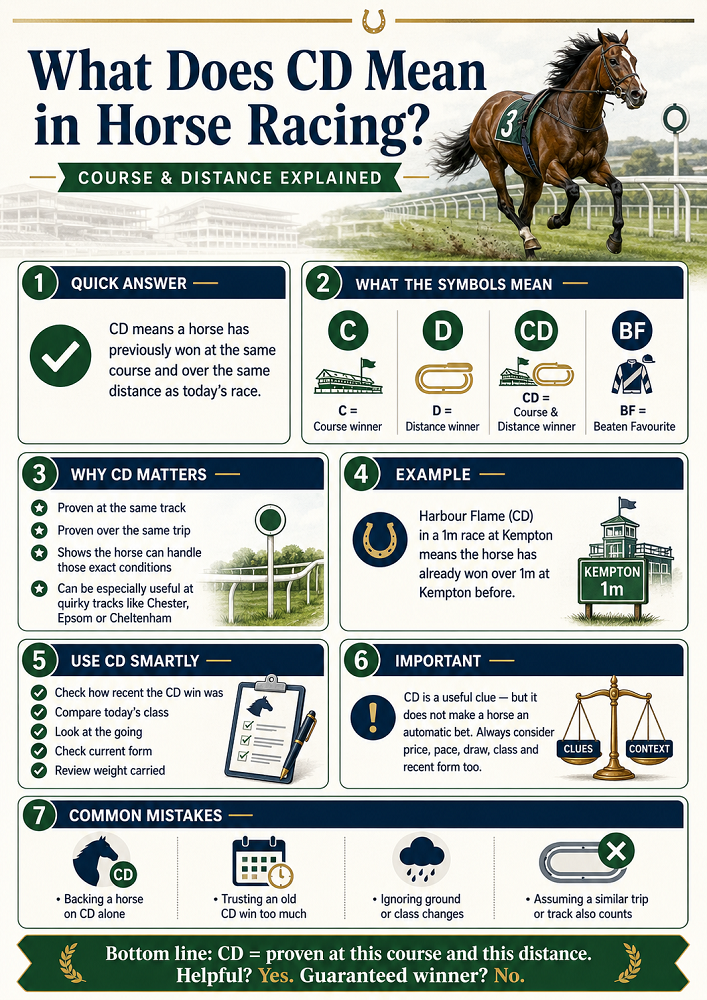
C means course, D means distance, and CD stands for ‘Course and Distance’, indicating that a horse has previously won at the same course and over the same distance.
A course and distance winner has already won at the exact track and over the exact distance of today’s race.
This is not a loose label for “similar conditions”. It must be the same course and the same advertised trip, such as 1m2f at Sandown or 5f at Chester.
The term CD is primarily used by punters, tipsters, and handicappers as a quick reference tool when studying form or reading a racecard.
- CD next to a horse in a 2m Chase at Kempton means the horse has already won over 2m at Kempton.
- CD next to a runner in a 5f handicap at Chester means the horse has previously won over that sharp 5f course.
- A win at a similar distance does not count. A horse that won over 1m1f has not proven the exact distance if today’s race is 1m2f.
- A win at a similar type of racetrack does not count either. A horse that has won at Epsom but has not won at Chester would not count, even if both tracks have their own quirks.
- Horses with a CD next to their name are often favored by punters because they have a proven track record under identical conditions.
The CD tag serves as a strong stamp of approval, indicating that a horse can handle the track’s layout and has the necessary stamina and speed to win over that specific length.
That does not make the horse an automatic bet, but it is a useful starting point.
Course, Distance and CD: What the Symbols Mean
C, D and CD are related indicators, but they do not all mean the same thing. A simple way to remember them is: C = course only, D = distance only, CD = both.
These letters usually appear near the horse’s name, age, weight, form line or other details on UK and Irish race cards.
The layout may vary between bookmakers, newspapers and racing websites, but the meaning is broadly consistent.
- C means course winner. A horse marked with a ‘C’ on a racecard indicates that it has previously won at that specific course.
- D means distance winner. The abbreviation ‘D’ signifies that a horse has won at the specific distance of the race it is about to run.
- CD means course and distance winner. The horse has already won over today’s course and trip.
- BF means beaten favourite. The ‘BF’ abbreviation on a racecard indicates that the horse was a Beaten Favourite in its last race, suggesting it was expected to perform better than it did.
- If a horse was a joint favourite and was beaten, some cards may still show BF depending on how the data provider records the market position.
For example, a previous distance winner may have won over 1m2f at York, but if today’s race is 1m2f at Sandown, that horse is a D horse, not a CD horse.
By contrast, a horse that has won over course and distance at Sandown over that same number of furlongs would qualify for CD.
Why Course and Distance Matter in Horse Racing
Racecourses vary more than casual bettors often realise.
Some are flat and galloping, some are undulating, some are left-handed, some are right-handed, and some have tight bends or short straights that can expose a horse’s weaknesses.
A horse that looks talented on paper may not be suited to a particular track.
Distance also matters because every trip tests a slightly different blend of speed, stamina, cruising speed and finishing effort. Sprinters over 5f or 6f need sharp acceleration.
Milers over 1m need a balance of pace and control. Stayers over 2m+ on the Flat, and 3m+ over jumps, need deeper stamina and the ability to keep going when others are beaten.
- Course form matters because some horses are comfortable with a specific layout, camber, bend, uphill finish or downhill run.
- Distance form matters because a horse may travel strongly but fail to stay, or stay well but lack the speed for shorter races.
- CD status proves that a horse isn’t bothered by a venue’s specific quirks, as it combines both course and distance achievements.
- Horses that have won at a specific course and distance are generally considered more reliable bets, as they have demonstrated their ability to handle both the track and the distance.
- Horses marked with CD are generally considered more reliable as they have proven their capability to win under the same race conditions.
- Course and distance suitability can matter more than class on paper alone, especially at tracks such as Chester, Epsom or Cheltenham.
This is why a CD winner can be particularly interesting in a handicap. The horse has already shown that its ability can be translated into performance at this venue, over this trip, under race pressure.
There is also data to support the idea that course and distance form can have value.
For example, a Geegeez study on UK turf Flat racing from 2016–2023 found that previous course, distance and course-and-distance winners did have higher strike rates than horses without those credentials.
However, when it came to value, the picture was much less clear: returns to SP were virtually identical, and at Betfair SP non-CD winners actually performed better, losing around 4p in the £ compared with about 10p in the £ for CD winners.
That same Geegeez study did identify some more interesting subsets. For example, horses with a high previous C&D win percentage — especially those that had won at least 67% of their previous runs over course and distance — appeared stronger statistically.
But the study also warned that horses with four or more previous C&D wins were poor value on the Flat, losing over 34p in the £, suggesting they may be over-bet by the market.
So it seems CD the market is usually aware of course-and-distance form, meaning much of the advantage is already built into the price.
CD becomes more useful when combined with other filters such as recency, course type, handicap mark, going, class, draw, trainer record and value in the odds, which we discuss further below.

CD on the Race Card: Practical Example
A typical UK race card may show C, D and CD symbols next to each runner, usually close to the horse’s name or form details.
You might see a line such as: “Harbour Flame (CD) 9yo b g, 10st 2lb, trainer: A Smith, jockey: B Jones.”
That would tell you that Harbour Flame has won over course and distance before. It does not mean the horse won the same race in the previous year.
It simply means the horse has won a race at this course over today’s distance at some point in its previous races.
Imagine an 8-runner handicap at Kempton over 1m:
- Harbour Flame (CD) has won over this exact 1m trip at Kempton. That is the strongest course-and-distance signal.
- Night Circuit (C) has won at Kempton before, but not necessarily over 1m. It may like the track but still have a distance question.
- Royal Measure (D) has won over 1m before, but not at Kempton. It has the trip proven, but not the particular track.
- Green Haze has no letters. This does not mean the horse cannot win, only that it has no recorded win at this course or distance.
- Bright Mare (BF) may have been favourite last time but disappointed; if the horse finished poorly, you would want to know why.
Online race cards from major bookmakers, newspapers and form providers all show similar symbols, though colours, icons and position can differ.
On some cards the letters appear after the horse’s name; on others they appear beside the form figures.
A form line might also show numbers and letters from the horse’s most recent run and earlier runs.
These help identify the finishing position or reason a horse did not complete. For instance, PU can mean pulled up, F can mean fell, and UR can mean unseated rider.
If a horse finished 2nd in its last race, that is different from a horse pulled up after a break or one whose jockey was left behind after a jumping error.
The key point is that CD is useful, but it is only one part of the full picture represented on the race card.
How Bettors Use CD When Making Selections
Many punters treat CD as a green flag, especially in handicaps, big-field races and meetings where course specialists often run well. But smart bettors do not back a horse based only on those two letters.
When evaluating a horse’s past performance, bettors should consider the recency of the CD win, the class of the race, ground conditions, and the current form of the horse.
When evaluating a horse marked with CD, bettors should consider factors such as the recency of the win, the class of the race, and the similarity of ground conditions to the current race.
Use this checklist before placing a bet:
- Check how recent the CD win was. A course and distance win from the current season or previous season is usually more relevant than one from six years ago.
- Compare the race class. A CD win in a Class 5 handicap may not carry the same weight if today’s race is a Class 2 with stronger horses running for more prize money.
- Look at the going. A CD win on heavy ground may not translate if today’s ground is good to firm.
- Study current form. A horse with strong CD form but a poor recent run may be declining, badly handicapped or out of form.
- Review the weight. In handicaps, a previous win may mean the horse must now carry more weight, making the same task harder.
- Consider trainer and jockey form. A confident jockey booking or an in-form trainer can support the case for a CD horse.
- Look for BF clues. A beaten favourite may have disappointed last time, but if there was a clear excuse, the market may have overreacted.
You should also look at how the horse achieved its distance win. Did it lead from the front, travel strongly and quicken, or only win because the pace collapsed?
That detail can matter if today’s race shape is different.
For example, a front-running colt with a CD win at Chester may be dangerous from a good draw, because Chester’s tight turns can reward early position.
But the same colt drawn wide, carrying more weight, and running on different ground may no longer be such an obvious bet.
CD vs Distance Winner and Beaten Favourite (D & BF)
CD is powerful, but it should be read in context with D and BF.
A distance winner has proven the trip, while a beaten favourite tells you something about market expectation and recent disappointment.
- A pure D horse, with no C, may handle the trip well but struggle with a unique course layout, such as tight turns, an unusual camber or a stiff uphill finish.
- A CD horse has already handled the combined test of track and trip, which is why many punters give it extra credit.
- A BF horse was expected to run well in its last race but was beaten. That may point to hidden ability, or it may indicate a horse that the market keeps overrating.
- A CD winner that was also a recent BF can be interesting if there was a valid excuse, such as being short of room, racing on unsuitable ground, or returning from a long break.
- A CD winner in long-term decline is a different matter. If the horse has lost speed, changed trainer, or repeatedly failed to show ability, the old CD form may not be enough.
At Honest Betting Reviews, we often examine how tipsters and systems treat CD, D and BF when we run live trials on horse racing strategies.
A tipster who blindly selects every course and distance winner is very different from one who checks price, class, pace, going and current form before advising a bet.
The british horseracing authority sets the official framework for racing in Britain, but the job of interpreting a race card sits with the bettor.
The symbols are there to give quick access to useful information; they are not a substitute for judgement.

Common Mistakes When Using CD in Horse Racing
Over-reliance on CD can be costly if other crucial factors are ignored. A horse can be a course and distance winner and still be a poor bet at the current odds.
Here are the main watch-outs:
- Do not back a horse solely because it has CD next to its name. Always check whether the horse’s performance has remained strong since that win.
- Do not assume an old CD win is still relevant. A horse may be older, slower, with a different trainer, or returning from a long break.
- Do not ignore the handicap mark. A horse that won easily before may now be badly handicapped and forced to carry more weight.
- Do not ignore ground conditions. A CD win on heavy ground may not help much in a fast-ground race, even at the same course and distance.
- Do not ignore class. A low-grade CD win does not automatically transfer to a higher-class race with better rivals.
- Do not ignore the form line. Letters such as PU, F, UR and R can reveal that a horse pulled up, fell, unseated rider or refused.
- Do not assume the CD tag means the same race was won last year. It only means a race over the same course and distance was won at some point.
It is also worth checking the head position, beaten distance and finishing effort from previous races.
A horse that won narrowly in a weak race may not be as strong as a horse that finished second in a much deeper contest.
The vast majority of good racing analysis involves weighing several signals together.
CD is a helpful idea, but it should sit alongside price, pace, draw, trainer intent, jockey booking, going, class and the horse’s overall profile.
Using CD and Other Race Card Abbreviations with Honest Betting Reviews
We help bettors interpret data such as CD, C, D, BF and other race card abbreviations when evaluating tipsters and betting systems.
We are interested in whether a method produces measurable results, not whether it sounds convincing on paper.
When we assess horse racing tipsters and systems, we look at live trial evidence, including ROI, strike-rate, average odds, losing runs, each way performance and how often selections rely on course and distance winners.
A system that selects lots of CD horses may have a higher strike-rate, but the value still depends on the odds available.
CD can help you identify a horse that is suited to a specific race, but no symbol can guarantee a winner.
Bankroll management, realistic expectations and disciplined staking still matter.
If you follow tipsters, combine your own understanding of course and distance form with independent reviews and transparent results.
That gives you a better chance of separating genuine edge from guesswork, hype and lucky short-term runs.




Leave a Reply
Want to join the discussion?Feel free to contribute!