
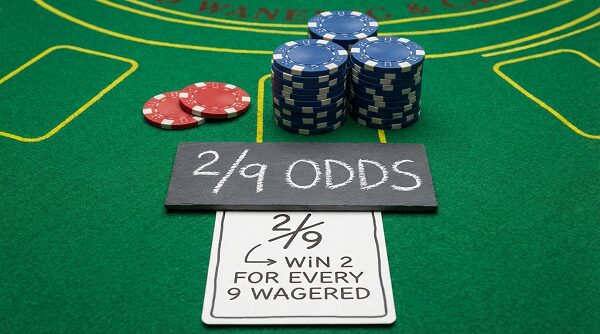
Odds 2/9 Meaning: What Do These Betting Odds Really Tell You?
If you’ve ever placed a bet or browsed a racecard, you’ve almost certainly come across odds like 2/9. But what exactly do odds of 2/9 mean?
- How much could you win
- What do these odds say about the chances of the bet landing?
- And are 2/9 odds ever worth taking?
Whether you’re brand new to betting or simply brushing up on your knowledge, this guide will walk you through what 2/9 odds mean, how to calculate your potential returns, what the implied probability is, and how to approach betting on short-priced favourites.
Let’s break it all down in plain English.
🔢 What Does 2/9 Odds Mean?
In simple terms, 2/9 is a type of fractional odds, widely used in the UK and Ireland. They are read as “two to nine.”
Here’s what they mean:
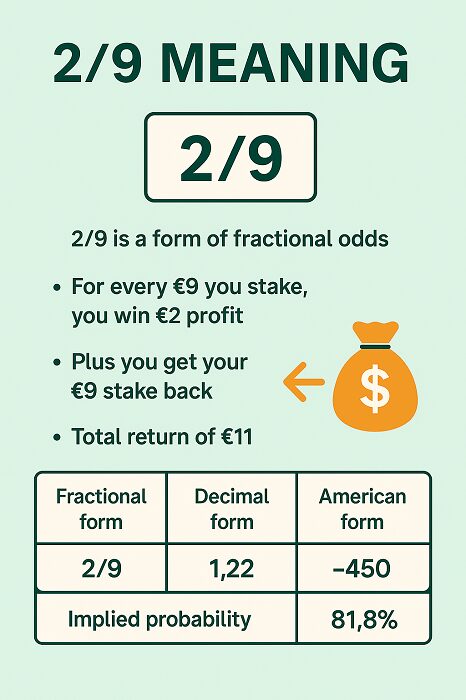
- For every £9 you stake, you’ll make £2 profit if your bet wins.
- You’ll also get your original £9 stake returned.
- Your total return would therefore be £11.
Fractional odds show the profit-to-stake ratio.
So in 2/9:
- 2 = profit
- 9 = stake required to earn that profit
These are odds-on — meaning the selection is considered highly likely to win. Bookmakers expect this outcome over 80% of the time.
So to summarise:
For every £9 staked, you win £2 profit (plus your stake back).
💰 How Much Do You Win at 2/9 Odds?
Let’s look at some quick examples so you can see your potential returns at different stakes.
| Stake | Profit (at 2/9) | Total Return |
|---|---|---|
| £1 | £0.22 | £1.22 |
| £5 | £1.11 | £6.11 |
| £10 | £2.22 | £12.22 |
| £20 | £4.44 | £24.44 |
| £50 | £11.11 | £61.11 |
| £100 | £22.22 | £122.22 |
So if you place a £10 bet at 2/9, you’ll make £2.22 profit, with a total return of £12.22.
Short odds don’t deliver big wins — but they imply a high likelihood of success.
Here’s 2/9 summarised:
- Very strong favourite
- Small profit relative to stake
- Often seen in sports where one competitor is overwhelmingly superior
🧮 Converting 2/9 to Decimal or American Odds
If you prefer other formats, you might want to see 2/9 odds in decimal or American style. Here’s how it works:
- Decimal odds:
- American odds: Since the odds are below even money, they’re negative: -450
So:
- 2/9 = 1.22 in decimal
- 2/9 = -450 in American odds
All three formats express the same thing: a potential £0.22 profit for every £1 staked.
🏟️ Examples of 2/9 Odds in Different Sports

To understand how common 2/9 is, let’s explore how these odds show up across a range of sports and markets.
🐎 Horse Racing
2/9 is most commonly seen in horse racing when there’s a clear standout favourite.
Example:
You back Silver Shadow at 2/9 in a small four-runner field.
- Stake: £20
- Profit: £4.44
- Total return: £24.44
This sort of price often reflects a horse with strong form, ideal ground conditions, and very little competition.
⚽ Football
Odds of 2/9 can appear in:
- Match winner markets (when a top team plays a much weaker one)
- “To qualify” markets
- Tournament group games with highly uneven matchups
Example:
England to beat Malta at home might be priced at 2/9 or even shorter.
Stake: £15
Profit: £3.33
Total return: £18.33
These odds show that the bookmaker sees the stronger team as overwhelming favourites.
🎾 Tennis
In tennis, 2/9 odds are typical when a top seed faces a significantly lower-ranked opponent.
Example:
A world number 5 versus a qualifier in the first round of Wimbledon.
Stake: £30
Profit: £6.67
Total return: £36.67
These prices reflect:
- Ranking difference
- Surface suitability
- Head-to-head history
🥊 Boxing & UFC
Odds of 2/9 might be given to a defending champion or dominant fighter facing a challenger expected to struggle.
Example:
Champion at 2/9 vs a late-replacement opponent.
Stake: £25
Profit: £5.56
Total return: £30.56
Short odds mean the market expects a routine win — but upsets do happen.
🏆 Outrights & Tournament Betting
You might also see 2/9 in markets like:
- Team to qualify from a group
- Player to advance to the semi-finals
- Heavy favourite to win a particular heat or stage
Example:
A dominant F1 driver might be 2/9 to finish on the podium.
🤔 Are 2/9 Odds Good Value?
That depends entirely on whether the true probability of the outcome is higher than the implied probability.
We’ll calculate that shortly — but spoiler: 2/9 implies around 82%.
If you believe:
-
The real chance is 85–90% ✔️
Then 2/9 may be a value bet.
If you believe:
-
The real chance is only 60–75% ❌
Then the odds are too short and offer poor value.
The key question with these kinds of prices is:
- Is the bet safer than the odds suggest?
Short odds don’t guarantee success, and over time, blindly backing heavy favourites can chip away at your bankroll.
🧙 Strategies for Betting on 2/9 Shots

Odds of 2/9 are very short, so you won’t strike it rich — but they can still play a role in a smart betting strategy.
Here are some effective approaches:
🎯 1. Focus on Value, Not Safety
Many bettors see 2/9 and assume it’s a “safe bet.”
But the real question is:
Does the selection win more than 82% of the time?
If yes, it’s good value.
If not, you should skip it — no matter how “easy” it looks.
📊 2. Analyse the Context
Short odds only matter when supported by data.
Ask yourself:
- Is the favourite in peak form?
- Are there injuries or tactical concerns?
- Is the team or player motivated?
- Is the opposition stronger than the market suggests?
Look beyond reputation — focus on facts.
💷 3. Use a Sensible Staking Plan
Because your profit is small, avoid the temptation to stake big just to make the winnings look meaningful.
Good approaches include:
- Level stakes
- Percentage staking (e.g., 2% of bankroll)
Avoid doubling stakes or “chasing” losses — a single upset can wipe out multiple previous wins.
🧾 4. Track Results
Tracking results with short-priced favourites is vital because:
- You often need a high strike rate to stay profitable
- Upsets can distort results
Record:
- Stake
- Odds
- Profit/loss
- Type of market
After 50 or 100 bets, you’ll clearly see whether 2/9 bets are helping or hurting your overall profitability.
📈 5. Shop Around for Prices
Occasionally you might find:
- 1/5 at one bookmaker
- 2/9 at another
- 1/4 on the exchange
Getting the best price every time is crucial — especially with short odds where margins are tight.
⏳ 6. Don’t Bet Every 2/9 Shot You See
Some favourites are priced short simply because they’re popular, not because they’re unstoppable.
Patience pays:
- Only bet when value exists
- Avoid emotional bets
- Skip “bankers” that aren’t backed by evidence
🧠 What Do 2/9 Odds Say About Probability?
Odds aren’t just about payouts — they also tell you how likely an outcome is.
2/9 odds imply an 81.8% chance of success — roughly an 82% probability.
That’s very high — meaning the selection is expected to win four out of five times on average.
Remember: bookmakers also build in a margin, so the true probability might be slightly lower.
Again, only bet if you consider the true chances of the bet winning are above 82%.
📝 Quick Recap: Odds 2/9 Meaning
Here’s everything you need to know:
✅ You win £2 profit for every £9 staked
💷 Total return includes your stake (e.g., £11 from a £9 bet)
📊 Implied probability is about 82%
🔄 Converts to 1.22 decimal or –450 American odds
🏇 Indicates a strong favourite
📈 Can represent value — but only if the favourite’s chances exceed 82%
🧠 Upsets at short odds do occur, so discipline is essential
🔍 Final Thoughts: What Do 2/9 Odds Really Tell You?
Odds of 2/9 tell you that the bookmaker thinks the outcome is highly likely — but not guaranteed.
These odds offer small but steady returns if used wisely and only when the price reflects genuine value.
When you next see a selection priced at 2/9, you’ll know exactly:
- What you can win
- What the odds imply
- Whether the price is worth taking
Short odds can still be profitable with the right strategy — just make sure you’re backing value, not simply favourites.




Leave a Reply
Want to join the discussion?Feel free to contribute!