
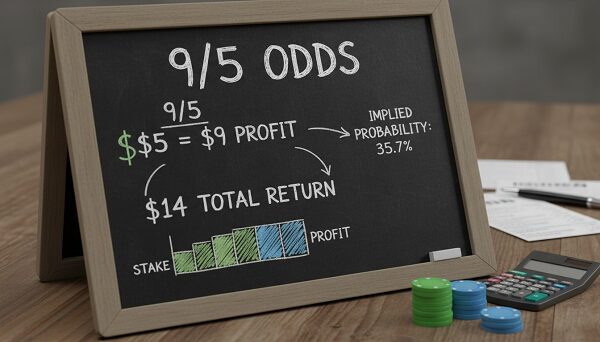
Odds 9/5 Meaning: What Do These Odds Really Tell You?
If you’ve ever looked at a betting market and spotted odds 9/5, you might have paused for a second to work out exactly what they mean.
They’re not quite short odds, not a big outsider either — but somewhere in that interesting middle ground where many bets live.
In this guide, we’ll break down odds 9/5 meaning in plain English.
You’ll learn how much you win at 9/5, how to convert these odds into other formats, what they imply about probability, and whether they can represent good betting value.
We’ll also look at examples across different sports and discuss some sensible strategies when betting at this price point.
Whether you’re new to betting or just brushing up, this article will give you a solid understanding of 9/5 odds.
What Does 9/5 Mean in Betting?
9/5 is a set of fractional odds, the traditional odds format used by UK bookmakers.
Fractional odds show profit relative to stake, not the total return.
So when you see 9/5, it means:
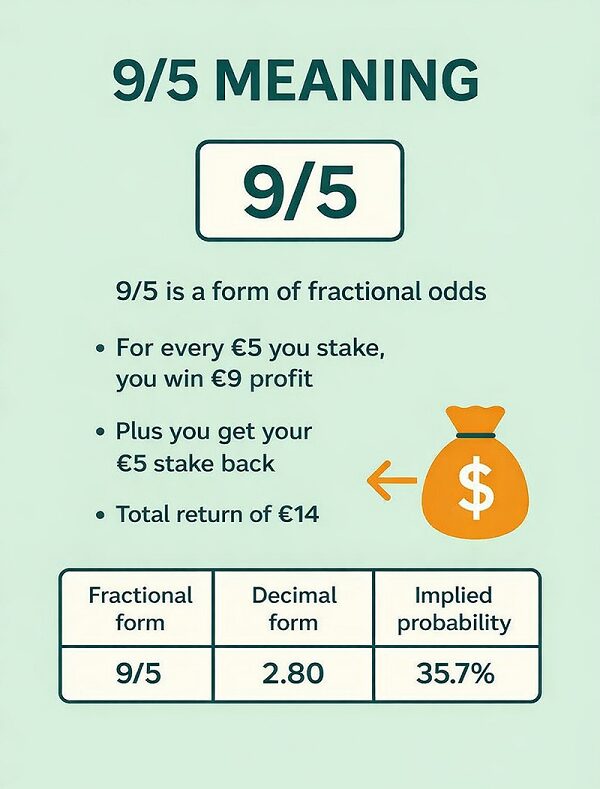
- For every £5 you stake
- You win £9 in profit
- Plus you get your original stake back
In short, 9/5 tells you how much you stand to win over and above your stake if the bet is successful.
How Much Do You Win at 9/5 Odds?
Let’s make this concrete with some real examples. The maths behind odds 9/5 is straightforward once you see it in action.
Basic Rule
To calculate profit at 9/5:
Stake × (9 ÷ 5)
That’s the profit. Then add your stake back on top to get the total return.
Example 1: £10 Stake
- Profit: £10 × 9 ÷ 5 = £18
- Total return: £28
Example 2: £25 Stake
- Profit: £25 × 9 ÷ 5 = £45
- Total return: £70
Example 3: £50 Stake
- Profit: £50 × 9 ÷ 5 = £90
- Total return: £140
A useful shortcut is to remember that 9/5 equals 1.8.
So you can quickly estimate profit by multiplying your stake by 1.8.
Converting 9/5 to Decimal or American Odds
While fractional odds are common in the UK, you’ll often see odds displayed in other formats — especially if you’re using international bookmakers or betting exchanges.
9/5 to Decimal Odds
To convert fractional odds to decimal odds:
(9 ÷ 5) + 1 = 2.80
So:
9/5 fractional = 2.80 decimal
This means you receive £2.80 back for every £1 staked, including your stake.
9/5 to American Odds
American odds work a little differently, but since 9/5 converts to decimal 2.80, it becomes +180 in American format.
That tells you:
-
A £100 stake would return £180 profit
Examples of 9/5 Odds in Different Sports

You’ll see 9/5 odds across a wide range of sports. They usually indicate a selection that is competitive but not dominant.
Horse Racing
In horse racing, 9/5 is often associated with:
- A strong second favourite
- A horse with solid form but a few doubts (ground, draw, class)
- A contender in a competitive handicap
It’s a common price for horses that are expected to go close but aren’t the obvious standout.
Football
In football betting, odds around 9/5 might appear when:
- A decent away side plays a stronger home team
- Two evenly matched teams meet, but one has a slight edge
- A team has injury concerns or rotation risks
You’ll often see 9/5 in match odds, correct score markets, or specials.
Tennis
In tennis, 9/5 can crop up when:
- One player is marginally favoured
- Surface or recent form slightly swings the balance
- The market expects a competitive match
Other Sports
You’ll also see 9/5 odds in:
- MMA and boxing
- Golf outright markets
- Cricket match betting
In most cases, the price reflects uncertainty with upside.
Are 9/5 Odds Good Value?
Whether 9/5 odds are good value depends on one thing:
Do you think the real probability is higher than 35.7%?
Value betting isn’t about picking winners — it’s about backing outcomes that are priced too generously.
Example
If a bookmaker offers 9/5 (35.7%) but you believe:
-
The true chance is closer to 45%
Then the odds are potentially undervaluing the selection, which creates value.
On the flip side, if the true chance is only 30%, then 9/5 would actually be poor value — even if the bet wins occasionally.
Over time, consistently backing value prices is what separates profitable bettors from casual punters.
Strategies for Betting on 9/5 Shots

Odds of 9/5 sit in an interesting sweet spot. They’re not speculative longshots, but they’re also far from “bankers”. Because of that, how you approach these bets can make a big difference to long-term results.
Below are several sensible strategies bettors commonly use when dealing with 9/5 shots, along with real-world examples to show how they work in practice.
1. Treat 9/5 as a “Value Favourite”, Not a Certainty
One of the biggest mistakes bettors make is treating odds like 9/5 as if they should win.
In reality, the implied probability is only around 36%, meaning the bet will lose more often than it wins over time.
The key is to think of 9/5 as a value favourite rather than a safe one.
Example (Football):
A mid-table Premier League side is playing at home against a newly promoted team.
The home side is priced at 9/5 due to a couple of injuries, but underlying stats (xG, shot volume, home form) still strongly favour them.
If your analysis suggests the true chance is closer to 45%, then 9/5 may represent value — even though the team will still lose plenty of the time.
The takeaway:
✔ Back 9/5 shots when the price looks wrong, not just because the team or horse “should win”.
2. Use 9/5 Bets as High-Quality Singles
Because 9/5 sits in the middle of the odds spectrum, these selections often work best as single bets rather than being bundled into accumulators.
Accas can be tempting, but bookmaker margins multiply quickly when you start stacking selections.
Example (Horse Racing):
A horse priced at 9/5 has:
- Strong recent form
- A favourable draw
- Proven performance on today’s ground
Backing it as a £25 single returns £45 profit if it wins. Adding it to a four-fold might look attractive on paper, but one unpredictable result wipes out the entire bet.
For many bettors, consistently backing strong 9/5 singles is more sustainable than chasing bigger returns via accumulators.
3. Look for Market Overreactions
Odds of 9/5 often appear when the market reacts too strongly to a single factor — such as an injury, a team sheet, or a recent loss.
These overreactions can create value if the underlying picture hasn’t changed as much as the price suggests.
Example (Tennis):
A player loses their last match heavily and drifts to 9/5 for their next fixture. However:
- The loss came against a top-10 opponent
- Today’s match is on their preferred surface
- Head-to-head record is favourable
If the market has overreacted to one poor result, 9/5 might be a better price than it should be.
This is a common situation where informed bettors are happy to step in.
4. Compare Bookmakers Before Placing the Bet
Because 9/5 is a very common price point, you’ll often find variation between bookmakers.
One firm might offer 9/5, while another has the same selection at 13/8 or 7/4.
That difference matters.
Example (MMA):
A fighter is priced:
- 9/5 at one bookmaker
- 7/4 elsewhere
The implied probability at 7/4 is higher than at 9/5. Taking the bigger price improves your long-term edge — even though the outcome is identical.
This is a simple but often overlooked strategy that can significantly improve profitability over time.
5. Consider Each-Way or Place Markets (Where Relevant)
In sports like horse racing, a 9/5 favourite doesn’t always have to be backed to win.
Sometimes the win price looks tight, but the place terms offer a more sensible risk-reward balance — especially in competitive fields.
Example (Horse Racing):
A 9/5 favourite is running in a 12-runner handicap. The horse is consistent but not dominant, and the race looks competitive.
Instead of backing it outright:
- You back it to place
- Or consider an each-way alternative on a slightly bigger-priced rival
This approach can reduce variance while still capitalising on your read of the race.
6. Watch for Late Price Moves on 9/5 Shots
Because 9/5 is a “decision price”, late market movement can be particularly revealing.
- A move from 9/5 to 13/8 may suggest confidence from informed bettors
- A drift from 9/5 to 5/2 could indicate doubts emerging late on
Example (Football):
A team opens at 9/5 but shortens across the market an hour before kick-off after confirmed team news. That move can reinforce your original analysis.
While price movement shouldn’t be followed blindly, it can provide useful confirmation — or a warning — when betting at this odds level.
7. Match Your Staking to the Odds
Finally, sensible staking matters. Because 9/5 shots lose more often than they win, aggressive staking can quickly lead to drawdowns.
Many experienced bettors use:
- Level stakes
- Or slightly reduced stakes compared to shorter prices
This helps smooth variance and protects the betting bank during inevitable losing runs.
Example:
Instead of staking £50 on every selection, you might:
- Stake £30 on 9/5 shots
- £40–£50 on shorter prices
- Smaller stakes on longer odds
The goal is consistency, not chasing one big win.
Key Takeaway
Betting on 9/5 shots is most effective when:
- You believe the true probability is higher than 35.7%
- You treat them as value opportunities, not certainties
- You use disciplined staking and avoid emotional accumulators
Handled correctly, 9/5 odds can be a profitable price range — but only when backed with logic, patience, and value-focused thinking.
🙋 FAQs About 9/5 Odds
Is 9/5 better than 2/1?
No — 2/1 offers a bigger return but implies a lower chance of winning. 9/5 is shorter and suggests a more likely outcome.
Is 9/5 close to evens?
Not really. Evens (1/1) imply a 50% chance, while 9/5 implies about 36%.
What’s the decimal version of 9/5?
2.80 decimal odds.
Do 9/5 odds include my stake?
No. Fractional odds show profit only. Your stake is added on top of the winnings.
Are 9/5 odds common?
Yes — especially in UK horse racing and competitive football markets.
Common Mistakes When Reading 9/5 Odds

Even though 9/5 odds are fairly straightforward, they’re often misunderstood. These small errors can add up over time if you’re not careful.
Confusing Profit With Total Return
At 9/5, the £9 refers to profit only, not what you get back in total. You always receive your stake back on top.
For example, a £5 bet returns £14, not £9.
Treating 9/5 as a Safe Bet
9/5 might feel like a strong price, but it still implies only a 35.7% chance. These bets will lose more often than they win, so they shouldn’t be treated as certainties.
Ignoring Implied Probability
Odds are probability statements, not just payout figures. If you’re not asking whether the true chance is higher than around one in three, you’re not really assessing value.
Comparing Odds Without Converting Them
Fractional odds can be misleading at a glance. Converting 9/5 to 2.80 decimal or 35.7% probability makes it much easier to compare prices and spot the best value.
Overloading Accumulators
Stacking multiple 9/5 selections into accumulators might look appealing, but margins and variance add up quickly. These odds are usually better suited to singles.
Quick Takeaway
Most mistakes with odds 9/5 come from overestimating how often they win or misunderstanding what the price actually represents.
Keep probability and value in focus, and those traps are easy to avoid.
Final Thoughts on Odds 9/5 Meaning
Understanding odds 9/5 puts you in a much stronger position as a bettor. They represent a selection with a solid chance, but not a certainty — roughly one win in every three attempts according to the market.
When used thoughtfully, 9/5 odds can offer excellent opportunities, especially when your own assessment suggests the bookmaker has slightly misjudged the true probability.
As always, the key isn’t the odds themselves — it’s whether the price is right.




Leave a Reply
Want to join the discussion?Feel free to contribute!