

Total Betting: Over/Under Markets and How to Beat Them
Total betting—also known as over/under betting—is one of the most popular and versatile markets in sport.
Instead of worrying about who wins, you’re simply betting on how much happens: goals, points, games, runs, or yards.
That simplicity is deceptive. Behind every total line sits data, pricing models, public bias, and bookmaker margins—and understanding how those forces interact is where smart bettors gain an edge.
In this guide, we break down how over/under markets really work, how sportsbooks set and move totals, the key rules that trip bettors up, and the strategies professionals use to find value.
Whether you’re betting soccer goals, NBA points, NFL totals, or tennis games, this is a practical, no-nonsense deep dive into one of betting’s most important markets.
What Is Total Betting (Over/Under)?
Total betting is one of the most straightforward markets in sports betting. Rather than picking a winner, you wager on whether the combined points scored by both teams will finish above or below a number set by the sportsbook.
The terms “total,” “over/under,” and “O/U” all refer to the same thing across UK bookmakers, European operators, and US sportsbooks.
Consider two concrete examples:
- A Premier League match might have a total line of 2.5 goals—you bet Over if you expect three or more, Under if you expect two or fewer.
- In an NFL game, the line could sit at 44.5 points, and you’re betting on whether the two teams will combine for more or less than that total number.
Totals can apply to full matches, halves, quarters, periods, and even player props.
These totals are based on the total number of events—such as goals, points, or cards—that occur during the game or a specific segment.
In tennis, you might bet Over/Under 22.5 games in a match.
In the NFL, you could wager on a quarterback throwing Over 274.5 passing yards.
The flexibility of this market is part of its appeal.
From our perspective at Honest Betting Reviews, we look at totals both for straight betting and as part of the systems and trials we review.
Many tipster services focus on goal-based markets or NBA totals, and we track their results to help you separate profitable services from noise.
How Total / Over–Under Bets Work
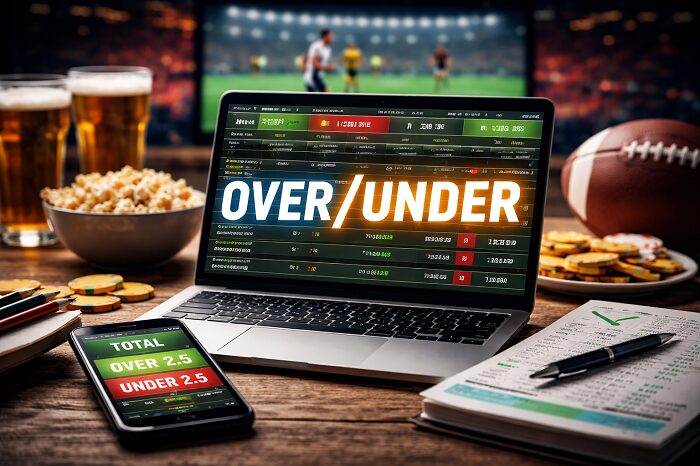
The bookmaker sets a line—say 2.5 goals, 25.5 games, or 44.5 points—and your job is simple: decide whether the actual combined score will be higher (Over) or lower (Under) than that line.
You place your stake, and if your prediction is correct, you win.
Let’s walk through a detailed football example.
Suppose Arsenal play Tottenham in the Premier League, and the sportsbook sets the total at 2.5 goals.
If the match finishes 2-1, 3-0, 2-2, or any scoreline with three or more goals, the Over wins.
If it ends 1-0, 0-0, 1-1, or 2-0, the Under wins.
Notice that 2.5 is a half-point line—there’s no way to land exactly on it, which eliminates ties.
For a second example, consider an NBA game where the total is set at 215.5 points.
If the Lakers beat the Celtics 118-104 (total 222 points), the Over wins.
If the game ends 102-98 (total 200 points), the Under wins.
What happens when the total is a whole number? Suppose an NFL game has a total of 44 and finishes with exactly 44 points combined.
This is called a push, and your wager is refunded. You neither win nor lose money.
Most sportsbooks return stakes on pushes, though a minority count them as losses—always check the house rules before you bet.
The odds for Over and Under are often close, typically around 1.91/1.91 (or -110/-110 in American format).
However, they can differ depending on where the money flows. If heavy action comes in on the Over, a bookmaker might price it at 1.83 while offering 2.00 on the Under to balance their exposure.
How Sportsbooks Calculate & Move Total Lines
Bookmakers don’t pluck numbers from thin air. They use team stats, pace metrics, expected goals (xG), injury reports, weather forecasts, schedule congestion, and sophisticated simulations to set initial totals.
Importantly, they also incorporate present market conditions and present data to ensure their lines reflect the most current information available.
The goal is to create a line that attracts roughly equal action on both sides.
Injuries can shift lines significantly. If a star quarterback like Patrick Mahomes is ruled out before an NFL game, the total might drop by 3-4 points because the offence is expected to be less productive.
Similarly, if a prolific striker like Erling Haaland misses a Premier League match, the goal total could fall from 2.5 to 2.0 or see the Over priced more generously.
In MLB, starting pitchers heavily influence totals. A matchup featuring two elite aces at a pitcher-friendly park like Dodger Stadium might open at 7.0 runs.
The same teams at Coors Field in Colorado—notorious for thin air and long-distance hitting—could see a total of 11.5 runs.
Cricket totals work similarly, with venue size and pitch conditions playing crucial roles.
After opening, lines move based on betting activity. Public money typically favours Overs—casual bettors enjoy cheering for goals and points.
Sharp bettors, by contrast, often find value hitting Unders when totals are inflated by recreational action. Watching line movement can tell you which side the smart money prefers.
The vig (or overround) is also built into every total. If both Over and Under are priced at 1.91, the implied probability for each is about 52.4%.
Combined, that’s 104.8%, with the extra 4.8% representing the bookmaker’s edge. Even when the true probability is 50/50, you’re paying a premium to play.
Types of Total Bets Across Different Sports: Points Scored

Totals are available across nearly every sport: football, basketball, American football, tennis, baseball, ice hockey, and more.
The specific lines and units vary, but the core principle remains the same.
Football (Soccer) is where many UK bettors encounter totals first. The most common market is match goals, with lines typically set at 2.5 or 3.5 goals.
You can also bet on team goals—for example, “Liverpool Over 1.5 team goals” in a match against Everton—as well as corners, cards, and shots on target.
In addition to match totals, you can bet on the total for one team, such as “Over 1.5 goals for one team.”
Asian bookmakers and exchanges often offer granular lines like 2.25 or 2.75 goals, splitting your stake across two outcomes.
Basketball (NBA/EuroLeague) features high-scoring games, so totals often range from 210 to 240 points.
You can bet full-game totals, team totals (e.g., Miami Heat Over 108.5), quarter totals, or half totals. It’s also possible to bet on the total points for one team in a game.
Player props like three-pointers made also function as totals—Over/Under 3.5 threes for Stephen Curry, for instance.
American Football (NFL) typically sees game totals in the mid-40s, though high-powered offences can push lines into the 50s.
First-half totals, team totals, and player props (passing yards, rushing yards, receptions) are all popular.
An example: Cowboys at Bills with a total of 52.5 points.
Tennis uses game totals—Over/Under 22.5 games in a best-of-three match, for example. You can also bet on set totals, aces, and double faults.
A Wimbledon match between two big servers might feature an aces line of Over 24.5.
Baseball focuses on run totals, usually ranging from 7.0 to 9.5 depending on pitchers and ballpark.
Yankees versus Red Sox at Fenway Park might see a total of 9.0 runs.
First-five-innings totals are popular for bettors who want to isolate starting pitcher performance from bullpen volatility.
Ice Hockey (NHL) typically has totals around 5.5 or 6.5 goals.
Overtime and shootouts count towards full-game totals unless the market specifically states regulation-only.
A matchup between defensive teams might open at 5.0, while a game featuring high-scoring offences could reach 7.0.
Key Rules: Overtime, Extra Time, Pushes & Half-Point Lines

Understanding the rules around overtime and settlement is critical in totals (over/under) betting.
In many sports—particularly basketball and American football—overtime is included in full-game totals by default, often referred to as “overtime counts.”
Unless a market is clearly marked as “regulation time only,” any points scored in overtime will contribute to the final total.
For example, if an NBA game is tied 102–102 at the end of regulation and finishes 115–110 after overtime, the total used for settlement is 225 points.
A bet on Over 214.5 would therefore win thanks to the extra-time scoring.
However, this rule does not apply universally. In football (soccer), standard over/under goals markets are settled on 90 minutes plus stoppage time only, with extra time excluded unless explicitly stated otherwise.
If an NBA game is tied 102-102 at the end of regulation and finishes 115-110 after overtime, the total of 225 points is what settles your bet.
A total of 214.5 would hit the Over thanks to those extra-time points.
However, this doesn’t apply to half or period-specific markets. If you bet on the first-half total in an NHL game, only goals scored in the first two periods count.
Overtime is irrelevant to that wager. Similarly, some football markets are explicitly “90 minutes only,” excluding extra time and penalties in cup matches.
Half-point lines exist specifically to avoid pushes. When the sportsbook sets a total at 44.5 instead of 44, there’s no possibility of a tie.
The game either finishes with 44 or fewer combined points (Under wins) or 45 or more (Over wins).
In football (soccer) however, the rules are different regarding over time (aka extra time). Let’s look at an example:
- A match between Man Utd and Chelsea finishes 1–1 after 90 mins and 3–1 after extra time
- Over 2.5 goals would LOSE on standard totals
A brief note: rules vary by bookmaker. Some player prop markets exclude overtime, while full-game totals include it. Before placing any wager, check the specific terms.
Disputes often arise when punters assume extra time counts when the market is regulation-only.
Strategies & Angles for Profiting from Total Betting
Let’s be honest: beating totals long-term is difficult. Sportsbooks have sharp analysts, and the vig means you need to win more than 52% of bets just to break even at standard odds when betting at odds of -110 (1.91 in decimal terms).
At Honest Betting Reviews, we focus on evidence-based approaches—tracking data, testing models, and reviewing systems before recommending any tipster or method.
Using data and models not only increases your accuracy but can also help you save time and money by focusing on the most promising opportunities.
Pace and style analysis is one productive angle. Fast-paced teams in the NBA that push tempo and take quick shots tend to produce higher-scoring games.
Defensive matchups between grinding, half-court teams often stay Under. In football, two possession-oriented clubs with low xG profiles might consistently produce scoreless draws.
Understanding these dynamics gives you an advantage over bettors who simply follow gut feelings.
Early-season edges can be valuable. In the first four to six weeks of major leagues like the Premier League, NBA, or NFL, bookmakers are still calibrating totals.
New coaches, tactical shifts, and varying fitness levels create mispriced lines. A team that switched from defensive football to a high-pressing system might see their games go Over before the market adjusts.
Weather factors matter in outdoor sports. Heavy rain and strong wind reduce passing efficiency in the NFL and suppress scoring in UK football.
A match at the Etihad Stadium played in driving rain might reasonably trend Under, even if both teams usually feature in high-scoring games. Checking forecasts before betting is time well spent.
Public bias towards Overs is real. Casual bettors enjoy cheering for goals and points, which pushes Over lines higher than they should be.
Sharp bettors exploit this by hitting Unders when the market has overreacted.
If a Premier League total opens at 2.5 goals and moves to 3.0 purely because of recreational money, the Under at 3.0 might offer value.
Line shopping and timing cannot be overstated. Getting Over 2.5 at 1.90 instead of 1.80 makes a significant difference over hundreds of bets.
That extra 0.10 in decimal odds compounds into substantial profit over a season. Use odds comparison tools, and don’t be loyal to a single sportsbook when better prices exist elsewhere.
To help you profit from total betting, here are a few actionable tips: focus on pace and style matchups, monitor early-season trends, check weather forecasts, and always shop for the best lines.
Automated Betting Software: Tools, Pros & Cons

Automated betting software has rapidly become a game-changer in the world of sports betting, offering both new and experienced punters a smarter, more efficient way to place wagers.
These tools are designed to streamline the betting process, allowing users to implement strategies—such as exclusive horse racing systems, football systems, and even roulette systems—without the need for constant manual input.
Football fans can benefit from automation. Whether you’re following a proven football system or experimenting with your own data-driven approach, betting software can monitor odds, track line movement, and place bets the moment value appears.
This is especially useful in fast-moving markets, where hesitation can mean missing out on the best odds.
Bankroll Management, Stakes & Understanding Value in Sports Betting
Even the best total betting strategy fails without proper bankroll management.
We recommend fixed staking—risking 1-2% of your betting bank on each wager.
If you have a limited bankroll, it’s especially important to be disciplined with your staking strategy to avoid running out of funds.
Chasing losses by doubling down on “certain” Overs after a losing run is a fast track to emptying your account.
Value is the foundation of profitable betting. Expected value (EV) means your estimated win probability exceeds the implied probability of the odds.
If a sportsbook offers Over 2.5 goals at decimal 2.10, the implied probability is about 47.6%.
If your model or data suggests a 55% chance of three or more goals, you have positive EV and should consider the bet.
Here’s a worked example. You’ve analysed a match and believe there’s a 55% chance of Over 2.5 goals.
The odds are 2.10. Your expected return per $1 staked is (0.55 × $2.10) – (0.45 × $1) = $1.155 – $0.45 = $0.705.
Wait—that calculation shows a 15.5% edge, which is excellent.
In reality, edges are smaller. A 3-4% edge on totals, consistently applied, can be meaningful over a season of hundreds of bets.
Because totals are often priced close to 50/50, small edges matter enormously. You don’t need to be right 60% of the time; at -110 odds, 53% accuracy produces long-term profit.
At Honest Betting Reviews, we track ROI, strike rate, and drawdowns when reviewing tipsters or systems focused on totals.
These metrics tell you whether a service genuinely has an edge or simply ran hot for a few months.
Common Mistakes in Total Betting & How to Avoid Them
Most losing bettors repeat the same errors, especially in Overs markets. Recognising these mistakes is the first step to avoiding them.
Overreacting to tiny samples is widespread. After one weekend where seven Premier League matches produce four or more goals, you’ll see punters declaring it “an Overs league.”
That’s noise, not signal. You need months of data—ideally across multiple seasons—to identify genuine scoring trends.
Ignoring line movement costs money. If a total drops from 3.0 to 2.5 before kickoff, that movement usually reflects sharp action or significant team news.
Blindly betting against sharp money without understanding why the line moved is a losing proposition.
Betting Overs purely for entertainment is fine if you’re treating it as a leisure activity with money you can afford to lose. But if you’re trying to create long-term profit, cheering for goals isn’t a strategy.
You need numbers, rationale, and discipline.
Misunderstanding rules leads to disputes and frustration. Many punters assume extra time counts in FA Cup matches when the market is 90-minutes-only.
A game that finishes 1-1 after regulation then 2-1 after extra time would settle as Under 2.5 for regulation-only markets. Always read the terms.
Chasing with late-night Overs on obscure leagues is a recipe for disaster.
After a losing day, the temptation to back Over 2.5 in a Brazilian Serie B or late MLS match without any research is strong.
This is tilt betting, and it rarely ends well. Step away, log your losses, and return with a clear head.
Total Betting vs Handicap Betting

Handicaps (or spreads) and totals are the two most popular alternatives to moneyline betting, but they work differently.
Handicaps adjust the final score to level the playing field between unequal teams. Totals ignore who wins and focus solely on combined scoring.
Consider a Premier League match between Manchester City and Nottingham Forest.
The handicap might be Man City -1.5 goals, meaning City need to win by two or more for the bet to land.
The total might be set at 3.5 goals.
These bets can win or lose independently. If City win 2-1, the handicap loses (they won by one, not two) but the total goes Under (3 goals).
If City win 4-0, the handicap wins (four-goal margin) and the total goes Over (4 goals).
In the NBA, suppose the Lakers are -5.5 against the Hornets, with a total of 224.5.
If the Lakers win 118-108, they covered the spread (winning by 10) and the total went Over (226 points).
If they win 108-102, the spread hits (6-point margin) but the total stays Under (210 points).
When might you prefer a total over a handicap? When the winner is unclear but the game’s style points to high or low scoring.
If two evenly matched defensive teams meet, you might struggle to pick a handicap but feel confident in the Under.
Many experienced bettors maintain portfolios that include both markets, adjusting stakes based on confidence and perceived edge.
Where Honest Betting Reviews Fits In: Systems, Tipsters & Transparency
At Honest Betting Reviews, we’re an independent review platform focused on testing betting systems—including those built around totals and over/under markets.
We don’t just list services or go off a handicapper’s claimed results; we run live trials, track every bet, and publish the results in full so can you see for yourself what works and what doesn’t.
We’ve reviewed football systems, horse racing tipsters, and multi-sport services over the years.
Some have focused specifically on goal-based markets, claiming high strike rates on Over 2.5 or Under 3.5 bets.
Our job is to verify those claims with real-world tracking before recommending anything to our readers.
We’ve seen both excellent and poor total betting systems. Some deliver consistent ROI with transparent records. Others promise unrealistic win rates—80% strike rates on mainstream Overs—without verifiable data to back up their claims.
The difference between the two usually becomes clear after a few months of independent tracking.
When we review a service, we publish full results, including losing runs and maximum drawdowns. A tipster might show 15% ROI over 500 bets, but if they had a 40-bet losing streak in month three, you need to know that before committing your money.
Volatility matters as much as profit. If any member has a query about our systems, strategies, or testing procedures, they can submit it for prompt support and clarification.
If you’re interested in total betting, our reviews can help you discover vetted sports bettors whose records include over/under markets.
Examples of Total-Based Challenges & Systems (and How to Judge Them)

“Challenges” and systems built around totals have become popular content online.
The format is usually straightforward: start with a $100 bank and set a challenge to grow it by placing daily Over 2.5 or Under 2.5 bets at specific odds, aiming to reach a target like $400 or $1,000 over a month.
Here’s a hypothetical example. A “2.5 Goals Builder” challenge aims to grow $100 to $400 in 30 days by backing two or three Over 2.5 bets daily at average odds of 1.85.
The creator posts daily selections, tracks results, and claims a 65% strike rate.
Before following any such system, demand these key metrics:
- Full bet history with timestamps and screenshots
- Odds taken at the time of selection (not odds available after the bet)
- Line movement context (did the total shift after the pick?)
- Realistic staking (not wild compounding that assumes no losing runs)
- Independent proof or verification from a third party
At Honest Betting Reviews, if we trialled a total betting system, we’d track every selection, record the line and exchange price, note whether we used Betfair or a bookmaker, and summarise ROI alongside worst drawdown. This is the standard we hold others to as well.
Watch for red flags. Claims of “no losing months” are statistically implausible over long periods. Guaranteed daily profits don’t exist in betting.
Very high strike rates (80%+) on mainstream totals without hard data are almost always exaggerated.
If a total betting club or service can’t provide transparent records, walk away.
Responsible Gambling & Final Thoughts on Total Betting

Total betting offers many angles—full-game markets, halves, team totals, player props—and can be engaging for both casual and serious bettors.
But it’s still gambling. The anticipation of hitting a last-minute goal to push a total Over is exciting, but the reality is that most bettors lose money over time.
Set staking limits before each session. Keep a betting log so you can review what’s working and what isn’t.
Treat any system or tipster as a tool, not a guarantee of income.
If you’re new to totals, consider starting with small stakes until you understand how markets behave.
Rather than focusing exclusively on one “magic” market, consider using totals as part of a balanced portfolio.
Mixing match odds, handicaps, and totals can smooth volatility and reduce reliance on any single approach.
The players who profit long-term are those who diversify, track results, and adjust based on data.
At Honest Betting Reviews, we provide ongoing education, reviews, and trial results so you can make informed, data-driven choices.
Whether you’re testing your own angles or considering a paid service, the same principle applies: verify before you trust. Demand transparency. Check the history. And never stake more than you can afford to lose.
Total betting rewards preparation. Understand the rules, read the markets, and hold any service you follow to high standards.
If you’re ready to explore further, visit our guides, access our newsletter, and discover which tipsters have genuinely profitable records in over/under markets.




Leave a Reply
Want to join the discussion?Feel free to contribute!