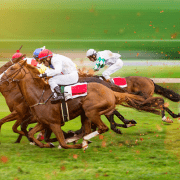
Welcome to the Honest Betting Reviews blog. Here you can find the latest updates on betting systems and tipsters currently under review as well as our tips on how to beat the bookies with the best winning betting systems we have profited from,

The Biggest Payouts in Slots History

In the 21st century, it has became very hard to keep stress levels under control. Fast living and longer working hours combined with unhealthy fast food is not helping with reducing stress.

While some people have taken up fishing, hiking, watching or playing sports, others have decided to have a go at slot machines. We are not going to discuss if that’s a smart decision or not, but we are going to disclose occasions where the choice has really paid off and what the best payouts are on slot machines in Las Vegas history.

Although most people visit the ‘betting paradise’ of Vegas with the secret hope that they will win enough to turn their life around like the soldier who won £13 million off a 25p bet, there aren’t many who have had enough luck to win a great amount of money.

A 25 year old software engineer from Las Vegas certainly did however. He managed to win $39,710,826 after putting just $100 into a slot machine. The odds of winning the jackpot on the machine he played were 1:1670000. So very low chances, don’t you think?

Another great win happened in 2010. A man from Las Vegas hosted his friend from another country and decided to show him why Las Vegas casinos are so famous around the world. They came to have fun and decided to bet $20 on a Megabucks machine. They played it for 10 minutes and hit a jackpot. It was $14,282,544. They decided to donate most of the money to charity, a nice gesture.

Another interesting story concerns a young man who decided to drop by the Excalibur Casino to play a few slot hands while waiting for a basketball game to start. An hour later he became a millionaire. He won 40 million dollars but decided to receive the amount in small payouts for 25 years. Not a bad way to spend an hour.

There have even been a few multiple winners. The most interesting story is that of World War II veteran Elmer Sherwin, who was 76 years old when he won the jackpot of $4.6 million dollars. Even with the money to travel the world, he continued to play slots once or twice a week to kill some time. Sixteen years later he won $21 million on the same machine where he won the first time! The odds of doing that were so slim as to be almost impossible.

Although there have been some crazy wins, there have been many significant losses too and examples where casinos ruined players’ lives. Please be careful if you decide to swim in these waters. One ideal slot machine for beginners is the Cinderella slots slot machine. This virtual slot gives you the chance to see how real slots machines work.

The best thing about the Cinderella slot machine is the fact that is completely free and made for fun. You just have to download Gambino Free social slots casino app to start playing the game for free or simply play the Gambino game on Facebook.

The game is designed to provide the fun story of finding Cinderella the love of her life. Just as with the fairytale Cinderella, there are all the folks from the book. There is an evil stepsister who is going to try to stop your progress just like Anastasia, the second evil step-sister will try aswell.

The Fairy Godmother is the only relative on her side. With her help, Cinderella will try to reach her high heel shoe and get to the ball by midnight. The Fairy Godmother will use her magic to turn Cinderella’s pumpkin into the Royal Carriage. Wild symbols at the board will help your progress. It replaces every symbol of the board except scatter, but it only appears on lines 2, 3, 4 and 5. Keep playing the game to help the queen reach the ball and to charm the Prince.

There is also a cash version of this game but it is way more fun to play free version at the Gambino free social slots casino and simply have fun. If you decide to play the cash game instead, the online video game will help you to understand the rules and get you ready for the challenges the real game provides.

Be sure to only risk money you can afford to lose. Help Cinderella to find her Prince and have fun, enjoy the game!


Top Horse Trainers

When it comes to horse trainers, we probably all have our favourites. Many of our bets are highly influenced by a horse’s training history.  Here is a short profile of some horse trainers who we think stand out from the rest. If we have missed your favourite, then apologies. Let us know, and we will look to include them next time.


Paul Nicholls


Of all the British National Hunt trainers, Paul Nicholls is arguably the most outstanding. Born in 1962 and based in Ditcheat, Somerset, he has trained over 3,000 winners. Accolades include four Cheltenham Gold Cups, eleven British jump racing Champion Trainer titles, and a Grand National win. He was quite a reasonable jockey in his time too, lifting the Hennessy Gold Cup twice and the Irish Hennessey Gold Cup.

Nicholls became a trainer in 1991, though it took until 1999 to make his first breakthrough with three wins at the Cheltenham Festival. But what really added icing to his cake was his partnership with stable jockey Ruby Walsh. The pair formed an unstoppable team winning, amongst many other prestigious events, the Queen Mother Champion Chase in 2008 and 2009, the King George VI Chase five times with Kauto Star and with the same horse two Cheltenham Gold Cups.  

Despite his prolific success, Nicholls is a nice guy. Approachable and friendly, he is always willing to give his opinion on any aspect of horse racing. He is currently with his third wife with whom he has two children plus another from his second marriage. 


Aidan O’Brien


The Irish horse trainer Aidan O’Brien is based at the Ballydoyle Stables in County Tipperary where he has trained many top class horses. He is generally proclaimed as the top flat racing jockey in the country. Just some of the famous horses he trained include Galileo (who he co-trained with one of his sons Joseph then 19)  best known for winning the Derby and the Irish Derby, Rock of Gibraltar part-owned by Sir Alex Ferguson, George Washington, and High Chaparral who won ten of his thirteen races before going to stud.

During the 2017 season, O’Brien trained a record-breaking 26 Group 1 winners. Other career records include training 7 winners are the 2016 Royal Ascot festival. He often works with his wife Anne-Marie with whom he has four children.

As a person, O’Brien is a little cautious and keeps his cards close to his chest and is never very keen to engage with journalists even after a big success. His characteristic dark glasses add to his aura of secrecy.


               ————–Check out this top recommended horse racing tipster here————


Willie Mullins

Willie Mullins began his career as a trainer in 1988 after previously assisting his father, Paddy. He has a wealth of successes having collected almost all the major prizes in Ireland and many of the major prizes in the UK and France. A small selection of these includes The King George, The Grand National, The Supreme Novice Hurdle English, the Irish and French Champion Hurdles,  along with multiple Cheltenham festival winners. During the 2017/2018 season, out of 797 runners, he had a record-breaking 212 winners making it his all-time most successful season.

In 2015 he achieved the record number of winners at the Cheltenham Festival with eight victories, though that record has now been broken.

In total he has been the Champion National Hunt trainer thirteen times, twelve of which have been in the last twelve years and in 2013 he achieved his 3,000th winner Timi Roli who was ridden by Willie’s nephew, Danny Mullins. Probably Mullins’  most famous horse is Hurricane Fly who won 24 out of his career total of 32 races including a record-breaking 22 Grade 1 wins, three of which were in his final season.


John Gosden


Currently based at Clarehaven Stables near Newmarket, John Gosden is considered to be one of the most outstanding racehorse trainers in Great Britain. With over 3,000 winners over 100 of which were Group Ones, he has undoubtedly earned his place in the record books.

Before starting his career as a horserace trainer, he attended Cambridge University from which he graduated with a degree in economics in 1974. His first job was in Venezuela where he was involved in developing a science park but returned after a year to become assistant to Vincent O’Brien, the champion trainer and later he worked with trainer Sir Noel Murless.

Next, he moved to the USA where he worked as an assistant to Tommy Dole in California, obtaining his US horse training license in 1979. His first big winner was Bates Motel, who won numerous significant events. Many more followed, but in 1989 he returned to the UK where he became a trainer at Stanley House Stables in Newmarket. Success followed success and the following year he moved to Manton where he achieved many more prestigious wins before moving on to Clarehaven in 2007.  

He lives with his wife Rachel who he met in Cambridge; they have four children. He is one of the sport’s leading communicators and makes frequent media appearances. He loves music and is a keen Bob Dylan fan.


Saeed bin Suroor


Saeed bin Suroor is one of the UK’s leading trainers. He has been British Trainer Champion four times, the first of which was in his second year as chief trainer. The other occasions were in 1998, 1999, and 2004.

He was born in the United Arab Emirates, where for some time served as a policeman before moving to the UK where he became a trainer at the Newmarket branch of Godolphin, the international thoroughbred racing stable owned by Sheikh Mohammed and headquartered in Dubai. He splits his time between Newmarket and Dubai.

In 2010 Saeed bin Suroor was involved in a major scandal. Mahmood Al Zarooni, a new appointee to the stable whose role it was to share the training surprisingly proved far more successful than predicted. Following an investigation, his success was subsequently attributed to doping 11 horses with anabolic steroids. The horses were withdrawn from racing for six months, and Mahmood Al Zarooni received an eight-year ban.  

Saeed bin Suroor has a reputation of being easy going with a strong work ethic. Despite his colossal success, he considers there is still much to be achieved, including the Grand National, the Kentucky Derby, the Melbourne Cup and the Japan Cup.  

Want to trade the Betfair markets like a pro? Well check out this top system from a professional trader.


Weight of Money on Betfair – How Important Is It?

The weight of money statistic tends to be ignored by many punters, but doing so is a mistake, as behind those somewhat obscure numbers lies some handy information.

Most of the people who ignore it do so because they don’t fully understand it, so let’s put that right. We will explain what it means and how you can use it to improve your trading strategy.


What is the weight of money?

If you were to be pedantic, then a better description of this valuable statistic might be “balance of money” as it indicates the balance between the current back and lay offers. Usually, we shorten the weight of money to WoM.

WoM concerns just the best 3 lay prices and the best 3 back prices on either side of the book. It is the balance between these and provides a real-time view of the amount of money waiting to be matched on both the lay and bet sides of the book.

It is essential to realise that the measure concerns just unmatched money; matched bets are irrelevant to WoM.


How is WoM calculated?

The calculation used is:

WoM = (unmatched money on best 3 lay prices) / ((unmatched money on best 3 lay prices) + (unmatched money on best 3 back prices))

Where can you find WoM on Betfair?

WoM indicators are clearly shown on the top of Betfair trading ladders.

Weight of money can be seen by comparing the money on the back side (blue) vs the lay side (pink)

What can you do with WoM?

Before we show how you can use it, we should point out some of its potential problems. The indicator may be manipulated by traders and should not be relied on. It can also be highly volatile and give a false impression of the market. That said, it can be beneficial indeed and can indicate the direction in which the odds are likely to change. For instance:

  • – When the amount of unmatched money placed on back bets is roughly equivalent to the amount of money placed on lay bets the WoM will be in the order of 50% (1/2), We refer to this as a balanced market.
  • – When there is more unmatched money on the lay side so that the WoM is significantly higher than 50%, then the odds on back bets are likely to increase
  • – When there is more unmatched money on the back side so that the WoM is significantly less than 50%, then the odds on back bets are likely to decrease

When you trade on Betfair, keeping close attention on the odds is crucial. Even tiny changes can make a big difference overall to your profit and loss. WoM should provide a clear indication of whether odds are likely to lengthen or shorten.


Dangers to be aware of

There are, however, caveats. For instance, there needs to be enough liquidity in the market. If there isn’t, then WoM is likely to be highly volatile. Even small changes to the money supply can make significant changes to the WoM. Never take the WoM in isolation; it is just one of the indicators you can use to hone your marketing strategy,

The other important caveat is the possibility of manipulation by other traders, especially traders equipped with the latest tool sets.  Such practices that are frowned on and illegal in financial markets are still not wholly outlawed in betting markets.

Without going into any details, it is surprisingly easy to manipulate the odds, and one way of doing so is to manipulate the WoM by placing false orders, thus forcing a change in the odds, then removing the orders. Profits are made from the changing odds.


Finally

WoM is an important statistic, but don’t rely on it. It is just an indicator, not an absolute predictor. 

Want to trade the Betfair markets like a pro? Well check out this top system from a professional trader.


Tipster Lands 180,000/1 Acca!

Members of horse racing tipster Russell Blair Racing were popping open the champagne over the weekend as he landed a quite astonishing four-timer at combined odds of over 180,000/1. 

Things got off to a promising start on Friday as Russell tipped 14/1 shot Air Raid to win the 7.40 at Hamilton, which netted a nice profit of 26 points on the day – or £260 profit to £10 stakes.

It was on Saturday however that things really took off, with a quite astonishing run of winners the likes of which we have rarely seen before. Here are the winners that Russell landed from 8 bets advised on the day:

  • – 2.10 Market Rasen – GRAPEVINE @ 33/1 2pts WON
  • – 3.20 Market Rasen – CASABLANCA MIX @ 11/1 2pts WON
  • – 4.50 Cartmel – PENA DORADO @ 33/1 2pts WON
  • – 7.45 Doncaster – KAESO @ 12/1 2pts WON

A £1 accumulator on those four would have netted an incredible £180,336!

Now not many people would have put an accumulator on but even just backing them all as singles would have netted 170 points profit on the day to advised prices, or £1,700 to £10 stakes.

And at Betfair SP it would have been even better, with 172 points profit made on the day.

Add that to 26 points profit made on Friday to advised prices (or 12 to BSP), and you would have had quite a weekend if following Russell Blair’s tips with just under £2,000 profit made to £10 stakes.

We have seen some of the messages from Russell’s members and it is clear they are very happy with the weekend’s events!

The great news though is that they are currently offering a 14-day free trial of the service to new members.

This weekend’s huge success was no fluke either. Since starting up in April 2015 Russell has amassed a whopping 2,000 points profit, a quite remarkable feat and one we haven’t seen matched just about anywhere else in the world of tipping. That would be £20,000 to £10 stakes or £50,000 to £25 stakes.

And the return on investment over the last four years has been over 30%, which is quite outstanding over such a long period.

So don’t miss out on grabbing a free trial of the service as we expect places to fill up fast after this weekend’s massive coup.

You can get your 14 day free trial of Russell Blair Racing here.


Lay the Field – Explained

Lay the field is becoming an increasingly popular way to improve your winning chances while minimising your risk.

It is only available through betting exchanges such as Betfair, but trading on such exchanges is now the bread and butter of a large proportion of online punters. First, we will explain what lay the field means, and then suggest some tactics around it that have the potential to increase your returns.

Of course, nothing is guaranteed, and there are some downsides too, but it is certainly worth investing some effort in exploring its potential. It doesn’t work for every race; so you need to learn where it is most effective, but effectively you are acting as the bookmaker, and you don’t see many poor bookmakers.

What is lay the field?

Laying involves betting on a horse to lose. It’s much easier to pick losers than winners as there are naturally more of them.  When you lay, and you find a matching bet, then you keep the bettor’s stake if the horse loses. If the horse wins, then you pay out the odds. Effectively, by laying you are going to reduce the frequency of your losses, but when they do occur, they are going to be relatively expensive.

By laying the field, you are betting on every horse to lose, so with a ten-horse race, you will win nine times and lose just once. Say you laid the field at 3.00. If every lay were matched, you would soon be rolling in it. The problem is that usually, you wouldn’t be able to find matching bets. But there is a way.


                  ———–Check out this top recommended horse racing tipster ———–


In-running

The secret is in-running. You lay the field (at Betfair this is the same as “Lay All”) at your chosen price, say 2.0 and keep the bets through the in-running part of the race. Several things can happen:

  • – None of your bets is matched – in which case you win nothing and lose nothing.
  • – At least three bets are matched – you will always make a profit
  • – Two bets are matched – you will break even
  • – One bet is matched, AND the horse wins, – you will make a small loss.

The reason this works is that in-running prices are likely to change throughout the race. For instance, for a runner starting at 4.00, the odds are likely to shorten if the horse looks like challenging for the lead, passing through your 2.00 lay and thus matching your bet.  

An example

Say you lay the field at 2.00 at £5.00, and four bets were matched in-running. If none of the matched bets won the race, you would have a clear profit of £20. Your worst case scenario is that one of your matched bets won the race. In that case, you would receive £15.00 from the three other bets, and you would pay out £5.00, leaving you with a profit of £10.

The downside is if only one of your lays was matched, and the horse won, you would lose £5. Laying the winner is unfortunate, but not such a huge downside when you consider the potential gains.

Choosing the best races

In our example, we decided to use odds of 2.00, but they might not be high enough to generate enough matched bets to cancel out the downslide of laying the winner. The best strategy is to modify the odds so that you generate enough matched bets. Getting this right isn’t easy, and the best odds will vary significantly between races, so you will need to choose the races carefully.

The best races for laying the field are close-run ones with similar odds on the four or so top entries. On the other hand, races with a clear favourite where the odds are very short, are not suited to laying the field.

Want to know how to trade the horse racing markets before the off? Check out this in-depth guide to scalping on Betfair. 


Four Mad Moments in Tour de France History

The 2019 Tour de France is already underway and this year’s race is certainly more open, with Chris Froome unable to participate due to his horrific injury earlier in the season. But, if you think you can predict who will win the Tour de France bet on the winner now.

Despite being in its early stages, incidents and drama are already unfolding – with Jakob Fuglsang, Dylan Groenewegen and Geraint Thomas all suffering crashes in stage 1, but able to continue the race. Here, we take a look back at some of the craziest moments in Tour de France history, beginning with who else, but four-time winner Froome himself.

2016: Froome forced to foot it

Chaos ensued at the end of stage 12 of the 2016 Tour de France. Race leader Froome was forced to run up the steep incline of Mont Ventoux after his bicycle was so heavily damaged. The route had been revised due to plummeting temperatures and strong winds and as Froome rode to the finish line with Richie Porte and Bauke Mollema in tow, a TV motorbike came to a sudden halt and the trio crashed into the back of it. Froome came off worse, with his bike hit by a second motorbike that was following the three, breaking his seat stay.

His spare bike on the team car was a lot further down the mountain, so he decided to run the route instead – in his cycling shorts and helmet. A service vehicle eventually arrived with a much smaller bike, which he rode for a while, before his spare Pinarello was brought by the team car, allowing him to ride to the finish.

But the chaos wasn’t over. Froome finished sixth, with the yellow jersey awarded to Adam Yates; however, the bike was eventually found and whisked off for checks. It was then announced that Froome would be awarded the same finish time as Mollema, not only retaining his yellow jersey, but extending his lead to 47 seconds.


2007: dogged determination from the German

It was a tour to forget for the T-Mobile team in 2007. With Michael Rogers and Mark Cavendish failing to finish stage 8 and Patrik Sinkewitz unable to start stage 9, it seemed as though the team were cursed and stage 9 wasn’t without incident.

As Marcus Burghardt was innocuously cycling through a fairly easy stretch of the course, from Val d’Isere to Briancon, the German found himself flying over the handlebars after colliding with a Labrador that had decided to cross the path. Luckily, neither the dog nor Burghardt were injured, with the bike coming off worst in the collision. He quickly replaced the buckled front wheel and carried on… eventually finishing 127th in the race.


1999: Guerini bounces back

Every year, the Tour de France sees plenty of crashes, usually between riders but in the 1999 edition of the race, Giuseppe Guerini was felled in spectacular fashion. It was during stage 10, near the end of the difficult stage, at the Alpe d’Huez.

As Guerini was ascending the Alpe, a kilometre from the summit, a spectator holding a camera jumped in front of him to take his photo, with the Italian riding straight into him. Luckily, he managed to re-mount his bike and carry on (after receiving a pat on the back and slight push from the spectator to urge him on) to win the stage, his first in the Tour de France.

1950: water into wine

One of the strangest stories to have ever unfolded at the Tour de France belongs to French-Algerian, Abdel-Kader Zaaf, riding for North Africa. It was during the 13th stage, from Perpignan to Nîmes that the legendary tale developed – and it took another 30 years for Zaaf to confirm it himself, leaving many people wondering its validity for the years in between.

With scorching temperatures of up to 40C being recorded, there was still a long way to go in the stage (200km in fact) – and despite building up an impressive lead with his teammate Marcel Molinès, here’s where the story takes a twist.

Zaaf accepted a bottle from a spectator and hoping to seek hydration, drank from it. The liquid turned out to be some kind of alcohol and that mixed with the heat, caused Zaaf to zigzag, before he decided to shelter under a tree and fall asleep. He awoke when supporters claimed the peloton was fast-approaching, but Zaaf cycled off in the direction he came from – luckily not colliding with the peloton. But he was forced to dismount and was rushed to hospital. His compatriot Molinès won the stage.


Remembering Venus Williams’ Five Wimbledon Singles Titles

You won’t find Venus Williams in the Wimbledon 2019 women’s competition odds – the 39-year-old suffered a first-round shock defeat to fellow American, Cori Gauff.

The 15-year-old, who is the youngest female to qualify for a Grand Slam tournament, as well as the youngest player ever to qualify for the main draw at Wimbledon, won in straight sets 6-4, 6-4. However, Williams has won the Rosewater Dish on five occasions and is up there as one of the best female tennis players of the Open Era. Let’s take a look back and remember those five special wins.


2000: a first Grand Slam title

The 2000 final saw Venus Williams take on defending champion, Lindsay Davenport, with Williams victorious: 6–3, 7–6 (7-3). This was the first of her Grand Slam titles, which marked her domination of the sport.

Williams went into Wimbledon as the fifth-seed and in the early rounds, managed to avoid any of the seeded players, beating all of her opponents in straight sets. She faced the number 1 seed Martina Hingis in the quarter-finals and it was the first – and only – time that year, any of her matches went the distance. Despite losing the second set, Williams won the match: 6-3, 4-6, 6-4 and found herself up against sister Serena in the semi-finals. A straight sets victory: 6-2, 7-6 (7-3) saw Venus progress to her second Grand Slam final, but a first at SW19.


2001: successfully defending her title

The number 2 seed this time, Williams successfully defended her Wimbledon ladies’ singles title, beating the eighth-seed Justine Henin in the final: 6-1, 3-6, 6-0. It was the Belgian’s first Grand Slam final.

Much like the previous year, she won all of her early round games in straight sets, before taking on the ninth-seed Nathalie Tauziat in the quarter-finals. The semi-finals saw a repeat of the 2000 final, with Davenport the opponent once again. She provided a sterner test this time, taking the match to the full three sets, but Williams overcame a close second set loss to win: 6-2, 6-7 (1-7), 6-1.


2005: Williams v Davenport II

After only winning the Australian Open in 2003 and failing to win a Grand Slam in 2004, Williams went into Wimbledon as the 14th seed, but managed to make the final. The 2005 final will always be remembered as it saw Williams take on her compatriot Davenport again, in what has proved to be the longest women’s final in Wimbledon history.

Straight set victories over lesser-ranked opponents in rounds one to four saw Williams face Mary Pierce in the quarter-finals. It took a second-set tiebreak to hand Williams victory 6-0, 7-6 (12-10) and her opponent in the semi-finals was defending champion, Maria Sharapova. After a close first set, the American triumphed, winning in straight sets: 7-6 (7-2), 6-1 to repeat the 2000 final. The match lasted two hours and 45 minutes, going to three sets, but Williams won her third Wimbledon – and seventh Grand Slam – title to defy the odds.


2007: a return to form

Having not won a Grand Slam title since her previous Wimbledon success, Williams went into this year’s tournament as the 23rd seed, and she was ranked 31st in the world at the time. Beating Marion Bartoli in the final: 6-4, 6-1, she was – and still is – the lowest ranked and lowest seeded woman to win Wimbledon. Interestingly that year, she was the first female champion to pocket the same prize money as the male champion (who was Roger Federer).

Williams suffered a scare in her third-round match against unseeded Akiko Morigami, but overcame that and faced Maria Sharapova in the fourth round. A straight sets victory saw her up against the fifth and sixth seeds, Svetlana Kuznetsova and Ana Ivanovic in the subsequent rounds, winning both games in straight sets to set up a final with the 18th seed Bartoli.


2008: Venus beats Serena

2008 was Venus’ last win at Wimbledon and she’s only made two finals since, but what a fitting way to win your fifth title at SW19. The two sisters had met in finals previously (2002 and 2003) with Serena the victor on both occasions, so it was certainly third time lucky for Venus, who won: 7-5, 6-4.

Venus had a fairly easy run-in to the semi-finals stage, at least. Four of her opponents were unseeded, while she also faced British wildcard Naomi Cavday and Spanish qualifier MJ Martínez Sánchez. She triumphed in her semi-final against the fifth-seed, Elena Dementieva to set-up a showdown against sister, Serena.


Get Your Wimbledon Tips Here!

It’s that time of year again. Mountains of strawberries and cream will be eaten, gallons of Pimms consumed and thousands of tennis balls gone through as the world focuses its attention on a sleepy corner of South-West London. Yes it’s Wimbledon time again. 

The biggest tournament on the tennis calendar is always a great watch and this year’s renewal should be more of the same.

On the men’s side, Novak Djokovic is the favourite in the betting at a best price of 2.4 following his triumph at the Australian Open and winning Wimbledon last year. With Nadal having emerged victorious at Rolland Garros, Djokovic will be eager to reestablish his dominance at the top of the game.  

Roger Federer is next in the betting at a best price of 4.33, with French Open champion Rafael Nadal available at 8.5 and both will fancy their chances of going deep into the tournament. Nadal however has admitted he struggles on grass because of his knees and has a very tough draw, whilst it may be asking too much of Roger to win once again at the age of 37. 

Andy Murray makes his return to Wimbledon after career-saving surgery and whilst few will be expecting a big run from him, it will be welcome to see him back on court and playing tennis again. 

On the women’s side, we have become accustomed to open-looking draws these days and we have one again this year, with French Open champion Ash Barty heading the betting at 7.0, closely followed by Eastbourne winner Karolina Pliskova at 8.0

If you are looking for some tips for the week, we can recommend some top tipsters for you:

Some top tipsters there for Wimbledon and indeed the whole year of tennis. 

It should be a cracking fortnight of tennis and hopefully the weather will behave for the players and fans as well.  

If you have any bets on Wimbledon over the coming fortnight, good luck and here’s hoping you find a few winners.


Is VAR Ruining Football Trading?

Anyone who’s traded football over the last few months will most likely have been affected by the operation of VAR at some stage. 

VAR (aka the Video Assistant Referee) has caused some controversy not just on the pitch and amongst fans all over the world, but in trading circles as well. Such has been the frustration some have experienced, they have gone as far as to say VAR is ruining football trading. 

Is that fair though? And what should traders be aware of now that VAR is going to be used in pretty much all the top European leagues and competitions, including the English Premier League?

We will have a look at these questions below.


How Betfair Are Dealing with VAR

The Video Assistant Referee can be used in a variety of different circumstances currently: to check on goals, penalties and red cards as to whether they have been correctly awarded by the on-field referee, or conversely to alert the referee’s attention to something he or she has missed and potentially should have awarded one of these decisions. 

Obviously this has presented a conundrum for Betfair as if left unchecked it would potentially mean people losing out because of VAR – rather unfairly – if they traded on something that occurred in a game (e.g. a goal, red card), only for that event to be reversed via VAR. 

So for example let’s say Liverpool were playing Man Utd and Liverpool scored the first goal to go 1-0 up. Their odds drop from 2.0 to 1.3.

You bet £100 on Liverpool @ 1.3 after they go 1-0 up.

But what’s that? Oh no, there’s going to be a VAR check, it looks like there may have been a minor infringement in the build-up to the goal. And yes there it is, the goal is chalked off and Liverpool’s odds go back to 2.0. 

You would then be sitting on a loss of around £50, through no fault of your own, if Betfair didn’t have rules in place to protect traders in such situations.

Now of course some people might say “it should be up to people to spot whether there might have been an infringement in the build up to the goal and to trade accordingly. If VAR chalked off the goal then it’s tough luck.”

Betfair don’t take this view however and think it is unfair for people to lose out due to a VAR decision. So here is what is says in Betfair’s rules regarding VAR:

“Where a Material Event is cancelled due to a determination made via a video assistant referee, Betfair will void all bets which are matched between the occurrence of the Material Event and the cancellation of it. The voiding of any such bets may take place during the event or retrospectively once a game is completed.

A Material Event on Betfair is a goal, red card or penalty. Let’s take each of them separately:

A Goal

In the case of a goal, it is pretty straightforward: if a goal is scored but then subsequently reversed (as in the example of Liverpool v Man Utd above), then:

“Bets matched between the time of the goal being scored and the time at which the video assistant referee finishes the review will be voided.”

So basically it will be as if those bets never happened. The same goes for bets placed when a goal is not originally given but then subsequently awarded via VAR – all bets placed in the interim will be voided. 

A Penalty

This is a bit more complex, in that Betfair says it will aim to suspend all markets “as soon as we believe the referee will use VAR to review a penalty incident.”

Penalties are a point of controversy with VAR and traders should beware.

However, “only bets matched after the time at which the video assistant referee commences the review will be voided.” 

So potentially there could be a window for bets to stand if Betfair doesn’t suspend markets quickly enough if it looks like a VAR review is coming.

Eagle-eyed traders could for example back a team who are on the attack, have a shot blocked by a hand in the box that the ref doesn’t spot and Betfair don’t see either. Then a few seconds later the ref is alerted to it, Betfair suspend the market and a VAR check is initiated. Bets placed within those few seconds would stand under Betfair’s rules currently.

A Red Card

With red cards it is also a little complicated. In the event that a red card is awarded and then reversed by VAR, Betfair says “only bets matched after the time at which the video assistant referee commences the review will be voided.”

So again there could be a window between a red card being awarded and VAR commencing a review when bets would stand. Hopefully in most cases Betfair would keep the market suspended from the time the red card is awarded until the VAR review is completed, but this is not guaranteed so it is worth being aware of. 

In the case that a red card is not given at first, but then awarded after a VAR review, again Betfair says “as soon as we believe the referee will use VAR to review a red card incident we will aim to suspend all markets,” but that “only bets matched after the time at which the video assistant referee commences the review will be voided.”

Once again there is a window for bets to potentially be placed that won’t be voided. 


So Where Does This Leave Traders?

This can all seem quite confusing and a lot to take in at first, but essentially with goals it is reasonably straightforward and shouldn’t affect trading too much. Any bets placed between the ball hitting the back of the net and VAR completing its review are voided. It’s as if they didn’t happen. 

Traders now need to be eagle-eyed and fully aware of Betfair’s rules in relation to VAR.

The complications arise in the case of penalties and red cards, when there is a potential window between an incident happening and either Betfair suspending the market and/or a VAR review happening. 

This could work for or against you. Maybe in this window you anticipate a team is going to be awarded a penalty via VAR but Betfair hasn’t realised it yet, so you place a back bet. If you are right you could be in profit, but if you are wrong you could lose out. 

In most cases traders are relying on Betfair suspending markets quickly so these anomalies don’t happen, but there are no guarantees. 


When Confusion Reigns

One of the biggest problems with VAR has not so much been Betfair’s rules in themselves, but all the confusion that has been created. A clue comes in Betfair’s main rule where it says “The voiding of any such bets may take place during the event or retrospectively once a game is completed.”

We have emphasised “or retrospectively” because it highlights something many people have experienced, ourselves included and that is a situation where you don’t know if your bets are going to be voided or not. Sometimes they are left in the market until after the game, making it difficult to know if you should place more trades given you don’t know for sure what you current situation actually is. That can be quite frustrating.

We even had a situation recently in the Women’s World Cup match between Italy and Brazil where they cancelled bets we had put on in the over/under and correct score markets about 20 mins before a VAR check!

Someone must have got a little trigger-happy and cancelled all bets in the market rather than just those during the VAR window, but the effect was to make it very difficult to trade the rest of the game not knowing the situation regarding our bets.

It took over a day for it all to be sorted out and even affected our bets in other markets like the match odds. And in that time we had our Betfair balance going up and down as Betfair cancelled/removed/reinstated bets. Sadly the customer service we received from Betfair during this time was virtually non-existent, despite contacting them numerous times. And no apology or explanation has been received from Betfair to date. 

We are not the only ones to have reported such goings-on and it does present a serious issue for Betfair as to how they deal with VAR going forward. It is not really acceptable for customers to have their bets wrongly cancelled, their Betfair balances affected and then receive no explanation or apology!


Conclusion – Hopefully Not the End of Trading

The bottom line to all this is that it has been a frustrating time for football traders. A lot of confusion has arisen about how to handle VAR – not least from Betfair themselves about how to deal with it and implement their own rules!

We can only hope that in time this settles down and some of the more egregious errors become a thing of the past. 

The main conclusions we can draw is to avoid trading altogether around a VAR incident if the opportunity arises. Even if you get some bets on just before or during a VAR review, you are likely to be left in limbo not knowing if your bets will be cancelled or not, potentially even until well after the game has finished. 

Our advice would be to try and wait until an incident has been well and truly settled and the game has moved on. And keep a detailed record of your trades and when you placed them, in case there are any issues around cancellation that don’t fit with Betfair’s rules.

Hopefully VAR doesn’t mean the end for football traders or ruin football trading and as we say, we hope that eventually all this will settle down. In the meantime though, do trade carefully and be aware of Betfair’s rules – maybe you will be better informed than them!

Have you been affected by VAR decisions or noticed any anomalies? Please let us know in the comments below.



3-Way Bet Explained

Regular football bettors will be acquainted with the concept of three-way bets (3-way bets) as these apply to sports events that have three possible outcomes. In football terms, league matches end in a home win, an away win, or a draw.

Naturally, they don’t apply only to football; they apply equally to rugby, cricket, and even boxing. They don’t apply to games such as tennis that have only two possible outcomes.   

Some examples of 3-way bets

Let’s dig a little deeper with an example, again using football betting. A few days before the 2019 FA Cup Final between Manchester City and Watford, typical odds for the match were Manchester City 1/4, Draw 6/1, Watford 14/1.

In this 3 way bet you can bet on any of these outcomes. A successful £5 bet on Manchester City will return a profit of £1.25; on a draw a profit of £30, and on Watford a profit of  £70.

What you need to consider is whether you want to take a gamble the underdog wins or even draws the game which would return you a healthy profit or bet on the favourite even though you stand to win very little.

Many 3-way football bets have much closer odds. For instance, a French Ligue 1 game between Bordeaux and Reims has odds of Home (Bordeaux) 11/8, Draw 23/10, Away 23/10. Again, you can bet on any of the three possible results.

Here is an example of a 3-way bet from cricket, this time the County Championship Division One. In the match between Kent and Yorkshire, the odds on offer were Kent 8/1, Draw 17/10, Yorkshire 1/2.


              ————Check out our top recommend football tipster here————-


3-way handicap bets

While with outright 3 way bets you bet on a home win, an away win or a draw starting from a level playing field, in other words from a score of 0-0, three-way handicap bets apply to the same outcomes, but the initial score isn’t 0-0, When one team has a distinct advantage over another, bookmakers often offer three-way handicap bets. To see how this works, let’s look at an example.

Consider a game in which Liverpool is playing away to Huddersfield Town. Even though Huddersfield is playing at home, so will receive some sort of home advantage, and Liverpool might not be starting with its top players, the outcome is something of a no-brainer.

The chances of a win for Huddersfield or even a draw is remote. Liverpool will almost certainly win, and the betting odds reflect this. You won’t make much money betting on Liverpool and, although there are attractive odds for a  Huddersfield win, dedicated Huddersfield fans will be reluctant to bet on their club winning; it’s just throwing money away.

To make betting on this match more attractive, bookmakers offer 3-way handicap bets in which game starts other than 0-0 are offered with different odds. Game starts might be offered at 0:1, 0:2, 0.3, or even 0:4. So if you chose a bet of Huddersfield  +4, then you will win even if Liverpool beat Huddersfield by three goals. If they beat them by four goals, then the game is paid out as a draw.

Handicap three-way bets are certainly another string for the football better’s bow and an exciting way to bet on any game where the sides are mismatched. To make the best of this strategy, you need to consider likely outcomes and the odds that available carefully. Often it isn’t too difficult to beat the bookmaker and discover value bets that maximise your chances of making a profit.

Get free football tips from the experts here.