Welcome to the Honest Betting Reviews blog. Here you can find the latest updates on betting systems and tipsters currently under review as well as our tips on how to beat the bookies with the best winning betting systems we have profited from,

FormHorse Select – Results Update

It’s been a slow start to our trial of horse racing tipster FormHorse Select, with a loss of 21 points made for our trial to date. 

You can view full results here.

This is a service that recommends bets at Betfair SP so there are no separate advised price/BSP results.

We like that the tipster provides detailed write-ups for his tips and clearly puts a lot of thinking into them.

So far that is not translating into results but it is still early days in our review so plenty of time to turn things around. 


——————————————————————————————————————————————————————

FormHorse Select – New Review

15th December 2025

Horse racing is one of the most competitive and data-driven betting markets around, and finding a tipping service that genuinely delivers long-term value isn’t easy.

That’s exactly why FormHorse Select has started to attract attention among UK punters — it promises a very clear edge in the racing markets, backed by verified results published ahead of racing and tracked at Betfair Starting Price (BSP). 

Launched by Paul Slattery — a lifelong punter who cut his teeth in the bookmaking world and later went on to win the On Course Profits tipster competition — the service aims to bring disciplined, form-based selections to paying subscribers on a daily basis.

Paul’s approach is rooted in years of hands-on experience studying horses, courses and race dynamics, and he’s open about the evolution of his methods and what he looks for when filtering races. 

According to the results on the FormHorse Select website, they have recorded a profit of 86 points so far, at a strike rate of 60% and with a return on investment (ROI) of 22%, which are highly commendable figures.

That is all at Betfair SP aswell, which makes the results even more impressive. 

The service is attracting quite a bit of attention, understandably given the results achieved to date so we are intrigued to check this one out and see if Paul can continue delivering such strong results.

We started receiving tips on 29th November so will records results from then. We will publish results here as we go along as usual, so you can see for yourself how they are getting on. 

In the meantime, you can check out FormHorse Select here.


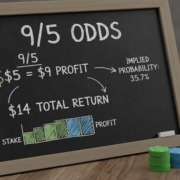
Odds 9/5 Meaning: What Do These Odds Really Tell You?

If you’ve ever looked at a betting market and spotted odds 9/5, you might have paused for a second to work out exactly what they mean.

They’re not quite short odds, not a big outsider either — but somewhere in that interesting middle ground where many bets live.

In this guide, we’ll break down odds 9/5 meaning in plain English.

You’ll learn how much you win at 9/5, how to convert these odds into other formats, what they imply about probability, and whether they can represent good betting value.

We’ll also look at examples across different sports and discuss some sensible strategies when betting at this price point.

Whether you’re new to betting or just brushing up, this article will give you a solid understanding of 9/5 odds.

What Does 9/5 Mean in Betting?

9/5 is a set of fractional odds, the traditional odds format used by UK bookmakers.

Fractional odds show profit relative to stake, not the total return.

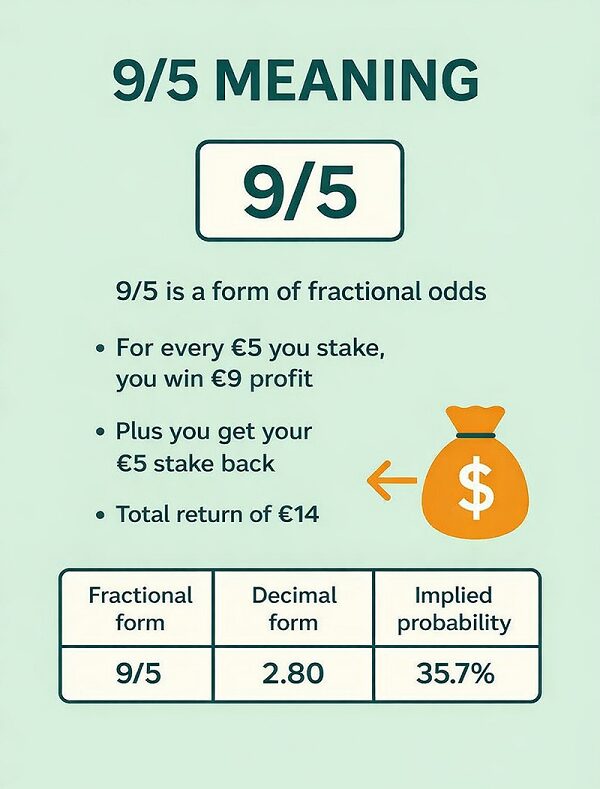
So when you see 9/5, it means:

  • For every £5 you stake
  • You win £9 in profit
  • Plus you get your original stake back

In short, 9/5 tells you how much you stand to win over and above your stake if the bet is successful.

How Much Do You Win at 9/5 Odds?

Let’s make this concrete with some real examples. The maths behind odds 9/5 is straightforward once you see it in action.

Basic Rule

To calculate profit at 9/5:

Stake × (9 ÷ 5)

That’s the profit. Then add your stake back on top to get the total return.

Example 1: £10 Stake

  • Profit: £10 × 9 ÷ 5 = £18
  • Total return: £28

Example 2: £25 Stake

  • Profit: £25 × 9 ÷ 5 = £45
  • Total return: £70

Example 3: £50 Stake

  • Profit: £50 × 9 ÷ 5 = £90
  • Total return: £140

A useful shortcut is to remember that 9/5 equals 1.8.

So you can quickly estimate profit by multiplying your stake by 1.8.

Converting 9/5 to Decimal or American Odds

While fractional odds are common in the UK, you’ll often see odds displayed in other formats — especially if you’re using international bookmakers or betting exchanges.

9/5 to Decimal Odds

To convert fractional odds to decimal odds:

(9 ÷ 5) + 1 = 2.80

So:

9/5 fractional = 2.80 decimal

This means you receive £2.80 back for every £1 staked, including your stake.

9/5 to American Odds

American odds work a little differently, but since 9/5 converts to decimal 2.80, it becomes +180 in American format.

That tells you:

  • A £100 stake would return £180 profit

Examples of 9/5 Odds in Different Sports

You’ll see 9/5 odds across a wide range of sports. They usually indicate a selection that is competitive but not dominant.

Horse Racing

In horse racing, 9/5 is often associated with:

  • A strong second favourite
  • A horse with solid form but a few doubts (ground, draw, class)
  • A contender in a competitive handicap

It’s a common price for horses that are expected to go close but aren’t the obvious standout.

Football

In football betting, odds around 9/5 might appear when:

  • A decent away side plays a stronger home team
  • Two evenly matched teams meet, but one has a slight edge
  • A team has injury concerns or rotation risks

You’ll often see 9/5 in match odds, correct score markets, or specials.

Tennis

In tennis, 9/5 can crop up when:

  • One player is marginally favoured
  • Surface or recent form slightly swings the balance
  • The market expects a competitive match

Other Sports

You’ll also see 9/5 odds in:

  • MMA and boxing
  • Golf outright markets
  • Cricket match betting

In most cases, the price reflects uncertainty with upside.

Are 9/5 Odds Good Value?

Whether 9/5 odds are good value depends on one thing:

Do you think the real probability is higher than 35.7%?

Value betting isn’t about picking winners — it’s about backing outcomes that are priced too generously.

Example

If a bookmaker offers 9/5 (35.7%) but you believe:

  • The true chance is closer to 45%

Then the odds are potentially undervaluing the selection, which creates value.

On the flip side, if the true chance is only 30%, then 9/5 would actually be poor value — even if the bet wins occasionally.

Over time, consistently backing value prices is what separates profitable bettors from casual punters.

Strategies for Betting on 9/5 Shots

Odds of 9/5 sit in an interesting sweet spot. They’re not speculative longshots, but they’re also far from “bankers”. Because of that, how you approach these bets can make a big difference to long-term results.

Below are several sensible strategies bettors commonly use when dealing with 9/5 shots, along with real-world examples to show how they work in practice.

1. Treat 9/5 as a “Value Favourite”, Not a Certainty

One of the biggest mistakes bettors make is treating odds like 9/5 as if they should win.

In reality, the implied probability is only around 36%, meaning the bet will lose more often than it wins over time.

The key is to think of 9/5 as a value favourite rather than a safe one.

Example (Football):
A mid-table Premier League side is playing at home against a newly promoted team.

The home side is priced at 9/5 due to a couple of injuries, but underlying stats (xG, shot volume, home form) still strongly favour them.

If your analysis suggests the true chance is closer to 45%, then 9/5 may represent value — even though the team will still lose plenty of the time.

The takeaway:
✔ Back 9/5 shots when the price looks wrong, not just because the team or horse “should win”.

2. Use 9/5 Bets as High-Quality Singles

Because 9/5 sits in the middle of the odds spectrum, these selections often work best as single bets rather than being bundled into accumulators.

Accas can be tempting, but bookmaker margins multiply quickly when you start stacking selections.

Example (Horse Racing):
A horse priced at 9/5 has:

  • Strong recent form
  • A favourable draw
  • Proven performance on today’s ground

Backing it as a £25 single returns £45 profit if it wins. Adding it to a four-fold might look attractive on paper, but one unpredictable result wipes out the entire bet.

For many bettors, consistently backing strong 9/5 singles is more sustainable than chasing bigger returns via accumulators.

3. Look for Market Overreactions

Odds of 9/5 often appear when the market reacts too strongly to a single factor — such as an injury, a team sheet, or a recent loss.

These overreactions can create value if the underlying picture hasn’t changed as much as the price suggests.

Example (Tennis):
A player loses their last match heavily and drifts to 9/5 for their next fixture. However:

  • The loss came against a top-10 opponent
  • Today’s match is on their preferred surface
  • Head-to-head record is favourable

If the market has overreacted to one poor result, 9/5 might be a better price than it should be.

This is a common situation where informed bettors are happy to step in.

4. Compare Bookmakers Before Placing the Bet

Because 9/5 is a very common price point, you’ll often find variation between bookmakers.

One firm might offer 9/5, while another has the same selection at 13/8 or 7/4.

That difference matters.

Example (MMA):
A fighter is priced:

  • 9/5 at one bookmaker
  • 7/4 elsewhere

The implied probability at 7/4 is higher than at 9/5. Taking the bigger price improves your long-term edge — even though the outcome is identical.

This is a simple but often overlooked strategy that can significantly improve profitability over time.

5. Consider Each-Way or Place Markets (Where Relevant)

In sports like horse racing, a 9/5 favourite doesn’t always have to be backed to win.

Sometimes the win price looks tight, but the place terms offer a more sensible risk-reward balance — especially in competitive fields.

Example (Horse Racing):
A 9/5 favourite is running in a 12-runner handicap. The horse is consistent but not dominant, and the race looks competitive.

Instead of backing it outright:

  • You back it to place
  • Or consider an each-way alternative on a slightly bigger-priced rival

This approach can reduce variance while still capitalising on your read of the race.

6. Watch for Late Price Moves on 9/5 Shots

Because 9/5 is a “decision price”, late market movement can be particularly revealing.

  • A move from 9/5 to 13/8 may suggest confidence from informed bettors
  • A drift from 9/5 to 5/2 could indicate doubts emerging late on

Example (Football):
A team opens at 9/5 but shortens across the market an hour before kick-off after confirmed team news. That move can reinforce your original analysis.

While price movement shouldn’t be followed blindly, it can provide useful confirmation — or a warning — when betting at this odds level.

7. Match Your Staking to the Odds

Finally, sensible staking matters. Because 9/5 shots lose more often than they win, aggressive staking can quickly lead to drawdowns.

Many experienced bettors use:

  • Level stakes
  • Or slightly reduced stakes compared to shorter prices

This helps smooth variance and protects the betting bank during inevitable losing runs.

Example:
Instead of staking £50 on every selection, you might:

  • Stake £30 on 9/5 shots
  • £40–£50 on shorter prices
  • Smaller stakes on longer odds

The goal is consistency, not chasing one big win.

Key Takeaway

Betting on 9/5 shots is most effective when:

  • You believe the true probability is higher than 35.7%
  • You treat them as value opportunities, not certainties
  • You use disciplined staking and avoid emotional accumulators

Handled correctly, 9/5 odds can be a profitable price range — but only when backed with logic, patience, and value-focused thinking.

🙋 FAQs About 9/5 Odds

Is 9/5 better than 2/1?

No — 2/1 offers a bigger return but implies a lower chance of winning. 9/5 is shorter and suggests a more likely outcome.

Is 9/5 close to evens?

Not really. Evens (1/1) imply a 50% chance, while 9/5 implies about 36%.

What’s the decimal version of 9/5?

2.80 decimal odds.

Do 9/5 odds include my stake?

No. Fractional odds show profit only. Your stake is added on top of the winnings.

Are 9/5 odds common?

Yes — especially in UK horse racing and competitive football markets.

Common Mistakes When Reading 9/5 Odds

Even though 9/5 odds are fairly straightforward, they’re often misunderstood. These small errors can add up over time if you’re not careful.

Confusing Profit With Total Return

At 9/5, the £9 refers to profit only, not what you get back in total. You always receive your stake back on top.

For example, a £5 bet returns £14, not £9.

Treating 9/5 as a Safe Bet

9/5 might feel like a strong price, but it still implies only a 35.7% chance. These bets will lose more often than they win, so they shouldn’t be treated as certainties.

Ignoring Implied Probability

Odds are probability statements, not just payout figures. If you’re not asking whether the true chance is higher than around one in three, you’re not really assessing value.

Comparing Odds Without Converting Them

Fractional odds can be misleading at a glance. Converting 9/5 to 2.80 decimal or 35.7% probability makes it much easier to compare prices and spot the best value.

Overloading Accumulators

Stacking multiple 9/5 selections into accumulators might look appealing, but margins and variance add up quickly. These odds are usually better suited to singles.

Quick Takeaway

Most mistakes with odds 9/5 come from overestimating how often they win or misunderstanding what the price actually represents.

Keep probability and value in focus, and those traps are easy to avoid.

Final Thoughts on Odds 9/5 Meaning

Understanding odds 9/5 puts you in a much stronger position as a bettor. They represent a selection with a solid chance, but not a certainty — roughly one win in every three attempts according to the market.

When used thoughtfully, 9/5 odds can offer excellent opportunities, especially when your own assessment suggests the bookmaker has slightly misjudged the true probability.

As always, the key isn’t the odds themselves — it’s whether the price is right.


Who is the Best Football Tipster?

Searching for the best football tipster in 2026? You’ve come to the right place. We’ve spent countless hours reviewing, testing, and comparing hundreds of services to bring you the most reliable and up-to-date list of today’s leading football betting tipsters.

With so many options out there, it can be difficult to know who to trust.

That’s where we step in. By focusing on verified results and proven performance, we highlight only the tipsters who consistently deliver.

So, whether you’re looking for expert Premier League predictions, value bets in the lower leagues, or tips on international fixtures, this guide showcases the football tipsters who truly stand out.

We’ll explain what makes a top football tipster — and reveal our definitive list of the Top 10 Football Tipsters.

Introduction to Football Tipsters

Football betting is a huge market, and many punters turn to experts for an advantage over the bookies. That’s where football tipsters come into play.

A football tipster is either an individual or a service that shares predictions and analysis on football matches. Their tips might cover everything from match outcomes and goals to corners and even player performances.

The aim is simple: to give punters the information they need to make smarter bets and increase their chances of winning.

The challenge, though, is that with so many tipsters out there, knowing who to trust isn’t easy.

Some tipsters bring years of experience and a proven record of success, while others make big promises but fail to deliver consistent profits.

Being able to spot the difference — and judge a tipster’s true reliability — can save you both time and money, while giving you a real edge in your betting. That’s why we provide fully independent, verified reviews of football tipsters, with every result tracked for complete transparency.

So whether you’re a seasoned bettor refining your strategy or a beginner keen to start on the right foot, choosing tipsters with a solid long-term record will give you a major advantage over the average punter.

What Makes a Great Football Tipster?

When assessing a football betting tipster, it’s important to look beyond the flashy winning bets they might showcase on social media.

These are the main factors we consider when evaluating a football tipster:

  • Strike Rate – This measures how often a tipster’s bets win. Most football tipsters operate with a strike rate of around 40–50%, depending on the markets they focus on.
  • Return on Investment (ROI) – ROI shows how much profit you make per 100 units staked. For example, if a tipster generated £20 profit for every £100 wagered, their ROI would be 20%. In football betting, an ROI of 5% is considered solid, while 10% or higher is outstanding over the long term.
  • Bank Growth – This reflects how much a tipster can increase your betting bankroll. For instance, turning a £2,000 starting bank into £4,000 within a year represents 100% bank growth.
  • Longevity – The best football tipsters don’t just perform well in the short term; they show consistency year after year. Many tipsters start strong but fade quickly, so long-term proof is crucial.
  • Verified Results – Far too many tipsters cherry-pick winners or highlight only short-term hot streaks.

At Honest Betting Reviews, we only feature tipsters with transparent, verified records — and we run our own independent trials to ensure they’re genuinely profitable.

By taking all these factors into account, we’re able to compile a clear, trustworthy list of the Top 10 Football Tipsters for 2026. So, let’s dive in!


Our Top 10 Football Tipsters

The moment you’ve been waiting for — our Top 10 Football Tipsters! 🎉

After months of live trials and in-depth reviews, we’ve crunched the numbers, tracked every bet, and analysed the performance of countless tipsters. The result? A definitive ranking of the football tipsters who truly deliver.

Finding a reliable tipster isn’t just about flashy wins — it’s about consistent profits, verified records, and long-term success. That’s exactly what we’ve looked for when putting this list together.

Each of the tipsters in our top ten has been tested under real conditions, with full transparency, and has proven their ability to beat the bookies time and time again.

So, let’s dive straight in and reveal the best football tipsters you can trust right now!

Rank Tipster speciality Profit ROI Strike Rate Rating
10 Goal King Goals Markets (Over/Under, BTTS) 210 points 3% 58% 3.5/5
9 Footballer Tips Goals Markets (Over/Under, BTTS) 400 points 5% 40% 4/5
8 Draw No Bets Draw No Bet 70 points 20% 40% 4/5
7 Bets for Today VIP Tips Multiples (Doubles, Trebles, Accumulators) 200 pts (Doubles) 4% 35% 4/5
6 Trade On Sports Various Goal Markets 51 points 8% 67% 4/5
5 Predictology Various Strategies, Global Leagues 38 points (Live Trial) 11% 52% 4.5/5
4 Back of the Net Lay the Draw In-Play 70 points 10% 41% 4.5/5
3 The Inside Man Match Odds, Asian Handicap, Player Passes 170 points 10% 43% 4.5/5
2 Scottish Confidential Scottish Football 200 points 10% 43% 5/5
1 JK Diego Draw Betting 100 points (live trial) 7% 44% 5/5


Now let’s break down the Top 10 Best Football Tipsters list in more detail, looking at their results, profitability and the type of markets each tipster specialises in:


10. Goal King

Kicking off our list is The Goal King, a football tipster service run by Steve Hudson — a respected name in the betting world.

Steve is also the man behind the long-running and successful AccaTipster service, so he brings plenty of credibility and experience to the table.

As the name suggests, The Goal King specialises in the goals markets, with a focus on popular bets like over/under 2.5 goals, over/under 3.5 goals, and both teams to score (BTTS). The service covers all the major European leagues as well as international tournaments.

The results speak for themselves: The Goal King has generated over 210 points profit in total. To put that into perspective, that’s £2,100 profit at £10 per point — or an impressive £10,500 at £50 stakes.

With a strong 58% strike rate, more than half of all bets placed have been winners.

During our own 12-month independent trial, The Goal King delivered 43 points profit, earning a solid PASSED rating from us.

Thanks to his proven track record and continued success beyond our trial, The Goal King fully deserves his place among the best football tipsters.

Rating: 3.5/5

You can check out the Goal King here.


9. Footballer Tips

In ninth place on our list is Footballer Tips, a long-standing and respected service within the Tipstrr network.

Much like The Goal King, this tipster specialises in the goals markets, including over/under bets, both teams to score (BTTS), and Asian handicap goals. Their selections span a wide range of football leagues — including some of the lesser-known competitions where market liquidity can be lower.

To maximise returns from this service, it’s recommended to hold accounts with multiple bookmakers so you can consistently secure the best available odds.

What really sets Footballer Tips apart is their remarkable consistency. Since launching in the summer of 2020, they’ve delivered over £11,000 profit to £25 stakes per point.

That’s been achieved with a 40% strike rate (just under half of bets landing) and a solid 7% ROI, maintained across more than three years of tipping.

Even more impressive, Footballer Tips has finished in profit in over two-thirds of all months since the service began — something very rare in football betting.

Thanks to this long-term reliability and steady profit record, Footballer Tips earns a strong 4-star rating and a deserved spot among the top football tipsters.

Rating: 4/5

You can check out Footballer Tips here.


8. Draw No Bets

Another service worth highlighting is Draw No Bets, part of the well-known Betting Gods network.

As the name suggests, this tipster focuses on the Draw No Bet market, where you back a team to win but get your stake refunded if the game ends in a draw. It’s a smart way to reduce risk while still securing solid profits.

Subscribers receive daily tips by email, usually around 8:30am UK time, covering a wide range of football leagues.

Since the selections are available with all major bookmakers and exchanges, it’s easy to follow the service.

So far the results have been very good, 70+ points profit made to 1-point stakes.

Their performance metrics have been excellent, with a 40% strike rate and 20% ROI.

They probably won’t keep this up forever—as an ROI of 10% is considered exceptional for football tipsters—but if they continue to be profitable and deliver winning months as they have then that would be very impressive.

Rating: 4/5

You can check out Draw No Bets here.


7. Bets for Today VIP Tips

Next up is Bets for Today VIP Tips, a service that stands out from most of the other football tipsters on this list.

Unlike many services that focus on a single sport, Bets for Today VIP Tips covers both football and horse racing — though subscribers can choose to receive football-only tips if they prefer.

What makes this service unique is its focus on multiples rather than single bets. They specialise in doubles, trebles, and accumulators, often taking advantage of bookmaker odds boosts to unlock extra value.

The results have been impressive:

  • Over £4,000 profit from doubles at £20 stakes
  • More than £4,400 profit from trebles
  • Over £3,100 profit from accumulators

During our own live trial, Bets for Today VIP Tips passed with flying colours, producing profits across all four of their football betting strategies.

Since most of their tips target the big leagues, there are no real liquidity issues, and the potential profits — particularly from accumulators — can be significant.

Add in the fact that their subscription price is very affordable, and Bets for Today VIP Tips is an excellent choice if you’re looking for reliable football betting tips at a fair cost.

Rating: 4/5

You can check out Bets for Today VIP Tips here.


6. Trade on Sports – Football

In sixth place we have Trade On Sports, a long-established and highly respected tipping service with a strong record of success.

While Trade On Sports is a multi-sport platform, football is at the core of what they do. The heart of their operation is the innovative Gamestate App — a huge database that analyses football leagues from across the globe.

The Gamestate App uses data from thousands of matches to assess how early goals influence the flow of a game. For example, an early strike might push a team to attack more aggressively, while a goal just before half-time could completely change the game’s momentum.

Building on this data, the Trade On Sports team has created a number of powerful strategies. One of the most popular is the Half-Time Overs Bot, which pinpoints matches with a strong likelihood of at least one second-half goal, often coming late in the game.

During our live trial of the HT Overs Bot, we recorded an impressive £5,120 profit to £100 stakes, backed by a 67% strike rate.

Beyond the HT Overs Bot, Trade On Sports also runs profitable systems for markets like over/under 2.5 goals, lay the draw, and even away team betting.

What makes Trade On Sports stand out is their constant innovation and drive to develop new ways of finding value. With a history of consistency and strong results, they’ve rightly earned their place as one of the top football tipsters in 2026.

Rating: 4/5 

You can check out Trade on Sports here. 


5. Predictology

Taking fifth place on our list is Predictology, a powerful football betting and trading toolkit.

In today’s betting world, punters have access to an overwhelming amount of stats, tools, and data.

While this is a big step forward compared to the past, the real challenge is cutting through the noise and turning that information into profitable betting systems.

That’s exactly where Predictology excels. With a huge database of over 350,000 football matches from leagues worldwide, it allows bettors to develop, test, and refine strategies with precision.

Predictology offers a dual approach:

  • Use their pre-built strategies, ready to follow.
  • Or dive into the database yourself, applying filters to create your own bespoke betting systems.

In our live trial, we tested their pre-designed strategies delivered daily via email — and the results were excellent: 38 points profit with a 52% strike rate.

They cover more than 50 leagues and run a variety of systems, including:

  • Lay the Draw – 497 points profit, 18% ROI
  • Goals, Goals, Goals – 67 points profit, 12.5% ROI
  • Value Home Wins – 148 points profit, 19% ROI

For those who prefer hands-off betting, Predictology also offers optional automation tools (at extra cost), making it easy to set up and run systems automatically.

In a world where staying ahead is everything, Predictology gives football bettors the tools and insights needed to gain a real edge and take their betting to the next level.

Rating: 4.5/5

You can get a 7 day trial of Predictology here.


4. Back of the Net

Next on our list is Back of the Net, a specialist football tipster service that focuses on lay the draw opportunities during live matches.

What makes Back of the Net stand out is its data-driven, analytical approach. By using in-play statistics and detailed match data, the service identifies scenarios where a goal is highly likely — perfect for lay the draw betting.

Subscribers receive regular selections by email, along with step-by-step instructions, making it straightforward to follow even if you’re new to this style of betting.

Selections are triggered by carefully designed filters that take into account multiple factors pointing to an imminent goal. Typical lay prices fall between 1.40 and 1.70, meaning liabilities remain relatively low.

Since its launch in May 2023, Back of the Net has produced over 70 points profit. At £50 stakes per point, that’s more than £3,500 profit.

In our live trial of the service, it produced a commendable 34 points profit at a return on investment of 9%.

With a solid 41% strike rate, Back of the Net has quickly built a reputation as one of the most promising football betting services, and it already boasts a proven track record of success.

Rating: 4.5/5

You can check out Back of the Net here.


3. The Inside Man

Claiming the number three spot on our list is The Inside Man, a football tipster with a rare advantage — he used to work on the other side of the counter as a bookmaker.

The man behind the service, Adam Cheng, was formerly the Head of Football Trading at Fitzdares. His job involved setting markets for the bookmaker and trading football odds to maximise profits.

In early 2020, Adam left the bookmaking world to become a full-time professional gambler, and since then he has delivered outstanding results.

According to his published records on the Bet Chat website, The Inside Man has produced 170 points profit, backed by a 10% ROI and a 52% strike rate — meaning more than half of his bets have been winners.

We’ve also tested the service ourselves, and in our own live trial we’ve made over 20 points profit — a solid effort so far.

The service is easy to follow, with around 5–10 bets per week, mostly in match odds, Asian handicap markets, and player passes.

All in all, The Inside Man is one of the best football tipsters we’ve come across in the last 3–4 years, combining insider expertise with consistent, profitable results.

Rating: 4.5/5

You can check out The Inside Man here.


2. Scottish Confidential 

Formerly known as the Scottish Football Income Booster (SFIB), Scottish Confidential is a specialist football tipster focusing exclusively on the Scottish leagues.

The service is run by a university-educated mathematician based just outside Glasgow, whose professional background is seriously impressive.

He has previously worked for major bookmakers, acted as a proprietary trader for an Asia-based private investment syndicate, and even served as a Scottish football consultant for a quant-driven hedge fund.

This unique mix of mathematical expertise and local insight gives him a major edge over ordinary punters. His in-depth knowledge of teams, players, and motivational factors within Scottish football consistently translates into profitable betting advice.

The track record speaks for itself: Scottish Confidential has delivered over 200 points profit, with a 43% strike rate and a 10%+ ROI.

We’ve been following and verifying results for more than four years, and the consistency has been outstanding.

The main focus is on match odds (1X2), but the service also provides occasional bets in markets such as over/under 2.5 goals, draw no bet (DNB), and double chance (DC). Every Scottish league is covered, from the Premiership down to League Two.

As one of the most reliable tipsters of recent years, Scottish Confidential stands out as a top football betting service, with unparalleled knowledge of Scottish football that gives subscribers a clear advantage.

Rating: 5/5

You can check out Scottish Confidential here.


1. JK Diego’s Draw Betting System

And now for the moment you’ve all been waiting for… taking the number one spot in our Best Football Tipster rankings is the one and only JK Diego’s Draw Betting System!

Unlike most services, JK Diego focuses exclusively on backing the draw in football matches.

This unique strategy was developed over many years of analysing the characteristics that lead to stalemates and pinpointing where the real betting value lies.

Draws are often overlooked in football betting. Many punters prefer to back one side to win, while betting on the draw can feel like sitting on the fence. Because of this, the draw is frequently under-bet, which means bookmakers sometimes offer excellent value prices.

The key, of course, is knowing exactly when the draw represents value — and that’s where JK Diego excels.

Certain leagues and teams, particularly in low-scoring competitions, have a natural tendency to produce draws. Spotting these patterns is the foundation of this system’s success.

The results speak volumes. JK Diego’s Draw Betting System has delivered over $11,000 profit to $100 flat stakes, or an incredible $60,000+ profit when using his progressive staking approach.

In our own extensive 15-month live trial, the system produced over 100 points profit, confirming its strength under real-world conditions.

There’s also the option to trade out at 85 minutes if a game is level, which can slightly boost profits while reducing losing runs — making the experience smoother for subscribers.

The only drawback is the relatively high subscription cost, but this is partly deliberate to keep membership numbers limited and prevent odds from being heavily impacted.

If you’re able to secure access to this exclusive service, it could easily be one of the most profitable decisions you make in football betting.

Rating: 5/5

You can check out JK Diego’s Draw Betting System here.


Best Football Tipster By Type

In addition to the best football tipsters in general across the board, there are an increasing number of footy tipsters who specialise in a particular type of market. 

Here we have dug in-depth to the best tipsters by their particular specialism:

So if you’re looking to focus in on a certain type of market, or want to gain access to an expert in their particular field of football betting, it can be worth checking out these betting specialists.


What to Avoid When Choosing a Football Tipster

When choosing a tipster, it’s equally important to know what to steer clear of. Watch out for these warning signs:

  • Unrealistic claims: Be cautious of tipsters who promise massive returns or boast an ROI exceeding 50%. Such guarantees are rarely credible.
  • Lack of transparency: Always seek verified performance records. If a tipster doesn’t provide clear, verifiable results, consider it a significant warning sign.
  • “Fixed matches” scams: Steer clear of anyone offering so-called fixed match outcomes. These are almost always fraudulent schemes.

By focusing on reliable tipsters and avoiding these common traps, you’ll set yourself up for smarter and more informed betting decisions.


Best Football Tipster – The Contenders

Now we assess the credentials of some of the more famous figures in football tipping and evaluate whether they have a claim to sit on the Iron Throne of football betting as tipster-in-chief.


Pete Nordsted – Premier Betting

Pete Nordsted rose to prominence with the publication of his 2009 book “Mastering Betfair” which contained strategies for making money trading on the betting exchanges.

That was quickly followed up in 2010 with “The Essential World Cup Betting Guide”, which received widespread acclaim, as did his Premier Betting Handbooks series. 

Pete now runs two football betting websites, Trade on Sports and also the premierbetting.com website with fellow full-time punter Danny Jacques.

He is a full-time sports trader and football betting expert and spends countless hours analysing football markets looking for value betting opportunities.

Contributing weekly articles at goal.com, and Matchbook – where you can view his drawmaster tips – Mr Nordsted is very widely respected in the industry and has built up a formidable knowledge of football betting.

With such a broad portfolio and a considerable depth of knowledge, Pete is rightly considered one of the foremost names in football tipping.


Kevin Pullein – Racing Post

Perhaps one of the most famous football tipsters around is Kevin Pullein from the Racing Post. According to his employers, he is “quite simply the best football analyst and forecaster ever to have appeared in print in the UK.”

Now perhaps they are biased, we couldn’t really say. But Kevin has established a formidable reputation as a predictor of all things football-related and used to have a regular column on the Guardian where he published some fascinating articles on general trends in football betting.

These articles were based on extensive research and years worth of statistics and often revealed that long-held beliefs about “universal truths” in football betting are, in fact, bunkum.

Some of our personal favourites were his article showing that it is not always a goal-fest when top teams play those lower down their division, analysis about the significance of playing at home (it’s actually more of a factor in South America than Europe) and stats showing you shouldn’t always to expect lots of cards in derby matches.

Some of these ideas were expanded on in his 2009 book “The Definitive Guide to Betting on Football,” which we thoroughly recommend as an insightful guide to developing winning football betting strategies.

Now frustratingly the Racing Post don’t publish full results of their tipsters so we can’t really say how good Mr Pullein’s tips are (cue a trial perhaps?). But given his long-standing reputation and contribution to exploding some of the myths around football betting, we think Kevin is certainly worthy of consideration for the accolade of “Best football tipster.”


Angus Loughran – aka “Statto”

Another famous tipster and professional gambler familiar to many is Angus Loughran.

Loughran rose to prominence on 1990s television show Fantasy Football League alongside Frank Skinner and David Baddiel. Clad in pyjamas and a dressing gown, Loughran was nicknamed “Statto” on the show and provided stats on the guests’ fantasy football teams.

Loughran built up quite a reputation for himself, appearing on the BBC’s horse racing coverage, writing a betting column for the Daily Telegraph and commentating on football for Eurosport and ESPN.

He was famed for his almost encyclopedic knowledge of football, reportedly watching hundreds of football matches per year (before the days of Sky and BT Sports when that sort of thing became normal) and there were even whispers that Loughran was making hundreds of thousands per year betting on football.

Sadly his carefully cultivated image appeared to have come crashing down in 2008 when he was declared bankrupt, reportedly for owing debts to spread betting firm Sporting Index.

Events surrounding the bankruptcy were shrouded in mystery however, with reports suggesting the debt amounted to little more than £5,000 and that Loughran had done promotional work for Sporting Index and had not expected the firm to press ahead with the bankruptcy proceedings.

In the event the bankrupty was annulled in April 2008 via a voluntary agreement. Whatever the exact circumstances surrounding the bankruptcy, the incident did little for the pundit’s reputation as one of the country’s most foremost professional gamblers.

Perhaps Angus had the last laugh though, as he was reported to be one of the main investors in stats firm Opta, which was sold for £47m in 2013.

He currently provide tips on the easyodds website, although these are on horse racing rather than football.

It is difficult to give a firm verdict on Loughran’s abilities as a football tipster – or even as a gambler. For reputation alone though he must be considered as one of the most famous of the modern era.


Ben Linfoot – Sporting Life

What isn’t such a mystery is the excellent record of Mr Linfoot, who has amassed quite a following at the Sporting Life’s tipping section

Ben is probably best known for his Value Bet column, which offers value bets for the top weekend race meetings. However, he has also produced a commendable return on his football bets, including tipping Athletico Madrid for the 2014 Champions League each-way at 40/1 (if you remember they were just a minute away from victory in the final before Sergio Ramos headed an equaliser for Real Madrid). 

Mr Linfoot concentrates mainly on the big leagues and Champions League and opts for the selective approach of a few well-thought out tips rather than tipping large numbers of selections.

With a large following and a profitable record, Bin Linfoot deserves to be recognised as one of the best football tipsters.


Matt Love – Football Elite

Matt ran the respected Football Elite website from 2009 to 2019 and built up a deserved reputation as one of the top football tipsters around during that time.

His selections are based on evaluations of home and away form and the over-valuation of big name teams when they are out of form. Together with other stats, Matt puts together weekly “recommended bets” that are usually around 5-10 of the top bets from around the top leagues in Europe.

The good thing about betting in the top European leagues is that prices stand up well and there is no rush to get the bets on in the fear that prices will crash. On the contrary, prices often drift out before kick-off with people tending to back the big-name clubs whilst Matt opposes them.

In the past couple of seasons, Matt also introduced tips for the English leagues below the Premiership and a “vulnerable home favourites” system.

The results speak for themselves, with his recommended bets having amassed 458% bank growth since going live, the football league bets producing 44% profit and his ante-post bets making 73%.

There are few football tipsters out there who can boast such an impressive long-term record, so although he may not be as well known as some of the names above, we believe Mr Love deserves to be considered for the crown of best football tipster.


Verdict

Well it seems there is no obvious winner of the title of “best football tipster.” Certainly we have a few contenders, but frustratingly many of the big names don’t actually publish their results, which is both unhelpful and usually a bad sign.

In terms of knowledge and publishing record, Kevin Pullein and Pete Nordsted would appear to have the edge.

Perhaps on notoriety and fame, few can top Angus Loughran. On their actual tipping record however, it appears Matt Love has it with his Football Elite tips.

We heartily recommend his football tips if you are looking for someone who can find value bets in high liquid markets and produce profit season-in and season-out.

As ever though, we will continue our quest to find the ultimate football tipster and we have a number of trials going on at the moment. Perhaps one will emerge to take the crown once and for all…


FAQ: Football Tipsters

1. What is a tipster?

A tipster is an expert who gives you predictions and advice on football matches.

These can be bets on match result, goals, corners or other aspects of the game.

Tipsters use various methods, stats, historical data and inside knowledge to make their tips.

2. How do tipsters make their predictions?

Tipsters use many methods to make their predictions.

These can include historical match data, team form and player injuries, stats models and algorithms.

Some tipsters also have inside knowledge from their time in the industry.

3. Are tipsters reliable?

Tipsters can be very hit and miss. Some have a good track record, others don’t deliver.

Research a tipster’s past performance, read reviews and understand their betting strategy before following their tips.

4. How do I choose the best tipster?

When choosing a tipster consider:

  • Track Record: Look for tipsters with a proven history of success and transparent results.
  • Specialism: Some tipsters focus on certain markets or leagues so choose one that suits you.
  • Strike Rate and ROI: Look at their strike rate (percentage of winning bets) and ROI.
  • Cost: Consider the subscription fees and is the potential return worth the investment.

5. What should I look for in tipster reviews?

In tipster reviews look for:

  • Performance Metrics: Profit, ROI and strike rate.
  • Transparency: How tips are made and past results.
  • User Feedback: Reviews and testimonials from other users.
  • Trial Periods: Availability of trial periods or free tips to try before you buy.

6. How do tipsters get their information?

Tipsters get their information from:

  • Match Data: Historical and current match stats.
  • Team News: Team line-ups, injuries and tactical changes.
  • Bookmaker Insights: Odds and market movements from bookmakers.
  • Expert Analysis: Industry experts and analysts.

7. Can tipsters guarantee profits?

No one can guarantee profits as football is an unpredictable sport.

While some tipsters have a good track record, betting always carries risk and past results don’t guarantee future success.

Bet responsibly and use tipsters’ advice as part of a bigger betting strategy.

8. How often do tipsters tip?

Frequency of tips varies among tipsters. Some tip daily, others weekly or for big matches. Check the tipster’s service details to see their tipping schedule.

9. Are there free tips?

Yes, many tipsters offer free tips to attract new subscribers.

But free tips aren’t always as comprehensive or reliable as paid services. It can be a good idea to track the results of free tips before you decide to follow them with your own money. 

10. Can I use multiple tipsters at once?

Yes, you can use multiple tipsters to spread your bets.

Just make sure to manage your bankroll – e.g. have a separate bankroll for each tipster – and track each tipster’s performance.

 

Gecko Edge – AI Tools for Sharp Bettors

Artificial intelligence is becoming a bigger part of sports betting — not as a magic prediction engine, but as a tool to help bettors think more clearly about probability, pricing, and value.

One of the newer platforms leaning into this approach is Gecko Edge.

Rather than offering tips or selections, Gecko Edge positions itself as an analysis and decision-support tool — something designed to help bettors identify expected value (+EV) opportunities, understand market mispricing, and build repeatable betting or trading processes.

This article explains what Gecko Edge is, how it works, and where AI fits into modern betting, along with the strengths and limitations of this kind of technology.

What Is Gecko Edge?

Gecko Edge is an AI-powered football betting analysis platform built around expected value, probability modelling, and market comparison.

Instead of telling you what to bet, it focuses on answering a more important question:

Is this price actually good value compared to the true probability?

The platform allows users to analyse unlimited matches and competitions each day, running different analytical “prompts” that evaluate goal markets, match odds, handicaps, and in-play scenarios.

In simple terms, Gecko Edge tries to highlight where the bookmaker’s odds don’t fully reflect the statistical likelihood of an outcome.

How Gecko Edge Works (In Plain English)

At its core, Gecko Edge combines three main ideas:

1. Statistical Modelling

The platform uses established mathematical tools such as:

  • Poisson distributions to model goal scoring
  • Expected goals (xG) data to estimate attacking and defensive strength
  • Bayesian updating to adjust probabilities as new information becomes relevant

These aren’t gimmicks — they’re widely used methods in quantitative football analysis.

2. Probability vs Market Odds

For any given market, Gecko Edge compares:

  • The model’s calculated probability
  • The bookmaker’s implied probability (from the odds)
  • The difference between the two (the EV%)

If the model believes an event has a higher chance of occurring than the odds suggest, that’s flagged as positive expected value.

3. Contextual Prompts Instead of Raw Stats

Most betting platforms dump statistics on you and expect you to interpret them.

Gecko Edge works differently. It runs structured prompts that surface conclusions such as:

  • “This Over 2.5 Goals price is undervalued”
  • “The market is overrating this favourite”
  • “Value may appear in-play if certain conditions are met”

The idea is to turn data into actionable insight, not spreadsheets.

How to Use Gecko Edge 

We’ll take a look now at how Gecko Edge works in practice. 

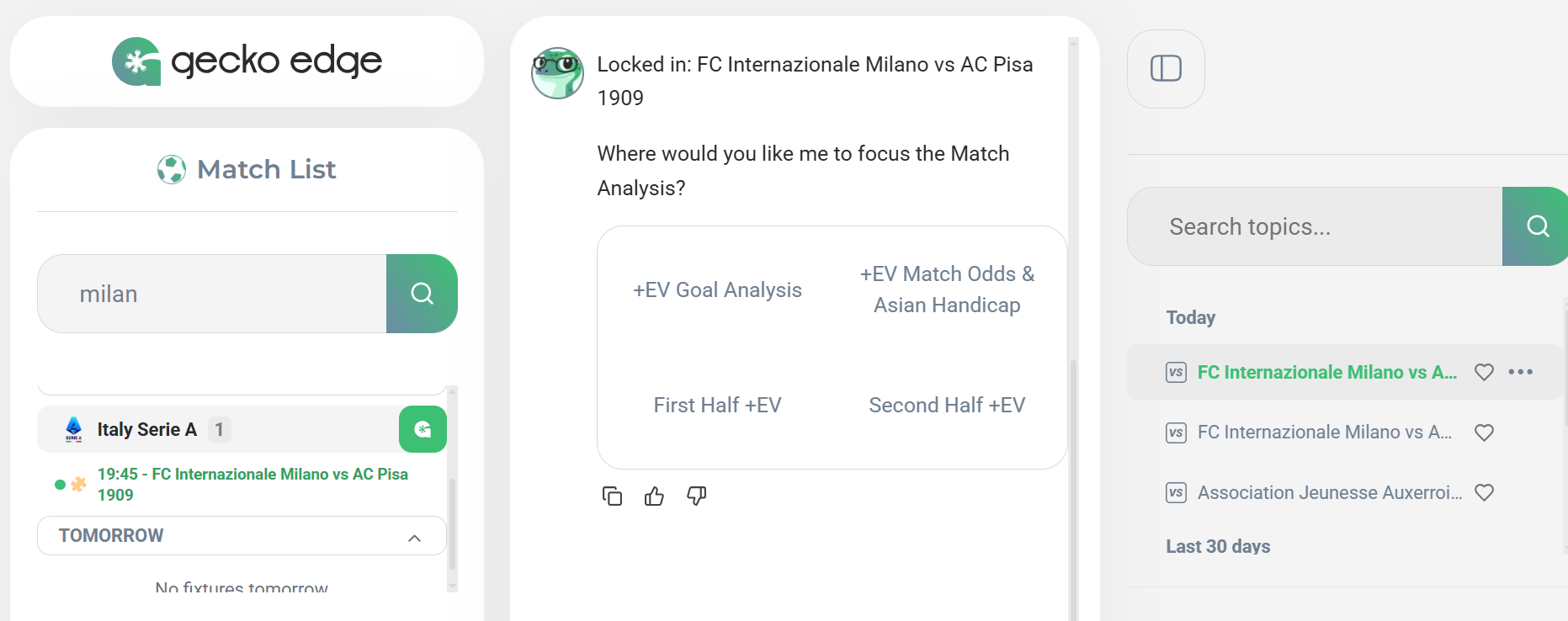
First you log in to the platform, then you will see a list of leagues and fixtures in the left side panel.

You can also search for fixtures.

After scanning the fixtures, you can then select a fixture to focus on. 

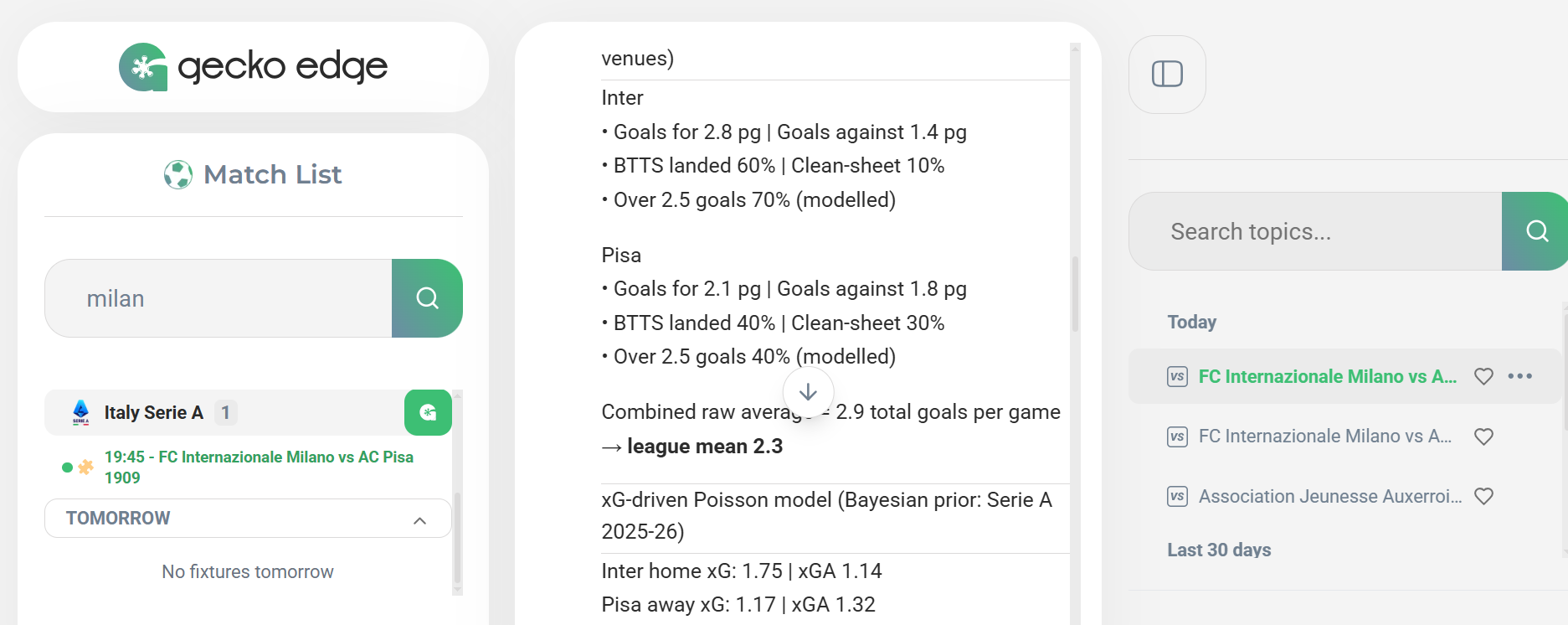
In this example we have selected Inter Milan vs Pisa:

Next you can select which type of market you would like Gecko Edge to focus on. 

Here we have selected +EV Goal Analysis, which looks at things like the over/under markets and Both Teams to Score

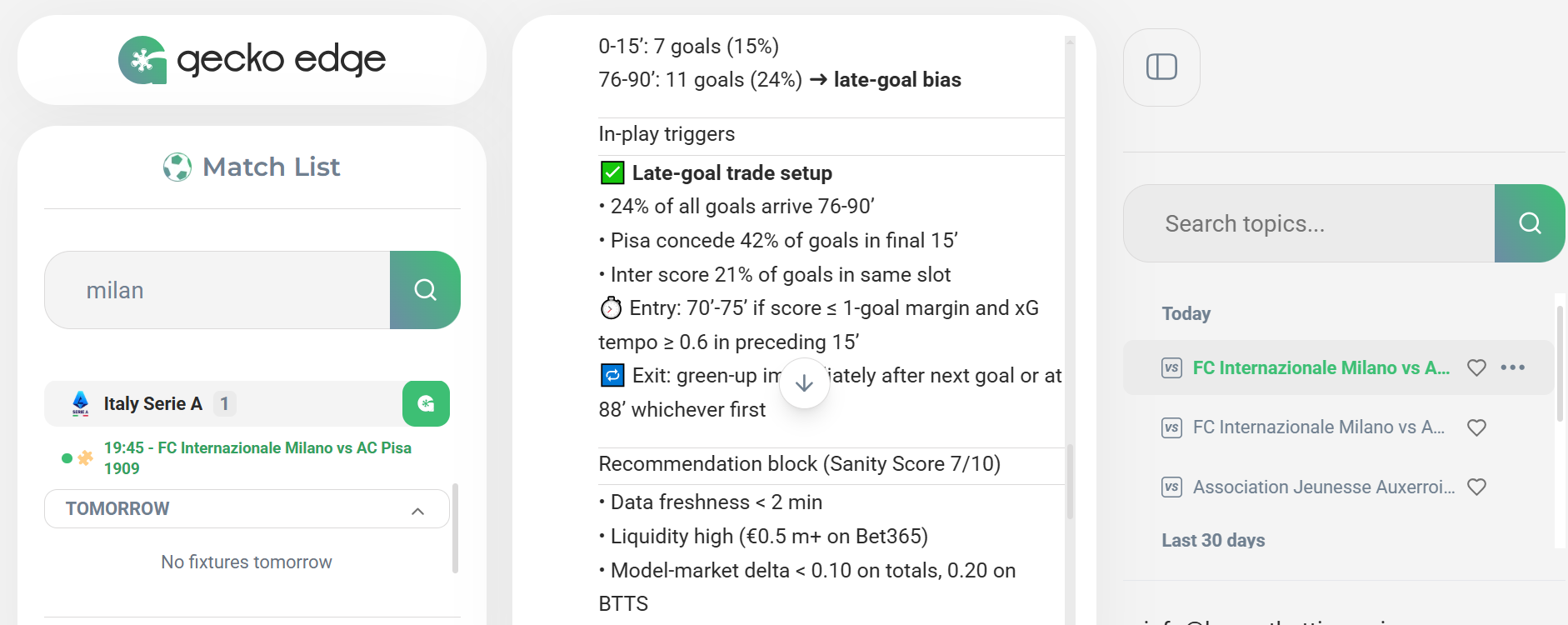
You are then given a detailed analysis looking at factors like the expected goals, Poisson distribution and scoreline probabilities:

There is a lot of detailed, useful information provided here on which to base potential bets.

You are even provided with some trade set-up examples, for those who like to trade on the exchanges rather than just betting on the pre-match markets.

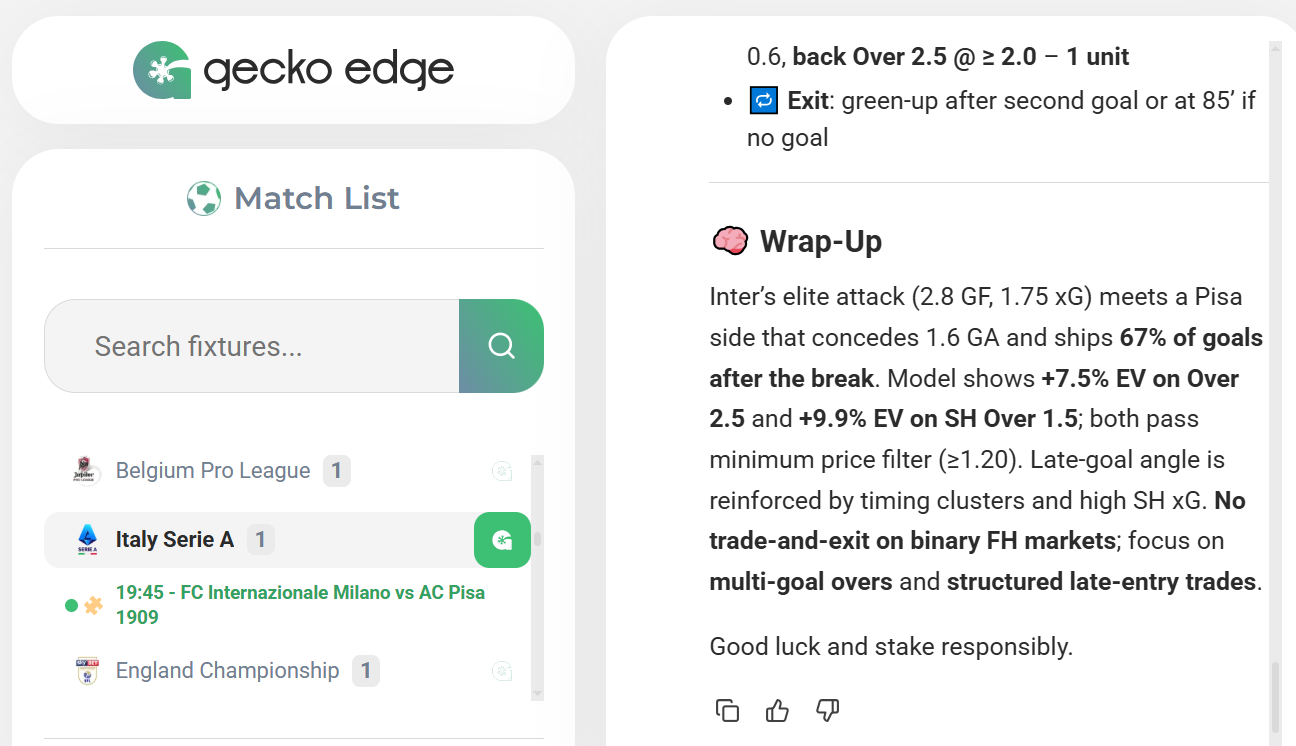
Finally there is the summary or “Wrap Up” with Gecko Edge’s final recommendations on the match.

It has found that there is expected value (EV) of 7.5% on over 2.5 goals and 9.9% expected value on over 1.5 second half goals.

So these would be potential bets to look at, plus the late goals trade indicated earlier in the analysis.

You can have a look at as many matches as you like in this way to find the best opportunities. The analysis is all very fast thanks to AI so it’s not time-consuming at all.

As this is a platform providing tools and analysis rather than “tips” or “picks” as such and as everyone would get different results when using it, we don’t think there is much value in doing a traditional review as such with our own results.  

However, we think it’s worth having a look a little deeper at the theory behind the platform, its pros and cons and any potential pitfalls.

Understanding Expected Value (Why It Matters)

Expected value is one of the most misunderstood concepts in betting.

A bet can win and still be bad, or lose and still be good.

Gecko Edge puts EV front and centre by showing how far the model’s probability diverges from the market price.

For example:

  • Model probability: 70%
  • Market implied probability: 58%
  • Edge: +12% EV

That doesn’t mean the bet will win — it means that over hundreds of similar bets, that edge should be profitable if the model is sound.

The platform also encourages nuance:

  • Small EV edges require volume
  • Larger EV edges deserve more scrutiny
  • Extremely high EV flags may indicate missing information (injuries, motivation, rotation)

In other words, it’s not just about finding bets — it’s about understanding confidence levels.

The Main Betting Markets Gecko Edge Analyses

Goal Markets and Totals

Gecko Edge places a strong emphasis on goal-based betting and trading, including:

  • +EV Over / Under lines
  • Both Teams To Score (BTTS)
  • First-half and second-half goals
  • Late-goal probability in the final 20 minutes

These prompts use goal expectancy, timing distributions, and match tempo indicators — areas where markets are often slower to adjust, especially in-play.

Match Odds and Handicaps

For bettors who prefer results markets, Gecko Edge also models:

Rather than just predicting winners, the system estimates margins of victory, which is crucial when assessing handicap prices.

Fixture-Specific Deep Dives

Users can run detailed match-level analysis that combines:

  • Goal expectancy across multiple markets
  • First-half vs second-half dynamics
  • Comeback and late-game scenarios

This is designed to give a full probabilistic picture of a single fixture, rather than relying on surface-level trends.

Pre-Match vs In-Play: A Key Strength

One of the more sensible aspects of Gecko Edge is its willingness to say “avoid pre-match”.

That’s important.

If the model thinks goals are likely but the market price already reflects (or exceeds) that probability, there’s no edge — even if the bet eventually wins.

Instead, Gecko Edge often points toward conditional in-play entries, such as:

  • Waiting for odds to drift
  • Using time-based triggers
  • Combining live xG with price movement

This reinforces a crucial betting lesson:

  • Being right is not the same as being profitable.

Pros of Using AI Tools Like Gecko Edge

✔ Focus on Value, Not Predictions

AI works best at probability comparison, not crystal-ball forecasting. Gecko Edge stays in its lane.

✔ Repeatable, Process-Driven Betting

The use of workflows and structured prompts encourages discipline rather than impulse betting.

✔ Handles Volume Better Than Humans

Analysing dozens of leagues and matches daily is unrealistic manually. AI excels here.

✔ Helpful for Traders as Well as Bettors

The emphasis on timing, in-play conditions, and late-match dynamics suits exchange trading styles.

Limitations and Real-World Caveats

AI is powerful — but it’s not magic.

⚠ Models Don’t See Everything

Injuries, tactical changes, motivation, weather, and team rotation aren’t always fully captured in data.

⚠ EV Isn’t Short-Term Friendly

Even good EV bets can lose frequently in the short run. Bank management still matters.

⚠ Users Still Need Judgment

Gecko Edge provides signals and probabilities — you still decide what to do with them.

Anyone expecting guaranteed winners will misunderstand what this kind of platform is for.

Who Is Gecko Edge Best Suited To?

Gecko Edge will appeal most to bettors who:

  • Already understand basic betting markets
  • Want to move beyond tips and predictions
  • Are interested in value betting or trading
  • Prefer data-driven decision-making
  • Are comfortable thinking in probabilities rather than certainties

It’s less suited to casual punters looking for quick picks or “bankers”.

Final Thoughts: AI as a Betting Assistant, Not a Shortcut

Gecko Edge reflects a broader shift in sports betting.

The edge no longer comes from secret systems or inside information — it comes from understanding probability better than the market, and acting with discipline when value appears.

Used properly, AI tools like Gecko Edge don’t replace human judgment — they sharpen it.

And in modern betting, that’s often where the real advantage lies.

In terms of our final thoughts on Gecko Edge, we really like the platform itself and the simplicity and user-friendliness of it. 

What we would like to see with Gecko Edge however is better tracking tools for the picks.

Quite a few of the matched betting and value betting packages these days have tools to allow you to track the bets you have made and their results so you can see exactly how they have performed.

A tracking tool like this in Gecko Edge, allowing you to filter by market, league etc to see which are performing best and any patterns would be handy and we have suggested this to them.

The platform could also do with slightly clearer referencing as to which odds they are using to compare the EV with. Sometimes it refers to Bet365 odds but on others it is not so clear. A link to live odds from the highlighted EV selections would be a real benefit here.

Overall we like the idea of Gecko Edge and think it has real potential. Certainly AI is developing very fast right now and it surely will have plenty of uses in betting.

It’s a bit difficult though to give it a “verdict” or rating as such without some clear sense of its long-term proficiency – or even whether it has been tested and proven to beat the market in the long run.

We would like to see a big sample of say 1,000 or 2,000 bets – ideally tracked live on the platform but even historic – demonstrating that it does actually have a clear edge over the market in the long-term. 

Although we appreciate the platform has not been designed to produce “tips” or “picks” as such and is more of an analysis tool, ultimately users are still going to want to know if they can make a profit from using it. 

Until it has proven that, it is difficult for us to give a firm rating on it either way.

As we say though, we do like the concept behind Gecko Edge and certainly the insights should be useful in picking out potential bets. And we do think there is great potential with it. 

With a few tweaks and some proven results, it could definitely be a big winner in the world of betting in the future. 

You can check out Gecko Edge for yourself here.


Roulette Strategies: What You Need to Know

Image by Greg Montani from Pixabay

Roulette is often considered a game of pure chance, but many players turn to strategy to feel more in control.

In this article, we break down the most common approaches, explain how they align with real odds, and why not all of them hold up.

Any strategy is best tested under minimal financial pressure, especially early on. One way to do that is by using Reveryplay no deposit bonus codes, which let you try roulette without using your own money.

It’s a simple way to see how a system performs in real conditions, without the risk.

Understanding the Odds: Why Roulette Is Hard to Beat

Roulette is built on fixed probabilities. Each spin is random, and the house edge ensures the casino always has a statistical advantage over time.

On an American wheel (with both 0 and 00), the house edge is 5.26%. European roulette, with a single zero, lowers that to 2.70%.

French roulette is even more favorable: thanks to rules like La Partage and En Prison (which return part of your bet on a zero), the edge drops to about 1.35%.

In practical terms, for every $100 wagered, the casino expects to keep $5.26 on an American wheel, $2.70 on a European one, and just $1.35 on a French table.

This margin doesn’t change, no matter what betting pattern you use. That’s why the first and simplest strategy is to choose the right variant.

Playing on a single-zero or French wheel doesn’t eliminate the edge, but it does reduce it, giving you better chances in the long run compared to double-zero games.

Another key point: every spin is independent. The ball doesn’t remember where it landed before.

Yet many players fall for the gambler’s fallacy, believing that if red has hit five times, black is now “due,” or that certain numbers are “hot.” But the odds don’t shift. If the chance of hitting red on a European wheel is 18 out of 37 (about 48.6%), it stays exactly the same on every spin.

Strategies built on tracking streaks or predicting what “should” come next ignore this reality. Unless the wheel is biased or rigged, no system can predict outcomes.

The best you can do is understand the odds and not fight them with false patterns.

The Truth About Popular Roulette Strategies

Roulette players have developed many betting systems over the years. Let’s explore a few well-known strategies and why they appear to work, as well as where they ultimately fall short.

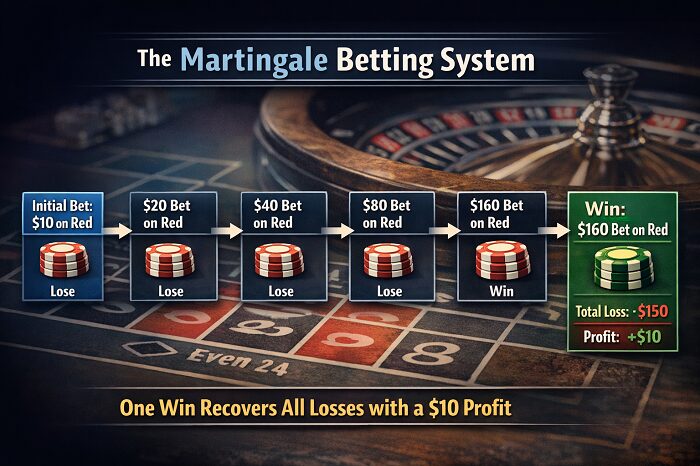
Martingale

Martingale is the most well-known roulette system. It works like this: after every loss, you double your bet, usually on even-money options like red/black.

The idea is simple. When you eventually win, the payout covers all prior losses plus a small profit equal to your original stake.

For example, if you bet $10 on red and lose, you go to $20, then $40, then $80, and so on.

A single win resets the cycle and locks in $10 profit.

In theory, with unlimited money and no table limits, this would work every time. But in real life, that’s not how it goes.

Losing streaks happen, even on a European wheel, the chance of seven losses in a row is about 1%, or once every hundred spin sequences.

If that happens, your $10 bet turns into a required $1,280 wager on the eighth spin.

If you cannot cover the required wager due to betting limits or insufficient bankroll, you will have lost $2,550 while trying to win just $10.

Most Martingale players experience many small wins, then one heavy loss that wipes out everything.

Typical simulations show that with a bankroll covering six doubles, you’ll succeed close to 98% of the time. But the 2% of failed sessions cause such large losses that they cancel out all gains.

One bust costs 63 units, while the total profit from the 58 successful attempts before it is only 58 units. Net result: negative.

Martingale doesn’t beat the house edge. It hides it until it hits all at once. That’s why casinos set maximum bets: to stop players from doubling into safety.

This system can feel effective short-term, but long-term, the math always catches up.

Gentler Progressions: Labouchere, D’Alembert, Fibonacci

To mitigate the Martingale’s steep risk, many players turn to less aggressive negative progression systems.

These include the Labouchere (Cancellation) system, where you increase bets according to a preset sequence of numbers, or the D’Alembert system, which has you raise your bet one unit after a loss and lower it one unit after a win.

The Fibonacci system follows a similar idea, using the famous Fibonacci sequence (1, 1, 2, 3, 5, 8, …) to determine bet sizes after losses.

All these strategies aim for the same basic goal: gradually recouping losses with slightly larger bets, hoping that a run of wins will cover any preceding downturn.

Because their bet escalation is slower than Martingale’s doubling, they require a smaller bankroll and hit table limits less quickly.

This makes them feel safer. A D’Alembert progression doesn’t put your entire bankroll on the line after a handful of losses.

However, the fundamental flaw remains. No progression can overcome a protracted losing streak or the constant drain of zero.

A long series of losses will still result in very large bets or an unrecoverable drawdown. And even when losses and wins alternate more mildly (which these systems anticipate), the house edge ensures that, on average, you’ll pay a tax on each bet you place.

The end result is that over many spins, the expected value of these systems is just as negative as flat betting. They merely alter the variance and timing of wins and losses.

You might string together a moderate profit during a session where luck alternates favorably, but eventually an unlucky run or the accumulated 2.7% edge on each wager erodes your funds. 

Paroli (Reverse Martingale)

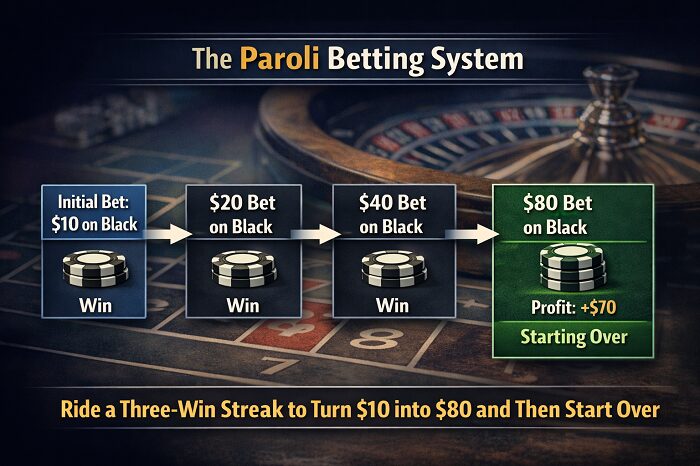
Paroli is a positive progression system. Unlike Martingale, it increases your bet after a win, not a loss. The idea is to ride short winning streaks while keeping losses small.

Let’s say you bet $10 on black and win. You then bet $20, win again, and go to $40. If you win three times in a row, you’ve turned $10 into $80.

You then start over at $10 and lock in the profit. If you lose at any stage, you simply return to your base bet.

That’s the appeal: you’re never chasing losses, and the most you risk per cycle is your original stake.

Many sessions end close to break-even or with a small loss, but when you hit that rare three-win streak, the payout can be significant relative to what you’ve risked.

Paroli helps you control the downside while letting you take full advantage of lucky streaks. But like all systems, it doesn’t change the odds.

The chance of winning a single even-money bet is about 48.6% on a European wheel.

What are the odds of winning three consecutive bets? Just 11.5%. Most of the time, you’ll lose before you get there.

Breakdowns of Paroli sessions show that the big +7 unit win is uncommon, while small wins or losses are more frequent.

The house edge is still there on every spin, it just doesn’t show up as steadily because you’re not increasing bets after losses.

Paroli is one of the safer systems out there. It won’t win long-term, but it can structure your play without putting your bankroll at serious risk.

Fixed Betting Combinations 

Some roulette strategies don’t change bet size, but they focus on how bets are spread across the table.

A well-known example is the James Bond strategy, which splits a fixed stake between high numbers (19–36), a six-number line (13–18), and a single chip on zero.

This setup covers most of the wheel and results in frequent wins, but those wins are usually small.

When you land on one of the uncovered numbers, the loss is larger and wipes out several previous gains. Other players create their own fixed combinations, like covering two dozen numbers or placing multiple corner bets to boost their hit rate.

And while these setups do win more often, they don’t improve your actual odds. The more numbers you cover, the lower the payout on each win.

For example, covering 25 out of 37 numbers on a European wheel gives you a 67.6% chance of winning something on each spin.

But the payout is small, and the losses from the 12 uncovered numbers are much bigger.

You’re trading win frequency for lower returns, not changing the edge.

The James Bond system gives you about a roughly 66% chance to win each spin, but the other 34% of spins will often cancel several wins at once. Over time, the math catches up.

The house edge stays the same. Some players also bet on “hot” or “cold” numbers, thinking a number is either due or lucky.

This misconception doesn’t hold up. Roulette spins are independent, and modern wheels are highly accurate.

Any small bias is usually too minor to matter. As gaming analyst Michael Shackleford notes, fair casino wheels don’t leave exploitable patterns.

So systems based on number streaks or “due outcomes” are driven by the gambler’s fallacy not fact. In a fair game, there’s no hidden logic to follow.

Just probability and the house edge.

Conclusion – Understanding Roulette Strategies

Understanding these strategies and the odds can help you play smarter.

In a sense, strategies that “actually work” are those that help you manage your bankroll and expectations, rather than those promising impossible guarantees.

For example, setting win and loss limits is a sound strategy: decide in advance that you’ll walk away after winning a certain amount or if you’ve lost a certain amount.

This doesn’t change the odds of each spin, but it can protect you from chasing losses in a downward spiral or from giving back a big win out of overconfidence.

Likewise, choosing European or French roulette whenever possible is a strategy that works to maximize your chances (by minimizing the house edge you face).

Using a moderate system like Paroli or a flat betting approach with discipline can provide structure to your play.

They ensure you don’t bet too big in the heat of the moment and can add to the fun when luck is on your side.


Total Betting: Over/Under Markets and How to Beat Them

Total betting—also known as over/under betting—is one of the most popular and versatile markets in sport.

Instead of worrying about who wins, you’re simply betting on how much happens: goals, points, games, runs, or yards.

That simplicity is deceptive. Behind every total line sits data, pricing models, public bias, and bookmaker margins—and understanding how those forces interact is where smart bettors gain an edge.

In this guide, we break down how over/under markets really work, how sportsbooks set and move totals, the key rules that trip bettors up, and the strategies professionals use to find value.

Whether you’re betting soccer goals, NBA points, NFL totals, or tennis games, this is a practical, no-nonsense deep dive into one of betting’s most important markets.

What Is Total Betting (Over/Under)?

Total betting is one of the most straightforward markets in sports betting. Rather than picking a winner, you wager on whether the combined points scored by both teams will finish above or below a number set by the sportsbook.

The terms “total,” “over/under,” and “O/U” all refer to the same thing across UK bookmakers, European operators, and US sportsbooks.

Consider two concrete examples:

  • A Premier League match might have a total line of 2.5 goals—you bet Over if you expect three or more, Under if you expect two or fewer.
  • In an NFL game, the line could sit at 44.5 points, and you’re betting on whether the two teams will combine for more or less than that total number.

Totals can apply to full matches, halves, quarters, periods, and even player props.

These totals are based on the total number of events—such as goals, points, or cards—that occur during the game or a specific segment.

In tennis, you might bet Over/Under 22.5 games in a match.

In the NFL, you could wager on a quarterback throwing Over 274.5 passing yards.

The flexibility of this market is part of its appeal.

From our perspective at Honest Betting Reviews, we look at totals both for straight betting and as part of the systems and trials we review.

Many tipster services focus on goal-based markets or NBA totals, and we track their results to help you separate profitable services from noise.

How Total / Over–Under Bets Work

The bookmaker sets a line—say 2.5 goals, 25.5 games, or 44.5 points—and your job is simple: decide whether the actual combined score will be higher (Over) or lower (Under) than that line.

You place your stake, and if your prediction is correct, you win.

Let’s walk through a detailed football example.

Suppose Arsenal play Tottenham in the Premier League, and the sportsbook sets the total at 2.5 goals.

If the match finishes 2-1, 3-0, 2-2, or any scoreline with three or more goals, the Over wins.

If it ends 1-0, 0-0, 1-1, or 2-0, the Under wins.

Notice that 2.5 is a half-point line—there’s no way to land exactly on it, which eliminates ties.

For a second example, consider an NBA game where the total is set at 215.5 points.

If the Lakers beat the Celtics 118-104 (total 222 points), the Over wins.

If the game ends 102-98 (total 200 points), the Under wins.

What happens when the total is a whole number? Suppose an NFL game has a total of 44 and finishes with exactly 44 points combined.

This is called a push, and your wager is refunded. You neither win nor lose money.

Most sportsbooks return stakes on pushes, though a minority count them as losses—always check the house rules before you bet.

The odds for Over and Under are often close, typically around 1.91/1.91 (or -110/-110 in American format).

However, they can differ depending on where the money flows. If heavy action comes in on the Over, a bookmaker might price it at 1.83 while offering 2.00 on the Under to balance their exposure.

How Sportsbooks Calculate & Move Total Lines

Bookmakers don’t pluck numbers from thin air. They use team stats, pace metrics, expected goals (xG), injury reports, weather forecasts, schedule congestion, and sophisticated simulations to set initial totals.

Importantly, they also incorporate present market conditions and present data to ensure their lines reflect the most current information available.

The goal is to create a line that attracts roughly equal action on both sides.

Injuries can shift lines significantly. If a star quarterback like Patrick Mahomes is ruled out before an NFL game, the total might drop by 3-4 points because the offence is expected to be less productive.

Similarly, if a prolific striker like Erling Haaland misses a Premier League match, the goal total could fall from 2.5 to 2.0 or see the Over priced more generously.

In MLB, starting pitchers heavily influence totals. A matchup featuring two elite aces at a pitcher-friendly park like Dodger Stadium might open at 7.0 runs.

The same teams at Coors Field in Colorado—notorious for thin air and long-distance hitting—could see a total of 11.5 runs.

Cricket totals work similarly, with venue size and pitch conditions playing crucial roles.

After opening, lines move based on betting activity. Public money typically favours Overs—casual bettors enjoy cheering for goals and points.

Sharp bettors, by contrast, often find value hitting Unders when totals are inflated by recreational action. Watching line movement can tell you which side the smart money prefers.

The vig (or overround) is also built into every total. If both Over and Under are priced at 1.91, the implied probability for each is about 52.4%.

Combined, that’s 104.8%, with the extra 4.8% representing the bookmaker’s edge. Even when the true probability is 50/50, you’re paying a premium to play.

Types of Total Bets Across Different Sports: Points Scored

Totals are available across nearly every sport: football, basketball, American football, tennis, baseball, ice hockey, and more.

The specific lines and units vary, but the core principle remains the same.

Football (Soccer) is where many UK bettors encounter totals first. The most common market is match goals, with lines typically set at 2.5 or 3.5 goals.

You can also bet on team goals—for example, “Liverpool Over 1.5 team goals” in a match against Everton—as well as corners, cards, and shots on target.

In addition to match totals, you can bet on the total for one team, such as “Over 1.5 goals for one team.”

Asian bookmakers and exchanges often offer granular lines like 2.25 or 2.75 goals, splitting your stake across two outcomes.

Basketball (NBA/EuroLeague) features high-scoring games, so totals often range from 210 to 240 points.

You can bet full-game totals, team totals (e.g., Miami Heat Over 108.5), quarter totals, or half totals. It’s also possible to bet on the total points for one team in a game.

Player props like three-pointers made also function as totals—Over/Under 3.5 threes for Stephen Curry, for instance.

American Football (NFL) typically sees game totals in the mid-40s, though high-powered offences can push lines into the 50s.

First-half totals, team totals, and player props (passing yards, rushing yards, receptions) are all popular.

An example: Cowboys at Bills with a total of 52.5 points.

Tennis uses game totals—Over/Under 22.5 games in a best-of-three match, for example. You can also bet on set totals, aces, and double faults.

A Wimbledon match between two big servers might feature an aces line of Over 24.5.

Baseball focuses on run totals, usually ranging from 7.0 to 9.5 depending on pitchers and ballpark.

Yankees versus Red Sox at Fenway Park might see a total of 9.0 runs.

First-five-innings totals are popular for bettors who want to isolate starting pitcher performance from bullpen volatility.

Ice Hockey (NHL) typically has totals around 5.5 or 6.5 goals.

Overtime and shootouts count towards full-game totals unless the market specifically states regulation-only.

A matchup between defensive teams might open at 5.0, while a game featuring high-scoring offences could reach 7.0.

Key Rules: Overtime, Extra Time, Pushes & Half-Point Lines

The image captures basketball players in mid-action during an intense NBA game, with one player making a dynamic move while another defends. In the background, the scoreboard displays the total points scored, adding to the excitement of the sport and the ongoing competition.

Understanding the rules around overtime and settlement is critical in totals (over/under) betting.

In many sports—particularly basketball and American football—overtime is included in full-game totals by default, often referred to as “overtime counts.”

Unless a market is clearly marked as “regulation time only,” any points scored in overtime will contribute to the final total.

For example, if an NBA game is tied 102–102 at the end of regulation and finishes 115–110 after overtime, the total used for settlement is 225 points.

A bet on Over 214.5 would therefore win thanks to the extra-time scoring.

However, this rule does not apply universally. In football (soccer), standard over/under goals markets are settled on 90 minutes plus stoppage time only, with extra time excluded unless explicitly stated otherwise.

If an NBA game is tied 102-102 at the end of regulation and finishes 115-110 after overtime, the total of 225 points is what settles your bet.

A total of 214.5 would hit the Over thanks to those extra-time points.

However, this doesn’t apply to half or period-specific markets. If you bet on the first-half total in an NHL game, only goals scored in the first two periods count.

Overtime is irrelevant to that wager. Similarly, some football markets are explicitly “90 minutes only,” excluding extra time and penalties in cup matches.

Half-point lines exist specifically to avoid pushes. When the sportsbook sets a total at 44.5 instead of 44, there’s no possibility of a tie.

The game either finishes with 44 or fewer combined points (Under wins) or 45 or more (Over wins).

In football (soccer) however, the rules are different regarding over time (aka extra time). Let’s look at an example:

  • A match between Man Utd and Chelsea finishes 1–1 after 90 mins and 3–1 after extra time
  • Over 2.5 goals would LOSE on standard totals

A brief note: rules vary by bookmaker. Some player prop markets exclude overtime, while full-game totals include it. Before placing any wager, check the specific terms.

Disputes often arise when punters assume extra time counts when the market is regulation-only.

Strategies & Angles for Profiting from Total Betting

Let’s be honest: beating totals long-term is difficult. Sportsbooks have sharp analysts, and the vig means you need to win more than 52% of bets just to break even at standard odds when betting at  odds of -110 (1.91 in decimal terms).

At Honest Betting Reviews, we focus on evidence-based approaches—tracking data, testing models, and reviewing systems before recommending any tipster or method.

Using data and models not only increases your accuracy but can also help you save time and money by focusing on the most promising opportunities.

Pace and style analysis is one productive angle. Fast-paced teams in the NBA that push tempo and take quick shots tend to produce higher-scoring games.

Defensive matchups between grinding, half-court teams often stay Under. In football, two possession-oriented clubs with low xG profiles might consistently produce scoreless draws.

Understanding these dynamics gives you an advantage over bettors who simply follow gut feelings.

Early-season edges can be valuable. In the first four to six weeks of major leagues like the Premier League, NBA, or NFL, bookmakers are still calibrating totals.

New coaches, tactical shifts, and varying fitness levels create mispriced lines. A team that switched from defensive football to a high-pressing system might see their games go Over before the market adjusts.

Weather factors matter in outdoor sports. Heavy rain and strong wind reduce passing efficiency in the NFL and suppress scoring in UK football.

A match at the Etihad Stadium played in driving rain might reasonably trend Under, even if both teams usually feature in high-scoring games. Checking forecasts before betting is time well spent.

Public bias towards Overs is real. Casual bettors enjoy cheering for goals and points, which pushes Over lines higher than they should be.

Sharp bettors exploit this by hitting Unders when the market has overreacted.

If a Premier League total opens at 2.5 goals and moves to 3.0 purely because of recreational money, the Under at 3.0 might offer value.

Line shopping and timing cannot be overstated. Getting Over 2.5 at 1.90 instead of 1.80 makes a significant difference over hundreds of bets.

That extra 0.10 in decimal odds compounds into substantial profit over a season. Use odds comparison tools, and don’t be loyal to a single sportsbook when better prices exist elsewhere.

To help you profit from total betting, here are a few actionable tips: focus on pace and style matchups, monitor early-season trends, check weather forecasts, and always shop for the best lines.

Automated Betting Software: Tools, Pros & Cons

Automated betting software has rapidly become a game-changer in the world of sports betting, offering both new and experienced punters a smarter, more efficient way to place wagers.

These tools are designed to streamline the betting process, allowing users to implement strategies—such as exclusive horse racing systems, football systems, and even roulette systems—without the need for constant manual input.

Football fans can benefit from automation. Whether you’re following a proven football system or experimenting with your own data-driven approach, betting software can monitor odds, track line movement, and place bets the moment value appears.

This is especially useful in fast-moving markets, where hesitation can mean missing out on the best odds.

Bankroll Management, Stakes & Understanding Value in Sports Betting

Even the best total betting strategy fails without proper bankroll management.

We recommend fixed staking—risking 1-2% of your betting bank on each wager.

If you have a limited bankroll, it’s especially important to be disciplined with your staking strategy to avoid running out of funds.

Chasing losses by doubling down on “certain” Overs after a losing run is a fast track to emptying your account.

Value is the foundation of profitable betting. Expected value (EV) means your estimated win probability exceeds the implied probability of the odds.

If a sportsbook offers Over 2.5 goals at decimal 2.10, the implied probability is about 47.6%.

If your model or data suggests a 55% chance of three or more goals, you have positive EV and should consider the bet.

Here’s a worked example. You’ve analysed a match and believe there’s a 55% chance of Over 2.5 goals.

The odds are 2.10. Your expected return per $1 staked is (0.55 × $2.10) – (0.45 × $1) = $1.155 – $0.45 = $0.705.

Wait—that calculation shows a 15.5% edge, which is excellent.

In reality, edges are smaller. A 3-4% edge on totals, consistently applied, can be meaningful over a season of hundreds of bets.

Because totals are often priced close to 50/50, small edges matter enormously. You don’t need to be right 60% of the time; at -110 odds, 53% accuracy produces long-term profit.

At Honest Betting Reviews, we track ROI, strike rate, and drawdowns when reviewing tipsters or systems focused on totals.

These metrics tell you whether a service genuinely has an edge or simply ran hot for a few months.

Common Mistakes in Total Betting & How to Avoid Them

Most losing bettors repeat the same errors, especially in Overs markets. Recognising these mistakes is the first step to avoiding them.

Overreacting to tiny samples is widespread. After one weekend where seven Premier League matches produce four or more goals, you’ll see punters declaring it “an Overs league.”

That’s noise, not signal. You need months of data—ideally across multiple seasons—to identify genuine scoring trends.

Ignoring line movement costs money. If a total drops from 3.0 to 2.5 before kickoff, that movement usually reflects sharp action or significant team news.

Blindly betting against sharp money without understanding why the line moved is a losing proposition.

Betting Overs purely for entertainment is fine if you’re treating it as a leisure activity with money you can afford to lose. But if you’re trying to create long-term profit, cheering for goals isn’t a strategy.

You need numbers, rationale, and discipline.

Misunderstanding rules leads to disputes and frustration. Many punters assume extra time counts in FA Cup matches when the market is 90-minutes-only.

A game that finishes 1-1 after regulation then 2-1 after extra time would settle as Under 2.5 for regulation-only markets. Always read the terms.

Chasing with late-night Overs on obscure leagues is a recipe for disaster.

After a losing day, the temptation to back Over 2.5 in a Brazilian Serie B or late MLS match without any research is strong.

This is tilt betting, and it rarely ends well. Step away, log your losses, and return with a clear head.

Total Betting vs Handicap Betting

Handicaps (or spreads) and totals are the two most popular alternatives to moneyline betting, but they work differently.

Handicaps adjust the final score to level the playing field between unequal teams. Totals ignore who wins and focus solely on combined scoring.

Consider a Premier League match between Manchester City and Nottingham Forest.

The handicap might be Man City -1.5 goals, meaning City need to win by two or more for the bet to land.

The total might be set at 3.5 goals.

These bets can win or lose independently. If City win 2-1, the handicap loses (they won by one, not two) but the total goes Under (3 goals).

If City win 4-0, the handicap wins (four-goal margin) and the total goes Over (4 goals).

In the NBA, suppose the Lakers are -5.5 against the Hornets, with a total of 224.5.

If the Lakers win 118-108, they covered the spread (winning by 10) and the total went Over (226 points).

If they win 108-102, the spread hits (6-point margin) but the total stays Under (210 points).

When might you prefer a total over a handicap? When the winner is unclear but the game’s style points to high or low scoring.

If two evenly matched defensive teams meet, you might struggle to pick a handicap but feel confident in the Under.

Many experienced bettors maintain portfolios that include both markets, adjusting stakes based on confidence and perceived edge.

Where Honest Betting Reviews Fits In: Systems, Tipsters & Transparency

At Honest Betting Reviews, we’re an independent review platform focused on testing betting systems—including those built around totals and over/under markets.

We don’t just list services or go off a handicapper’s claimed results; we run live trials, track every bet, and publish the results in full so can you see for yourself what works and what doesn’t.

We’ve reviewed football systems, horse racing tipsters, and multi-sport services over the years.

Some have focused specifically on goal-based markets, claiming high strike rates on Over 2.5 or Under 3.5 bets.

Our job is to verify those claims with real-world tracking before recommending anything to our readers.

We’ve seen both excellent and poor total betting systems. Some deliver consistent ROI with transparent records. Others promise unrealistic win rates—80% strike rates on mainstream Overs—without verifiable data to back up their claims.

The difference between the two usually becomes clear after a few months of independent tracking.

When we review a service, we publish full results, including losing runs and maximum drawdowns. A tipster might show 15% ROI over 500 bets, but if they had a 40-bet losing streak in month three, you need to know that before committing your money.

Volatility matters as much as profit. If any member has a query about our systems, strategies, or testing procedures, they can submit it for prompt support and clarification.

 If you’re interested in total betting, our reviews can help you discover vetted sports bettors whose records include over/under markets. 

Examples of Total-Based Challenges & Systems (and How to Judge Them)

“Challenges” and systems built around totals have become popular content online.

The format is usually straightforward: start with a $100 bank and set a challenge to grow it by placing daily Over 2.5 or Under 2.5 bets at specific odds, aiming to reach a target like $400 or $1,000 over a month.

Here’s a hypothetical example. A “2.5 Goals Builder” challenge aims to grow $100 to $400 in 30 days by backing two or three Over 2.5 bets daily at average odds of 1.85.

The creator posts daily selections, tracks results, and claims a 65% strike rate.

Before following any such system, demand these key metrics:

  • Full bet history with timestamps and screenshots
  • Odds taken at the time of selection (not odds available after the bet)
  • Line movement context (did the total shift after the pick?)
  • Realistic staking (not wild compounding that assumes no losing runs)
  • Independent proof or verification from a third party

At Honest Betting Reviews, if we trialled a total betting system, we’d track every selection, record the line and exchange price, note whether we used Betfair or a bookmaker, and summarise ROI alongside worst drawdown. This is the standard we hold others to as well.

Watch for red flags. Claims of “no losing months” are statistically implausible over long periods. Guaranteed daily profits don’t exist in betting.

Very high strike rates (80%+) on mainstream totals without hard data are almost always exaggerated.

If a total betting club or service can’t provide transparent records, walk away.

Responsible Gambling & Final Thoughts on Total Betting

A person is focused on studying sports statistics on a laptop, with a notepad beside them for taking notes. The scene suggests a deep engagement in analyzing data related to sports betting, including points scored and team performance.

Total betting offers many angles—full-game markets, halves, team totals, player props—and can be engaging for both casual and serious bettors.

But it’s still gambling. The anticipation of hitting a last-minute goal to push a total Over is exciting, but the reality is that most bettors lose money over time.

Set staking limits before each session. Keep a betting log so you can review what’s working and what isn’t.

Treat any system or tipster as a tool, not a guarantee of income.

If you’re new to totals, consider starting with small stakes until you understand how markets behave.

Rather than focusing exclusively on one “magic” market, consider using totals as part of a balanced portfolio.

Mixing match odds, handicaps, and totals can smooth volatility and reduce reliance on any single approach.

The players who profit long-term are those who diversify, track results, and adjust based on data.

At Honest Betting Reviews, we provide ongoing education, reviews, and trial results so you can make informed, data-driven choices.

Whether you’re testing your own angles or considering a paid service, the same principle applies: verify before you trust. Demand transparency. Check the history. And never stake more than you can afford to lose.

Total betting rewards preparation. Understand the rules, read the markets, and hold any service you follow to high standards.

If you’re ready to explore further, visit our guides, access our newsletter, and discover which tipsters have genuinely profitable records in over/under markets.


Understanding Betting Odds for Beginners

Sports betting can seem like a maze of numbers and symbols to newcomers.

When you first encounter betting odds, whether they’re displayed as fractions, decimals or American-style figures, figuring out what they actually mean can be challenging.

These numerical representations determine not just the likelihood of an outcome, but also how much money you might win from a successful wager.

Learning how to calculate potential returns is an important skill for anyone interested in betting.

Instead of relying on guesswork or bookmaker estimates, many bettors turn to specialised tools to work out exactly what they stand to gain from their stakes.

Free online calculators have become popular resources for both casual punters and serious gamblers who want to make well-informed decisions.

These calculators make betting maths simpler, allowing you to input your stake and the odds to see potential returns instantly.

They’re especially useful when placing accumulator bets or more complicated wagers where manual calculations would be time-consuming and prone to errors.

How Betting Odds Work in Different Formats

Betting odds come in three main formats: decimal, fractional, and American.

Each format presents the same information but in different ways, and each is preferred in different parts of the world.

Beginners can benefit from learning these formats through practice and comparison when first trying out sports betting.

Decimal odds are commonly used in continental Europe, Australia, New Zealand, Canada and Singapore.

Many online bookmakers in these regions display prices for sports like football, horse racing and tennis in decimal format.

Decimal odds show the total return for every £1 wagered, including the original stake.

For example, if the odds are 2.50, a £10 bet would return £25 in total, with £15 profit plus the £10 stake.

Using decimal odds in practice allows punters to quickly check potential winnings on standard markets.

The calculation stays the same no matter the stake. For those interested in a broader guide to how odds calculation works, resources are available from betting authorities and industry guides.

Fractional odds have a traditional association with the UK and are also known as British or UK odds.

Historically, major bookmakers in the UK listed these odds for sports like horse racing and football.

For example, odds of 5/2 mean a £10 stake would return £25 profit and £35 in total, including the original stake.

This process shows how fractional odds communicate possible profit and total payout for every wagered amount.

Checking real market odds before placing a bet helps avoid mistakes in these calculations. Many UK bookmakers now offer the option to display odds in decimal format as well.

Converting Between Odds Formats

Switching between odds formats involves simple calculations any bettor can learn.

For instance, to change fractional odds to decimal, divide the numerator by the denominator and add 1.

If the odds are 5/2, divide 5 by 2 to get 2.5, then add 1 for a decimal equivalent of 3.5.

For decimal to fractional, subtract 1 from the decimal odds and convert the remainder to a fraction.

For example, odds of 2.75 minus 1 equals 1.75, which is 7/4 as a fraction. Bookmakers may show slight differences due to rounding or risk assessments.

American odds conversions use a simple formula.

For negative odds, divide 100 by the absolute value of the odds, then add 1 for the decimal equivalent.

For positive odds, divide the odds by 100, add 1, and that gives the decimal. For example, -200 converts to 1.5 in decimal, and +250 converts to 3.5.

Switching between odds formats can be helpful when using international betting platforms.

Many bookmakers offer a choice to display odds in different ways, but sticking to one format may lead to errors when comparing returns or finding the best options.

When comparing betting sites across Europe and North America, conversions allow direct comparison of offers to work out possible returns.

If odds seem confusing, double-check calculations with a calculator and consult bookmaker help resources if unsure.

Calculating Potential Payouts from Odds

Figuring out potential returns becomes straightforward once you learn the right formulas and apply them step-by-step.

For decimal odds, multiply the amount wagered by the decimal figure displayed. This method shows the total return, including both the original stake and any profit.

Checking that you’ve entered the correct odds and stake prevents overestimating returns.

Always reference the odds shown on the bookmaker’s site or validate results using this bet calculator for accuracy before placing the wager.

For fractional odds, use this formula: Stake × (numerator ÷ denominator) = profit. Then add the stake for the total return.

With a £10 bet at 3/1, the profit is £10 × (3÷1) = £30, and the total return is £40 including the stake.

With American odds, the formulas for conversion and calculation work the same way as described above.

For example, -200 converts to 1.5 in decimal, and +170 converts to 2.7. Converting American odds provides a way to check payouts for any given amount.

Many punters use a free online betting calculator to verify these calculations. These tools help with standard and accumulator bets, using the actual figures published for sporting events.

Implied Probability and Finding Value

Implied probability goes beyond showing what can be won on a bet. To understand how likely an outcome is, use the odds to calculate the implied probability.

For decimal odds, divide 1 by the displayed decimal, then multiply by 100 for the percentage chance.

For fractional odds, add the numerator and denominator together, then divide the denominator by that total and multiply by 100.

Implied probability is a calculation based on the odds, not a direct representation of actual chance. Bookmakers build their profit margins into these calculations.

Calculating Implied Probability from Different Odds Types

Implied probability calculations show a bookmaker’s view on likely outcomes using practical examples.

For decimal odds, dividing 1 by the decimal odds and multiplying by 100 gives the implied probability.

For fractional odds, add the numerator and denominator, divide the denominator by the total, and multiply by 100.

Spotting Value and Avoiding Common Probability Mistakes

Identifying opportunities relies on comparing your assessment of an outcome’s probability with what the bookmaker’s odds suggest.

If you believe a team has a true probability of 50% to win but find decimal odds giving an implied probability of 40%, that gap suggests a chance for a better bet.

However, accurately judging true probability can be extremely difficult, and most punters may not consistently find real advantages versus perceived opportunity.

Bookmakers set odds so the implied probabilities across all outcomes typically add up above 100%, covering their profit margin.

Accumulator and Multiple Bet Calculations

Accumulator bets combine more than one selection into a single wager, causing the odds for each pick to multiply for a larger possible return.

For example, if two teams have decimal odds of 2.10 and 2.60, multiplying these together gives total odds of 5.46.

A £10 stake would return £54.60 in total if both teams win, including stake and profit. These calculations show how multiples work using market odds.

Checking all odds before placing a combo bet avoids errors like adding prices rather than multiplying.

For a treble, multiplying three decimal odds together gives the combined odds.

For example, odds of 1.20, 2.38, and 2.62 multiplied together give 7.48 as the combined odds.

A £10 treble on these prices would return £74.80 if all selections won.

Because trebles and higher multiples carry extra risk, cross-checking confirmed starting prices through bookmaker websites and using a free online betting calculator provides a trustworthy read on payouts.

Always confirm each pick and result before finalising multi-leg bets to avoid common errors.


How Bettors Identify Safe Online Betting Environments

Online betting keeps growing fast, yet many sites still feel shaky. A new bettor can see bright ads and big claims, then miss the risk.

Smart players look for signs before they place any cash. Many people search for safe sites to bet online and where to find safe places to bet online, and that habit makes sense.

You can spot strong safety clues long before your first pay in. This guide shares real checks you can do at home. Each sign adds one more lock on the door.

When you stack those locks, you cut your odds of stress. You also keep the fun part in front. Safe play is not luck. It is a clear set of moves.

Licensing and Regulation

A fast safety check starts with the site license. Good books show a permit from the UKGC, the MGA, or a state group.

These groups push hard rules on cash, fair play, and player care. They make firms keep player funds apart.

They also demand third-party tests on key tools. A risky site may hide its license code. It may also show a dead seal. That alone should end the visit.

You can take the code and match it on the group site. The check takes a few mins. Some offshore books point to Curaçao.

That name can sound fine, yet the rules set can feel thin. Read the small text on the page. If the site runs on a sub permit, help can move slowly.

A clear, live permit works like a door pass. If you do not see it, walk.

Evaluating Security Features

After rules and papers, look at the tech. Start with the padlock and the https mark. SSL helps guard your login and payment data.

It turns your data into a code mix as it moves. A thief who sniffs the line sees trash. Good sites add more than one tool.

They use firewalls and 2 step sign in. They also run pen tests to spot weak spots. Some firms show seals from eCOGRA or iTech Labs.

Those marks can back fair play and clean feeds. Still, do not stop at a stamp. Read the site data note in full.

A solid note tells what data they take and why. It also tells how long the site keeps it. If the text stays foggy or skips key names, trust should drop.

A safe book treats net safety like rent. It pays that cost each day.

Checking Reputation and Player Feedback

Even with seals and locks, real-life use tells more. Look at how the book acts when things go bad. Fans talk on sports boards and chat groups.

You can also scan review hubs that keep old posts. One angry post can mean a bad day. A long row of the same claim means a trend.

Watch for repeat notes on locked funds. Watch for slow cash out with no clear cause. Praise can help too, if it stays steady.

Many users talk about fast pay and kind help. That sort of talk beats any ad line. You can also check a case group like IBAS. They list past cases and how the book dealt with them.

News posts can add more cues. They may note fines, leaks, or ties with pro teams. A book with a long, open trail tends to act fair.

A book with only hype talk may care more for sales than trust.

Testing Banking Options and Customer Care

Cash flow shows the truth in full. Safe books make pay-in and cash-out clear. They list times, fees, and minimum sums on the cash desk page.

You should see cards, bank wire, e-wallet, and crypto coins. A site may brag about fast pay. Then it may stall for days with weak notes.

That gap can warn you. Good books share a clear KYC page. It tells what files you must send and when.

Clear rules cut fights later. Helping staff also matters a lot. You want live chat, mail, and phone lines that work each day.

A good agent gives plain steps, not stock lines. If a book pays fast and talks straight, it earns trust.

You can then think about odds and plan. To sum up, you should treat each check like a gate. When the site fails one gate, you leave.


How to Win at Casino Slots: 7 Smart Ways to Improve Your Chances

Slot machines are one of the most popular casino games in the world — simple to play, fast-paced, and packed with eye-catching features that promise big wins with just the press of a button.

But if you’ve ever spent time spinning the reels, you’ve probably asked yourself the same question most players do: can you actually win at casino slots, or is it all just blind luck?

The truth sits somewhere between the hype and the harsh math. Slots are designed to favor the house over the long term, yet that doesn’t mean every session is doomed from the start.

How you choose games, manage your bankroll, use bonuses, and even decide when to stop can make a meaningful difference to your overall experience — and occasionally to your bottom line.

This guide cuts through the myths, “secret systems,” and misleading advice that surrounds slot play.

Rather than selling false promises, we focus on practical, evidence-based ways to improve your chances, stretch your budget further, and avoid the most common (and costly) mistakes players make.

If you enjoy slots and want to play smarter, this article will show you exactly how to approach them with realistic expectations, better decisions, and far more control over your money and time.

The Truth: Can You Really “Win” at Casino Slots?

Let’s be clear from the outset: there is no guaranteed way to beat casino slots over the long term.

Every legitimate slot machine—whether online or in a licensed land-based casino—uses a random number generator (RNG).

Each spin is completely independent, and no outcome is ever “due” to happen.

So what does “winning at slots” actually mean in practical terms?

It does not mean finding a system that overcomes the house edge.

Instead, it means playing in ways that reduce your expected losses, extend your playing time, and increase your chances of short-term success—while accepting that the math always favours the casino over time.

That comes down to choosing higher-RTP games, understanding volatility, using bonuses carefully, managing your bankroll with discipline, and knowing when to stop.

At Honest Betting Reviews, we test casinos, bonuses, and betting systems through live trials using real money.

We don’t sell “secret strategies” or miracle systems—and over the years, we’ve tested and debunked plenty that claim guaranteed slot profits.

This guide focuses on what actually helps players make better decisions, avoid common traps, and enjoy slots as entertainment—not as a way to generate reliable income.

What this article covers:

  • How the random number generator actually works and why you can’t beat it
  • Choosing high RTP slots and understanding volatility
  • Using casino bonuses and free spins without falling into traps
  • Bankroll management and stake sizing
  • Picking safe, licensed casinos with fair games
  • Why jackpot chasing is usually a bad long-term play
  • Common myths and mistakes that cost players money
  • Responsible gambling tools and when to seek help

How Slot Machines Really Work (RNG, RTP, and House Edge)

Before you start playing slots with any strategy in mind, you need to understand how modern slot machines work.

Whether you’re playing online slots at a casino or spinning reels in Las Vegas, the fundamental mechanics are identical.

Every licensed slot uses a random number generator—a mathematically-based algorithm that cycles through millions of numbers every second.

The moment you press spin, the RNG selects a number that determines exactly where the reels stop.

This happens so fast that the outcome is effectively decided before the reels even appear to move.

Here’s what matters:

  • Each spin is independent. The machine has no memory. A slot that just paid out a jackpot has exactly the same odds on the next spin as one that hasn’t paid in hours.
  • Casinos don’t “rig” individual sessions. On regulated sites (UKGC, MGA, AGCO in Ontario, NJ DGE in New Jersey, etc), all slot outcomes are tested and certified by independent labs.
  • The house edge is built into the maths. A 96% RTP slot returns $96 for every $100 wagered over millions of spins. The casino keeps $4. That’s how slot machines work—no manipulation needed. 
  • Unlicensed offshore or crypto-only casinos are a different story. Without regulatory oversight, you have no guarantee the RNG is fair or that payouts match advertised rates.

A practical example: if you wager $1,000 on a slot with 96% RTP, your expected return over the long run is $960.

That’s a $40 loss built into the game’s design. Short-term variance means you might win big or lose fast, but the math always favors the house edge over time.

Please be aware though that RTP applies across very large samples and does not guarantee anything over a single session—or even thousands of spins.

Tip 1: Choose High RTP Slots – Your #1 Edge

If there’s one thing you control that genuinely affects your expected losses, it’s RTP—Return to Player.

This single number tells you what percentage of wagered money a slot pays back over millions of spins.

RTP (Return to Player) is the long-term percentage of total stakes a slot is designed to pay back to players over millions of spins. For example, a 96% RTP means it returns about $96 for every $100 wagered on average across millions of spins (not in a single session).

Most UK and EU online slots range from around 88% (avoid these) to 99% (rare but excellent). A 96% RTP is a solid baseline for regular play.

Anything below 94% should be treated with caution unless you’re specifically chasing a progressive jackpot.

Key points on RTP:

  • Actively seek games with 96%+ RTP, preferably 97% or higher where available. The difference between 94% and 97% RTP is significant over hundreds of spins.
  • Many modern slots have variable RTP versions. Providers like Pragmatic Play and NetEnt often release the same game at 88%, 94%, and 96% RTP. The casino chooses which version to host—and they don’t always pick the player-friendly one.
  • Always verify the active RTP before playing. Check the slot’s in-game info or paytable, the casino’s game information page, or search “[slot name] RTP 2026” to find current figures.
  • Watch out for branded slots. Games tied to films, TV shows, or celebrities often carry lower RTP (sometimes 90-94%) because licensing fees eat into the return pool.

At Honest Betting Reviews, we flag games with unusually low RTP in our casino and slot reviews.

If a site is pushing 88% RTP slots as their featured games, that’s a red flag.

Tip 2: Understand Slot Volatility and Pick the Right Style for You

RTP tells you how much comes back over time. Volatility (also called variance) tells you how those returns are distributed—frequent small wins versus rare big wins.

Low volatility slots:

  • Pay out frequently but in smaller amounts
  • Smoother balance line with fewer dramatic swings
  • Ideal for smaller bankrolls ($50-$100) and lower stakes ($0.10-$0.40)
  • Good for clearing wagering requirements where you need sustained play
  • Example: Classic fruit machines, Starburst-style games

High volatility slots:

  • Long dry spells punctuated by potentially large wins
  • Can wipe out a small bankroll quickly
  • Require deeper funds and emotional resilience for losing streaks
  • Often feature Megaways mechanics or high-multiplier bonus rounds
  • Example: Many 2023-2025 releases with 10,000x+ max win potential

Medium volatility sits between these extremes and describes many popular video slots released in recent years. You get moderate hit frequency with decent top-win potential.

Practical guidance:

  • With a $50-$100 session bankroll, favor low volatility slots at lower stakes
  • With $200+ you can consider high volatility games, but size your bets accordingly
  • Check volatility in the game info, provider descriptions, or review sites
  • Look for clues: games with 5,000x-20,000x max win are typically high volatility; those capped at 500x-1,000x are usually lower

We classify volatility in our slot reviews at Honest Betting Reviews so you can quickly match games to your risk tolerance and preferred playing time.

The image contrasts a serene, calm lake with a turbulent, stormy sea, symbolizing low volatility versus high volatility levels in casino games. This visual metaphor can help players understand their risk tolerance when choosing slots and employing a winning strategy in online casinos.

Tip 3: Use Bonuses, Free Spins, and Offers Without Getting Trapped

Casino bonuses don’t change the odds of any individual spin, but they can extend your play and reduce your effective cost per session—if you use them correctly.

Common types of slot offers:

  • Welcome deposit bonus: Match your deposit (e.g., 100% up to $100)
  • Free spins on specific games: Often tied to new releases or featured slots
  • No-deposit free spins: Small number of spins just for signing up
  • Reload bonuses and loyalty rewards: Ongoing offers for existing players

Understanding wagering requirements:

This is where most players get caught. A 100% bonus up to $100 with 35x wagering on the bonus means you must wager $3,500 before withdrawing any winnings.

At 96% RTP, you’d typically expect to lose roughly $140 just playing through—more than the bonus itself.

Red flags to watch for:

  • Very high wagering (40x or above)
  • Game restrictions excluding high-RTP slots from contribution
  • Low maximum bet limits during wagering (e.g. $2 max)
  • Short expiry times (7 days or less)
  • Maximum cashout limits on no-deposit bonus spins

How to use deposit bonus codes and offers wisely:

  • Compare bonuses by effective wagering and game contribution, not headline amounts
  • Favour terms of 20x-30x on bonus only (not deposit + bonus)
  • Check which slot games contribute 100% to wagering
  • Read the full T&Cs before claiming anything

At Honest Betting Reviews, we test leading UK casino brands’ bonuses in live trials and publish real-world results.

We’ve found that some welcome bonus offers that look generous on paper become poor value once you factor in realistic play-through.

Tip 4: Bankroll Management – The Only Part You Truly Control

You can’t control the random number generator. You can’t control when bonus features trigger.

But you absolutely control how much you bet, how long you play, and when you stop.

This is where bankroll management becomes your most powerful tool.

Core principles:

  • Keep a dedicated gambling bankroll. This is money separate from rent, bills, and savings—funds you can afford to lose entirely.
  • Size your stakes for longevity. Aim for at least 200-300 spins per session budget. If your session bankroll is $50, bet $0.20-$0.25 per spin, not $1.
  • Set a loss limit before you start. Decide your maximum daily or weekly loss and stick to it regardless of what happens.
  • Set a realistic win goal. If you double your session stake, consider cashing out. Walking away ahead is winning.

Staking approaches:

Approach How it works Best for
Flat betting Same stake every spin Most players, simple and controlled
Percentage of bankroll 0.5-1% of starting bankroll per spin Adjusts naturally to wins/losses
Progressive systems (Martingale etc.) Increase stakes after losses Not recommended—accelerates ruin on volatile slots

Use built-in casino tools:

Regulated casinos under UKGC and MGA must offer deposit limits, loss limits, session time limits, reality checks, and self-exclusion options. Use them. They exist because the industry knows players often overestimate their control.

At Honest Betting Reviews, we use strict starting banks and fixed stakes when testing any slot-related system.

This keeps our results comparable and transparent—and it’s the same discipline we recommend for real-money play.

Tip 5: Pick the Right Casino – Safety and Slot Selection Matter

Choosing high-RTP games with perfect bankroll management means nothing if you play at a rogue online casino that delays withdrawals or refuses to pay.

Site selection is just as important as game selection.

Licensing bodies to trust:

  • UKGC (United Kingdom Gambling Commission): Strict player protection, mandatory RTP disclosure
  • MGA (Malta Gaming Authority): Strong EU regulator with broad international reach
  • Spelinspektionen (Sweden): Tight responsible gambling requirements
  • AGCO/iGaming Ontario: Canadian provincial regulation with good oversight
  • US state regulators: NJ DGE, Pennsylvania Gaming Control Board, Michigan Gaming Control Board and other official state regulators.

Before depositing at any casino, check:

  • Licence number and regulator logo in the website footer (verify it’s real)
  • Independent testing certifications (eCOGRA, iTech Labs, GLI)
  • Payout speed and withdrawal limits in the T&Cs
  • KYC verification procedures—legitimate casinos verify identity
  • Player reviews on independent forums (not just the casino’s own testimonials)

Prioritize casinos with:

  • Clear RTP disclosures for each game
  • Wide range of slots from reputable providers (NetEnt, Microgaming/Games Global, Play’n GO, Pragmatic Play, Blueprint)
  • Fair bonus terms
  • Responsive customer support with live chat

We regularly publish updated lists of recommended UK and international casinos based on live testing, actual withdrawal times, and ongoing promotions.

A site like Sky Vegas or other major UKGC-licensed operators typically meets these standards, though individual offer quality varies.

A person sits at a desk, focused on their laptop computer while enjoying a cup of coffee. The scene suggests a cozy environment, ideal for exploring online casino games or researching strategies for winning at slots.

Tip 6: Practice and Research – Don’t Bet Blind

One of the smartest things you can do before wagering real money on any slot is to play it in demo mode first.

Most reputable online casinos offer free play versions of their games.

Why demo mode matters:

  • Learn hit frequency and how often winning combinations actually appear
  • Experience how bonus rounds and bonus features work without financial risk
  • Understand complex mechanics like Megaways, cascading reels, or multiplier systems
  • Get a feel for volatility before committing your session bankroll

Before playing any slot for real money:

  • Read the paytable completely—know symbol values, wild symbols, scatter rules
  • Understand special symbols and how they trigger features
  • Check if there’s a “Buy Bonus” or “Ante Bet” option and what extra cost it adds
  • Note the minimum and maximum bet limits

Research beyond the game itself:

  • Read independent reviews from sites that test with real money
  • Check Reddit threads and gambling forums for player experiences
  • Look for session data showing actual results, not just marketing claims

At Honest Betting Reviews, our slot and casino tests show real session data.

We don’t just repeat what providers claim—we verify it through actual play, the same approach we use when testing tipsters and betting systems.

A practical example: before committing $50 to a new 2025 release, load the demo on a UKGC-licensed site.

Play 50-100 spins in free slots mode, trigger the bonus if possible, and decide if the game suits your style and budget.

Jackpot and Progressive Slots: When to Chase Big Wins

Progressive jackpot slots are among the most exciting casino games available.

Every bet feeds a networked prize pool that can reach millions of pounds across multiple casinos. But chasing the biggest jackpot comes with significant trade-offs.

How progressive slots work:

  • A portion of every bet (typically 1-5%) goes into the growing jackpot pool
  • Some progressives are “must-hit-by” types that trigger at a secret threshold (e.g. between $9,000 and $10,000)
  • In most standard progressive slots, the odds of hitting the jackpot remain fixed regardless of size—each spin is still independent

Progressive and branded slots usually have lower base-game RTP—often 90-94% instead of 96%+.

That jackpot potential comes directly out of your expected returns. You’re essentially paying a premium for lottery-style upside.

Common rules to know:

  • Some games require max bet or higher stakes to qualify for the top jackpot tier
  • The jackpot potential may be better value when pools are unusually high compared to their “seed” amount (the reset value after someone wins)
  • Multi-million-pound wins are extremely rare—treat them as entertainment, not expectation

Practical approach to jackpot chasing:

  • Allocate a small, defined portion of your bankroll specifically for jackpot “shots”
  • Spend the majority of your play on higher-RTP non-jackpot slots for more frequent wins
  • Never chase a progressive jackpot as your primary slot strategy

At Honest Betting Reviews, we evaluate jackpot slots on both excitement and long-term expected value.

We don’t pretend they’re “easy life-changers”—the math doesn’t support that claim.

Myths, “Systems”, and Common Slot Mistakes to Avoid

The slot industry is surrounded by myths that cost players money. Understanding why these beliefs are wrong can save you from expensive mistakes.

Common myths debunked:

Myth Reality
“This machine is due to pay” Each spin is independent. RNG has no memory.
“Hot and cold machines exist” Perceived patterns are human pattern-seeking, not real cycles
“Time of day affects payouts” Licensed slots run the same RNG 24/7
“Pressing the button at the right moment helps” Outcome is determined before reels visually stop
“Someone just won, so it won’t pay again soon” Probability is identical on every spin

Land-based slot myths:

  • “Lurking” behind losing players to pounce when they leave doesn’t work—the machine doesn’t track who’s playing
  • Physical slot machines in regulated venues use the same RNG principles as online slots
  • Modern fruit machines and video slots in UK betting shops follow UKGC-mandated payout rules

Why betting systems fail on slots:

Martingale (doubling after losses) and similar progressive betting strategies cannot overcome the house edge.

On high-volatility slots, these systems can accelerate your losses dramatically. The random number generator doesn’t care about your staking pattern.

Mistakes that cost real money:

  • Playing at unlicensed casinos hoping for “better odds”
  • Ignoring RTP and volatility information entirely
  • Chasing losses instead of accepting your loss limit
  • Over-staking relative to bankroll ($1 spins on a $50 budget)
  • Accepting any bonus without reading wagering requirements
  • Assuming a winning strategy exists because someone on YouTube claims it does

At Honest Betting Reviews, we’ve investigated many “guaranteed slot systems” over the years.

The pattern is consistent: they don’t work, and the people selling them profit from your hope, not your results.

Responsible Gambling: How to Keep Slots Fun, Not Harmful

The most important win you can achieve is maintaining control over your time, money, and emotions while gambling.

Slots are designed to be engaging—that’s not inherently bad, but it requires self-awareness.

Practical steps to stay in control:

  • Set strict deposit limits and loss limits before you start playing
  • Use session timers and reality checks 
  • Never play when tired, stressed, or under the influence of alcohol
  • Treat your session bankroll as the cost of entertainment, not an investment
  • Know when to stop playing—ideally before your predetermined limit, not after

Warning signs of problem gambling:

  • Chasing losses—continuing to play specifically to win back what you’ve lost
  • Hiding gambling activity or spend from family and friends
  • Borrowing money to gamble
  • Feeling unable to stop despite wanting to
  • Gambling interfering with work, relationships, or mental health

Help resources:

Region Resources
UK BeGambleAware, GamCare, GamStop (multi-operator self-exclusion)
International National gambling helplines, local self-exclusion schemes

All regulated casinos under UKGC must provide tools for time-outs, deposit limits, and self-exclusion.

These are typically found in your account settings under “Responsible Gambling” or “Safer Gambling.”

At Honest Betting Reviews, we only recommend casinos that meet strong safer gambling standards.

We encourage readers to treat slots as paid entertainment with a fixed budget—never as income or a winning strategy for life.

A person is enjoying an outdoor leisure activity under the bright sunshine, possibly relaxing or engaging in a favorite pastime. The scene conveys a sense of joy and tranquility, reminiscent of the excitement found in casino games like online slots, where players seek to win big with strategies and bonus features.

Summary: How to Give Yourself the Best Shot at Winning on Slots

There is no best strategy that guarantees profit on slots. The random number generator ensures the house always has an edge over the long term.

But that doesn’t mean every session is predetermined to fail—variance works both ways.

What you can control is how you approach the game:

Golden rules for smarter slot play:

  • Choose high-RTP slots (96%+) and verify the active RTP before playing
  • Match volatility to your bankroll—low volatility for smaller budgets, high volatility only with funds to sustain losing streaks
  • Use bonuses intelligently—favor lower wagering requirements and read T&Cs completely
  • Practice strict bankroll management—set loss limits, win goals, and stick to them
  • Play only at licensed, reputable casinos where withdrawals are reliable and games are certified fair
  • Ignore myths and “secret systems”—if someone’s selling guaranteed slot profits, they’re the ones profiting
  • Prioritize responsible play—gambling should be entertainment, not financial stress

These steps won’t turn slots into a positive expectation game. But they can reduce your cost of play, extend your sessions, and maximize your chances of walking away ahead on any given day.

At Honest Betting Reviews, we test casinos, bonuses, and betting systems with real money and publish transparent results.

We don’t sell dreams of easy winnings—we help you make informed decisions so you’re not gambling blind.

If you prefer games where skill genuinely affects outcomes, check out our sports betting tipster reviews.

If you’re staying with slots, use the principles above and treat every session as entertainment with a fixed budget.

And if gambling ever stops being fun, seek help early. The resources exist—use them.

How to Win at Casino Slots – FAQs

The questions below cover the most common queries from new slot players. If you’re just getting started, this quick Q&A should address your main concerns.

Is there a trick or system that beats slots?

No. Every legitimate slot uses an RNG that produces independent outcomes on each spin. Any claim of guaranteed profit from slot systems is a red flag.

At Honest Betting Reviews, we’ve investigated many such claims and consistently found they don’t hold up to real-money testing.

How do I pick the best slot machine to play?

Look for high RTP (96%+), volatility that matches your budget and play style, enjoyable features you understand, a reputable casino with proper licensing, and fair betting limits.

Use demo mode to test before committing real money.

Be aware though that whilst demo mode reflects the same math, it doesn’t replicate real-money volatility or emotional pressure.

Do maximum bets increase my chances of winning?

On most regular slots, max bet doesn’t change the odds per spin.

However, some progressive jackpots and fixed jackpot games require max bet (or a minimum qualifying stake) to be eligible for the top prize.

Check the game rules before playing.

Can I tell when a slot is about to pay out?

No. Each spin is mathematically independent. If a slot seems to be “warming up” after a dry spell, that’s human pattern recognition, not reality.

The random number generator doesn’t track previous results or adjust future outcomes based on them.

What’s better: land-based slots or online slots?

Online slots generally offer higher RTP (typically mid-90s) compared to many physical machines (often low 90s or less).

Online also provides more transparency about RTP and game mechanics. However, both are still negative expectation games—the house edge applies regardless of format.

How much should I bring to the casino to play slots?

Bring only what you can comfortably afford to lose. Size your stakes so your budget gives you at least 200-300 spins.

For example, a $100 session bankroll works well with $0.30-$0.50 spins, giving you meaningful playing time and a realistic shot at hitting bonus features before your funds run out.


Trends Shaping Betting Systems in 2026

Betting in 2026 is very different from just a few years ago. Most players now bet through apps rather than shops. Systems work faster, rules are tighter, and expectations are considerably higher. People want clear payments and quick markets.

Betting companies also face more pressure to act responsibly while keeping their platforms straightforward to use. But how do the main trends shaping gambling systems in 2026 affect real users day to day?

Payment Systems Built Around Control and Speed

Money movement sits at the heart of every betting system. Players expect deposits and withdrawals to be quick, clear, and easy to track.

Long delays and confusing fees push users away faster than poor odds ever could.

Many bettors still rely on cards because they’re familiar and simple to manage. This is why betting sites that accept credit cards still play a significant role within modern gambling systems.

These platforms allow players to deposit with well-known card providers whilst offering clear spending limits, strong security checks, and easy-to-read transaction records.

Players can also review withdrawal times, card fees, and other payment choices before signing up. This helps users choose sites that fit their habits without guessing or taking unnecessary risks.

Digital wallets and bank apps are also popular. Faster payouts and fewer steps appeal particularly to mobile users who value convenience above everything else.

In response, betting systems now group payment options in clean menus that explain each method in plain language. Gone are the days of confusing terminology and hidden charges buried in small print.

Mobile-First Design Shapes Every Feature

Nowadays, betting systems are built for phones. Desktop sites still exist, but mobile design leads every decision.

Layouts focus on speed and clarity on smaller screens rather than cramming in every possible option.

Menus now show fewer options, with popular sports and markets appearing first on the main screen. Less-used sections move into secondary tabs or drop-down menus.

This helps players find bets quickly without scrolling through endless clutter or getting lost in complicated navigation.

Touch-friendly buttons and simple text reduce mistakes during live play, where seconds count. Notifications are also a lot smarter than they used to be.

Users can set which sports and markets trigger updates, keeping distractions low whilst ensuring they never miss the moments that count. It’s about quality over quantity in every sense.

Live Betting Drives System Speed

Live betting now shapes how gambling systems operate at their core. Many players wait until matches start before placing bets, preferring to read the game rather than predicting outcomes hours in advance.

This shift forces platforms to handle data faster than ever before.

Odds update in seconds during live play. Systems rely on direct data feeds and quick processing to avoid delays that could frustrate users or create disputes.

Even small timing issues can cause significant frustration or lead to complaints, so speed has become essential.

Cash-out tools also improve year on year. Players see clearer values and smoother updates as matches unfold.

Some systems show simple graphs to explain how cash-out prices change during a match, helping users understand exactly why values rise and fall.

These small details help users make decisions with genuine confidence rather than guesswork.

Artificial Intelligence Works Behind the Scenes

Artificial intelligence plays a quiet but crucial role in betting systems. Most users never notice it, yet it affects almost every screen they see and every interaction they have.

AI helps adjust odds, detect unusual betting patterns, and organise content in ways that feel natural.

A football fan often sees football markets first when they open the app.

A tennis bettor gets match reminders earlier in the day. This saves time and makes apps feel personal without requiring extra effort from users.

There are important limits, though. Too much personalised sorting can hide options that users might actually want to explore.

Many platforms now allow users to reset or adjust preferences manually, giving them back control.

This balance between automation and choice builds trust and keeps systems flexible for different betting styles and preferences.

Identity Checks Grow Faster and Smoother

In 2026, systems will handle account checks for users with considerably less friction and hassle.

New methods confirm age and location quickly using secure databases and modern verification technology.

Most users finish checks within minutes, which transforms the initial experience. This speeds up withdrawals dramatically and reduces irritating account holds that used to delay everything.

Clear messages explain why checks happen and what data is actually used. Transparency helps users feel safer when sharing personal details, building trust from the very first interaction with a platform.

Crypto Betting Finds Its Place

Crypto betting has settled into a smaller but steady part of the market with its own dedicated following.

Some players genuinely like the speed and privacy digital coins offer, but others avoid them due to price volatility and uncertainty.

Betting systems respond by showing crypto values in local currency alongside coin amounts.

This reduces confusion and helps players understand real costs without needing to constantly check exchange rates.

Rules around digital coins are considerably stricter now than they were in the early days. Most platforms apply the same checks to crypto users as card or wallet users.

This brings welcome stability and removes much of the early uncertainty that made people nervous.

Data Accuracy Becomes a Trust Signal

Accurate data matters more than ever in modern betting. Players expect stats, scores, and results to update quickly and correctly every single time.

Betting systems now rely heavily on official data feeds from sports bodies and governing organisations.

This reduces errors significantly and speeds up settlement times when bets conclude.

Some platforms actively label markets that use verified data sources, giving users extra confidence before they place money down.

In that sense, blog posts written by industry experts, relying on recent and accurate market data, still serve as a valuable and trustworthy source of information. 

Fewer disputes mean smoother experiences for everyone involved. 

Social Features Focus on Small Groups

Social betting tools continue to evolve and change. Loud public feeds fade away into the background. Small group features take their place, creating more intimate experiences.

Players can follow friends, share tips privately, or join invite-only pools with people they actually know. Privacy controls let users decide exactly what others can see.

Some share wins only. Others stay fully private, keeping their betting entirely personal.

Group bets also gain attention, particularly around major sporting events. Friends can place shared bets with clear rules and limits that everyone agrees on beforehand. These tools focus on fun without excessive pressure.

Regulation Shapes System Design

Rules influence how betting systems look and work in 2026 more than ever before. Clear warnings, plain language terms, and visible limits are now standard features across the industry.

Platforms now design systems with regulation in mind from the very start of development. This reduces sudden changes and confusing updates later on that frustrate loyal users. Players benefit from stable layouts and predictable tools they can rely on.

Location-based rules still vary considerably between regions. Systems adjust features depending on where users log in from. This keeps services legal whilst remaining easy to use regardless of location.

Transparency Builds Long-Term Trust

Trust has become a fundamental goal for betting systems rather than just a nice addition. Players want to know how odds work, how payments move, and how limits apply to their accounts.

Clear explanations now appear beside markets and payment options throughout platforms. Pop-up guides explain features in short, digestible sentences. Help sections use everyday language rather than confusing legal terms that require translation.

This shift helps new users feel comfortable from day one and gives experienced bettors quick answers when needed.