

Predicting Horse Racing: How to Find Value, Winners and Beat the Bookies
Horse racing is one of the hardest betting markets to crack — not because it’s impossible to pick winners, but because it’s very easy to pick winners at the wrong price.
Every day you’ll see “tips” flying around: TV naps, WhatsApp groups, Telegram channels, racing forums, and paid services promising a steady stream of profits.
The problem? Most of it looks convincing…right up until you track it properly, account for odds availability, and sit through the first brutal losing run.
At Honest Betting Reviews, we don’t sell horse racing tips. We test them.
We sign up to tipsters, track every bet they post, record the odds (including Betfair SP) and publish the results so you can see what actually holds up in the real world.
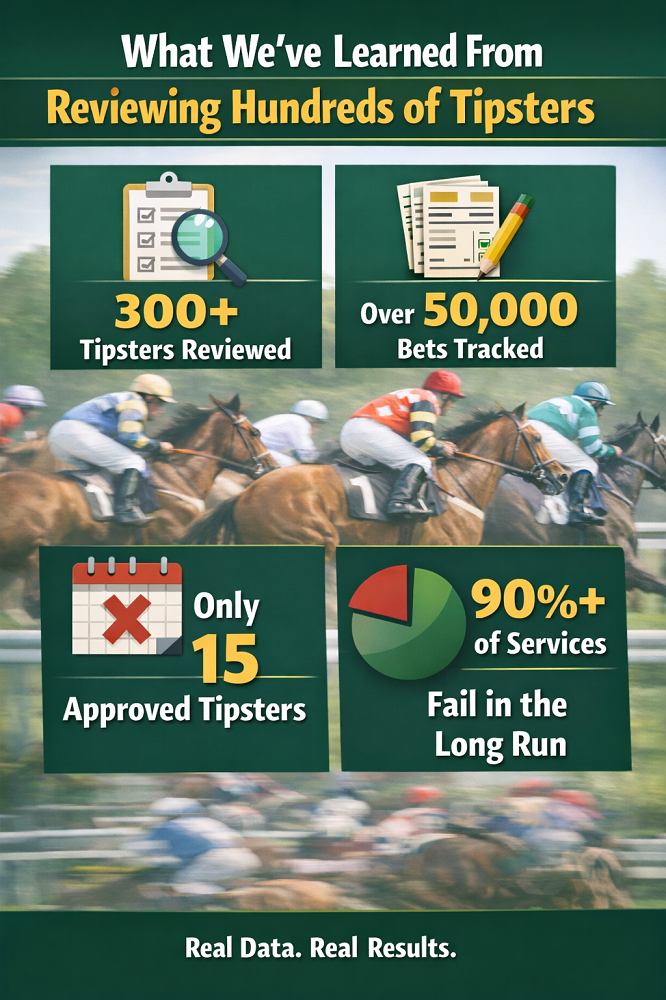
After reviewing 300+ tipsters and logging 50,000+ bets, one conclusion is hard to ignore: long-term profitability is rare — and more than 90% of services fail once you remove cherry-picked winners and marketing spin.
Making a long-term profit on the horses isn’t easy and only an elite few manage it.
In this guide to predicting horse racing, we’ll show you how smart bettors really do it: using data, understanding value, and (crucially) knowing when not to bet.
We’ll also break down the three main routes to getting predictions — free tips, paid tipsters, and DIY analysis — so you can choose the approach that fits your time, temperament, and bankroll…without getting taken in by the next “can’t miss” system.
If you want a repeatable process that puts evidence ahead of gut feel, you’re in the right place.
The Three Routes to Horse Racing Predictions
Three main routes exist for horse racing fans seeking predictions:
- Follow free tips
- Pay for professional tipsters; or
- Build your own prediction approach.
We’ll go through each option in detail below so you can decide which one is best for you.
Each has its advantages and drawbacks – here’s a quick summary table looking at all three:
| Route | Pros | Cons |
|---|---|---|
| Free horse racing tips | No cost, multiple opinions, accessible | Herd behaviour shortens odds, quality varies wildly |
| Paid tipsters | Time-saving, structured approach, some have proven edges | Subscription costs, many scams, requires vetting |
| DIY analysis | Full control, deep learning, can specialise in niches | Time-intensive, steep learning curve, easy to fool yourself |
Now let’s take a look at each of the three options in more detail.
Free Prediction Sites & Community Tipsters
Free horse racing tips sites typically offer daily selections, star ratings or value indicators, hot trainer/jockey lists, and comprehensive coverage of big horse racing festivals like Cheltenham, Royal Ascot, and the Grand National.
Many provide a nap of the day as their headline pick.
Benefits are obvious: no cost, access to multiple opinions, and data summaries including hot streaks, draw biases, and course stats.
You can consume daily horse racing tips without risking subscription fees.
The downsides are subtler. Popular free tips can shorten prices rapidly, especially around major ITV racing tips on Saturday afternoons.
When thousands of punters pile onto the same selection, the value evaporates before you get your first bet on.
We regularly see this around other races televised nationally—by the time you check odds, the 4/1 shot is now 5/2.
That is exactly what we saw in our review of Hugh Taylor’s tips—excellent results on the face of it, but the prices simply weren’t obtainable.
Treat consensus tips as a starting point, cross-checking with your own analysis or with independently verified tipsters we review.
There are some good free tipsters out there, as highlighted in our guide to the best free racing tipsters—but beware of the pitfalls in following free tips, particular the risks of odds collapsing when following a popular tipster.
Why Paid Tipsters Can Be One of the Best Routes to Profitable Horse Racing Predictions
When done properly, following a paid horse racing tipster can be one of the most effective ways to access profitable predictions — but only if the service has been thoroughly vetted first.
The reality is that the betting markets are tough to beat. Identifying value consistently requires time, data, discipline, and emotional control.
Good paid tipsters already have those foundations in place, which is why they can offer a genuine edge for bettors who don’t want to analyse every race themselves.
However, this route only works if you separate the few proven operators from the vast number of services that fail once results are tracked honestly.
That’s exactly where Honest Betting Reviews comes in.
We are an independent tester.
That means we run live trials of paid and free services—including horse racing systems—and publish full results with return on investment (ROI) and drawdowns.
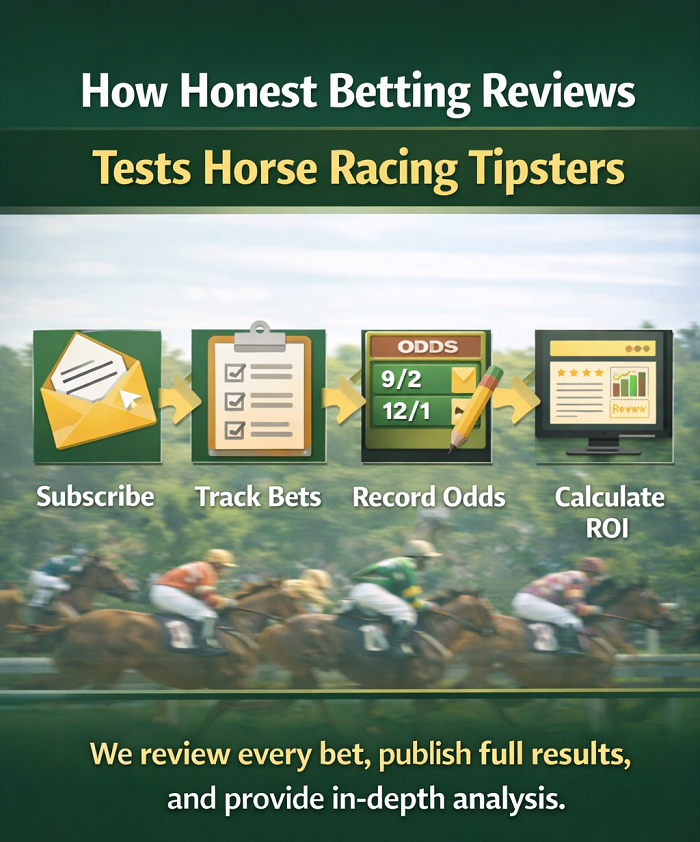
A long running horse racing tipster we trialled in 2024 for example, delivered 91 points profit over 1740 bets at advised prices but a 7 point loss at Betfair SP, highlighting the importance of price availability.
You can use our reviews to decide whether to copy a tipster, blend multiple services, or focus on learning your own predictive skills.
Why Vetting Matters (and Why We Do It)
The problem is that for every genuine professional tipster, there are dozens of services selling hype, screenshots, and short-term variance as “proof”.
That’s why we independently test paid tipsters through live trials, tracking:
- Advised odds vs what’s actually available
- ROI at level stakes
- Drawdowns and losing runs
- Strike rate and bank growth
- Performance at Betfair SP
Only after months of data do we publish a verdict — positive or negative.
If you’re considering following paid tipsters, we recommend starting with our Best Horse Racing Tipsters list, where we detail services that have demonstrated long-term performance rather than short-lived runs of luck.
The Advantages of Following a Properly Vetted Paid Tipster
When we look at the paid services that have performed well in our long-term trials, they tend to offer several clear advantages:
- Time efficiency – The analysis is done for you, allowing you to follow a structured strategy without spending hours studying racecards.
- Consistent methodology – Profitable tipsters use repeatable processes rather than gut feeling or chasing narratives.
- Value-driven betting – The best services focus on price and probability, not just picking likely winners.
- Emotional discipline – Tipsters operate to a staking plan, removing the impulse and “tilt” that damage many DIY bettors.
- Specialisation – Many successful services focus on specific race types, tracks, or seasons where they’ve identified an edge.
In short, you’re not paying for “inside information” — you’re paying for process, discipline, and experience.
Paid Tipsters Worth Checking Out
Based on our reviews and ongoing monitoring, the following services are well worth further investigation:
- Bookies Enemy No.1 – Beating the bookies for over 15 years, with more than 1,100 points profit made since 2017. Voted the no.1 horse racing tipster by punters.
- Andy Holding – One of the most respected analysts in racing, known as the “pundit’s pundit.” Over 300 points profit made in our live trial and +680 points made in the six years prior.
- Loves Racing – A service specialising in big race meetings and festivals, where it has landed over 300 points profit at Betfair SP. Over 700 points profit made in total.
- Racing Intelligence – Racing expert with network of contacts used to find under-the-radar selections. Made 192 points profit in our trial and over 1,000 points win-only betting.
- The Bet Alchemist – Jumps specialist with excellent Cheltenham record, over 750 points profit made.
As always, the key isn’t subscribing to lots of services — it’s choosing one or two that fit your temperament, bankroll, and expectations, and following them with discipline.
Paid tipsters aren’t a shortcut to guaranteed profits, but when properly vetted and followed correctly, they remain one of the most reliable routes to profitable horse racing predictions available today.
DIY Prediction: Everything You Need to Know

Okay so if you don’t want to follow free or paid tipsters, there is another option: doing the work yourself.
It takes a lot more time and discipline, but can be worth it in the long run—if you can make it work.
We’ll run through everything you need to know about DIY horse race predicting now, so buckle up—because there’s a lot to know!
Building Your Own Edge
Building your own predictive edge offers full control, deeper understanding of risk, and the ability to specialise in niches where less attention means less market efficiency.
Irish racing tips for smaller meetings, five-furlong sprints at specific tracks, or apprentice races might offer opportunities that mainstream tipsters overlook.
A simple roadmap to start:
- Focus on one race type (e.g., UK handicap hurdles, 2m–2m4f)
- Gather data from 2022–2025 seasons using free racecards and results databases
- Test a few simple rules (e.g., ground plus trainer angle, or horses dropping in class)
- Keep a results log in a spreadsheet tracking selection, odds, and outcome
- Compare performance versus SP and Betfair SP to gauge if your predictions beat the market
Free or low-cost tools include racecards from Racing UK sites, basic databases, and form guides.
The key is honest record-keeping—fooling yourself with selective memory is the biggest trap.
One option is to combine DIY work with insights from reviewed tipsters. Learn from their write-ups and reasoning while still demanding statistical proof.
Many of the best services we review started as individuals refining their own predictive methods over many years, not overnight systems created to sell.
How to Find Value
Predicting a race doesn’t mean knowing who will win. It means estimating each horse’s percentage chance of winning—and accepting that even a horse with a 40% chance will lose more often than it wins.
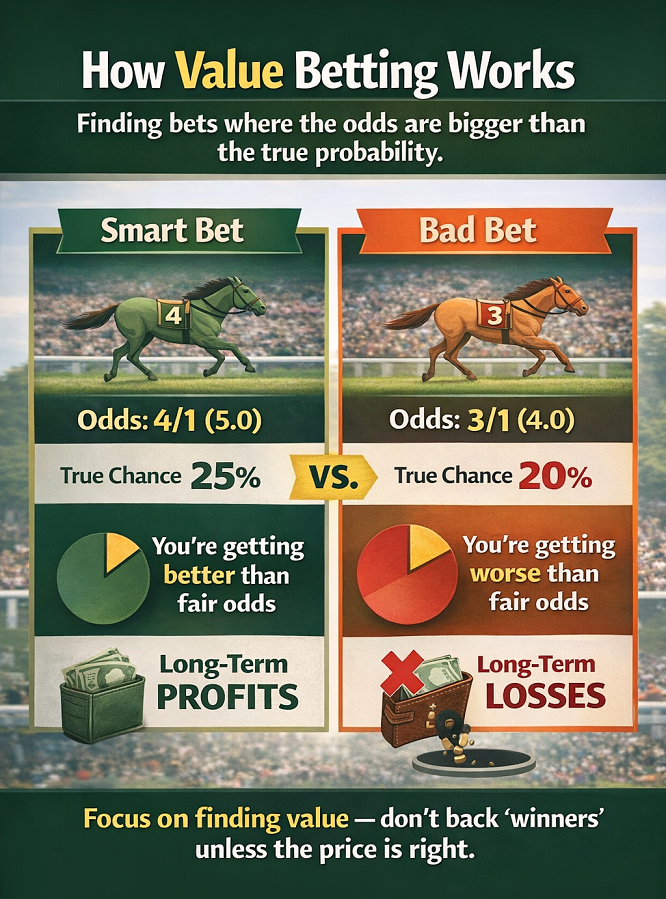
The goal is to find situations where your estimated probability exceeds what the betting odds imply, creating what’s known as a value bet.
Across our reviews, one of the most damaging misconceptions we see is the belief that good prediction equals frequent winners.
Any successful bettor will tell you however that it’s about finding those mis-priced horses—ones that the bookies have quoted too big a price on because they’ve focused on the horse’s last performance when conditions weren’t in its favour for example.
So if you can find a horse priced at 4/1 when really it should be 3/1, that’s a value bet and what you need to focus on.
Conversely, if you’re consistently backing horses that have already been backed in—maybe because a popular tipster has tipped them or the stable is confident in the horse’s chances—you might be backing 3/1 shots that should actually be 4/1.
In that scenario you will only lose money over the long-term because you aren’t identifying value—just following the crowd.
Many losing systems post impressive strike rates but still fail because the odds are too short to support long-term profit.
What Drives a Successful Prediction Model
Three broad inputs drive any serious prediction model.
- First, you need to assess horse ability and recent form: how fast has this horse run, against what quality of opposition, and how recently?
- Second, context matters enormously—ground conditions, distance, the draw (starting position), and course characteristics all influence outcomes in ways that vary by race type.
- Third, market information such as betting odds, money movements, and liquidity tells you what the crowd believes and where potential edges might exist if you disagree.
The prediction challenges differ sharply between race types.
A five-furlong sprint at York in August 2025 with 20 runners, where races can be decided by a nose and the draw plays a massive role, presents a very different puzzle than a small-field novice hurdle at Wetherby with just six runners and a clear class standout.
Flat races at Royal Ascot in 2025 will demand attention to speed figures and draw bias, while National Hunt racing at the 2026 Cheltenham Festival requires deeper analysis of jumping ability, stamina, and trainer patterns at the track.
Consider that five-furlong sprint at York. With a large field, the stalls on the stands’ side rail, and firm ground, you’d need to factor in draw position (historically low numbers have an edge), the likely pace scenario (will several front-runners clash?) and how each horse handles quick ground.
Contrast that with a Grade 1 novice chase at Sandown in December with four runners—here, class is easier to assess, but the sample size of runs is smaller and one mistake at a fence can change everything.
Understanding these structural differences is the first step toward realistic horse racing predictions.
When reviewing tipsters, we generally find that services that specialise narrowly—for example in all-weather racing, flat handicaps or high-quality jumps races, rather than trying to predict everything—consistently outperform generalist approaches in our long-term trials.
Key Data Factors in Predicting Horse Races
A strong prediction model doesn’t rely on a single angle or system.
Instead, it mirrors how professional bettors and quantitative teams weight multiple data factors, combining them into a coherent assessment of each runner’s chances.
Below are the core factors to consider, each of which can be turned into a repeatable checklist for your own analysis.
At Honest Betting Reviews, we don’t sell ratings or systems—but we regularly test commercial ratings and tipsters that claim to exploit these factors.
When we trial a prediction service, we look for evidence that they’ve built their methods on solid data, not cherry-picked examples.
- Ground conditions and going: How does this horse perform on today’s surface?
- Recent form and fitness: What have the last three to five runs shown, and how long since the last outing?
- Trainer form: Is this yard in a purple patch or a cold spell?
- Jockey and trainer form combinations: Do the rider and trainer have a strong recent strike rate together?
- Draw and stall position: In flat races, does the draw advantage or disadvantage this horse given field size and going?
- Course and distance suitability: Has this horse won or placed at this track over this trip before?
- Pace setup and running style: Will the likely race shape suit this horse’s preferred running style?
One consistent finding from our reviews is that systems built around a single “magic angle” almost always fail once exposed to live betting conditions.
Sustainable prediction methods tend to combine at least three to five factors but often many more, applied consistently across large data sets.
Ground Conditions & Going
Going descriptions on UK racecards—firm, good to firm, good, good to soft, soft, and heavy—directly affect performance.
Some horses are transformed by soft ground, while others need a fast surface to show their best.
This is central to any prediction model, and ignoring it will cost you over time.
In our trials, tipsters who fail to adjust selections after late going changes almost always underperform.
Accounting for real-time conditions is not optional—it’s essential.
Constitution Hill’s dominance at the Cheltenham Festival in 2023 came on soft ground that suited his powerful galloping style.
By contrast, horses like Stradivarius consistently delivered their best performances on good to firm ground at Ascot.
When you’re scanning a form line, look for comments such as “acts on soft” or “needs a sound surface” and check whether the horse has won on comparable going in the last 12–18 months.
Predictive models typically convert historical going performance into numeric scores.
You can do something similar manually: if a horse has run five times on soft ground and won twice with two more placed finishes, that’s a 40% win rate and 80% place rate—strong evidence the conditions suit.
If it’s never won on heavy, treat that as a warning.
Here’s a quick summary table for what to check when assessing the ground:
| What to check | What you’re looking for | Why it matters | Quick tip |
|---|---|---|---|
| Today’s going | Firm / Good–Firm / Good / Good–Soft / Soft / Heavy | Some horses need fast ground; others improve massively when it’s softer. | Confirm the official going on race day. |
| Proof on similar ground | Wins/places on today’s surface (ideally within last 12–18 months) | Recent evidence is far more reliable than old form or “gut feel”. | Check recent runs on comparable going, not just overall record. |
| Form comments | Notes like “acts on soft” or “needs a sound surface” | These clues often reveal whether a horse will underperform on the wrong ground. | Use comments as a guide — then verify with results. |
| Simple going stats | How often it wins/places on that ground | Turns “ground preference” into something measurable. | Example: 5 runs on soft, 2 wins + 2 places = strong fit 40% win / 80% place |
| Red flags | Never won on heavy (or repeatedly ran poorly) | Not a guarantee — but it’s a warning sign the conditions may blunt performance. | Be cautious if there’s no evidence they handle testing ground. |
| Late changes | Rain shifting “Good” to “Good–Soft” (or worse) | A going change can flip the race bias and invalidate earlier picks. | Recheck going about 1 hour before the off. |
| Tipster adaptability | Whether selections are adjusted after going updates | In HBR trials, tipsters who ignore late going changes tend to underperform long-term. | A “set and forget” approach is usually a bad sign. |
Mobile tip: swipe left/right on the table to see all columns.
A practical habit: check the official going again an hour before the off. Late rain can shift conditions from good to soft in minutes, changing the bias and therefore your predictions.
Racing tips that don’t account for going adjustments are incomplete.
Recent Form & Fitness

Most quantitative systems weight the last three to five runs more heavily than older history, and they track days since last run to gauge fitness.
A horse returning after 200+ days off is a very different proposition from one backing up 30 days after a confidence-boosting win.
In National Hunt racing, there’s a common pattern where horses improve on their second run after a wind operation or after a seasonal reappearance.
If you’re analysing November–January races and spot a horse that ran flat on debut but has a trainer known for bringing them on for a second outing, that’s worth noting.
Context matters when interpreting finishing positions. A fifth of 20 in a strong Class 2 handicap at Royal Ascot in 2025 may represent better form than an easy win in a weak Class 5 at a minor track.
Learning to “read between the lines” of results separates sharp bettors from those who just back last-time-out winners blindly.
Some trainers are renowned for having horses ready to win fresh. Nicky Henderson’s autumn National Hunt runners often arrive fit to race first time up, while William Haggas on the flat is known for seasonal debutants primed to perform.
At Honest Betting Reviews, we favour prediction services that demonstrate a robust method for form adjustment rather than simply following obvious momentum plays.
Trainers, Jockeys & “Hot” Connections
Trainer and jockey strike rates—wins divided by rides—matter, but current form streaks matter more when predicting races in any given week or month.
A yard hitting 30% winners over the last 14 days is in a purple patch that lifts the chances of all their runners.
Consider January 2025 National Hunt meetings where a trainer like Paul Nicholls enters a hot streak after a quiet spell.
Suddenly, backing anything from that yard at tracks like Exeter or Wincanton becomes appealing.
Some models use rolling 30-day win percentages or level-stakes profit figures to assign a “hot” bonus to certain yards and riders.
That said, blindly following big names loses money over time because the market already prices in reputation.
The value lies in context: a top jockey like William Buick taking a spare ride in a low-grade handicap at Wolverhampton is more significant than a claimer booking in a Group 1 at Ascot.
Gordon Elliott sending a well-handicapped horse to a smaller Irish meeting with a conditional jockey aboard might offer more value than his obvious Cheltenham contenders.
At the same time, one pattern we repeatedly see in profitable tipsters is a willingness to oppose fashionable yards when prices are compressed. Reputation is usually overvalued by the market.
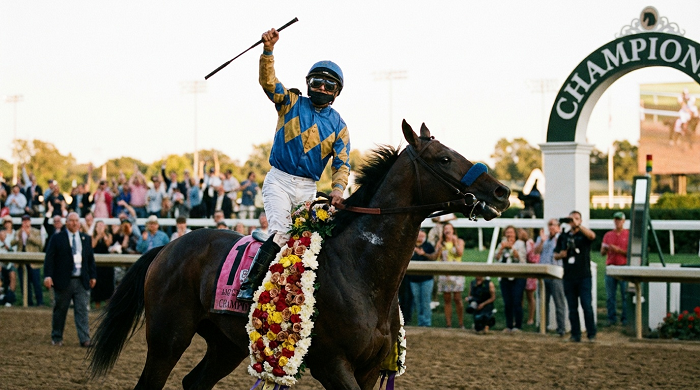
Draw, Course & Distance
Draw bias is real but widely misunderstood. Low draws help over five furlongs at Chester, where the tight left-handed bends favour inside positions.
On soft ground in large-field sprints at Ascot, high draws can gain an advantage on the stands’ side rail. Stall data from 2024–2025 seasons should inform your predictions in flat races.
“Horses for courses” is more than a cliche. Epsom’s undulations, Cartmel’s tight bends, and the stamina-sapping uphill finish at Sandown all suit specific types.
Prior course wins affect prediction ratings because they confirm a horse handles the idiosyncrasies of that track.
Distance suitability comes from pedigree and past performance. Milers stepping up to ten furlongs in the Juddmonte International at York may struggle to stay, while staying types targeted at the three-mile-two-furlong Cheltenham Gold Cup trip need proven stamina evidence in their form.
Before betting any particular race, scan course record, distance record, and assess whether the draw looks advantaged or disadvantaged given field size and going.
At Honest Betting Reviews, when we test prediction systems claiming to beat the market via draw bias or course factors, we insist on long-run proof over multiple seasons—not a handful of winners at Chester.

Pace, Running Style & Race Shape
Pace maps—diagrams showing where each horse is likely to position itself in the early stages—are increasingly used by sophisticated bettors.
Front-runners, prominently raced horses, and hold-up performers are affected differently by field composition and race tempo.
At certain all-weather tracks like Lingfield over specific trips, front-runners hold an edge because the surface rewards those who control the pace.
Conversely, in big-field six-furlong handicaps at Ayr’s Gold Cup meeting, strong early pace often leads to collapses where closers sweep past tired leaders late on.
Advanced prediction models simulate likely race shape and downgrade horses drawn wide with a hold-up style in slowly-run races, since they’ll give away ground with no pace to run into.
You can apply a simpler manual method: count the likely leaders in the racecard comments and imagine what happens if they duel early versus one getting an easy lead.
A lone front-runner in a tactical race has a significant edge.
Many commercial ratings ignore pace entirely. When we review a tipster that uses pace maps or sectional times, we highlight that as a plus—it shows more advanced data integration than surface-level form analysis.
Andy Holding is a tipster for example who uses sectional timings in his speed ratings and is one of the best horse racing tipsters we have reviewed.
Traditional vs Algorithmic Prediction Methods

Old-school “form students” predict races by manually reading racecards, studying previous form, and applying intuition built over years of watching racing.
This approach can work but is time-consuming and prone to cognitive biases. You might overweight a horse because you backed it before, or dismiss a runner because the jockey once cost you money.
Statistical and machine learning models now used by betting syndicates and some paid services take a different approach.
Common methods include speed figures (translating times into comparable ratings), handicap ratings analysis, regression models that weight multiple factors, and more opaque “black-box” AI systems that claim to find hidden patterns.
Research on horse racing prediction has shown that logistic regression models can achieve around 28% win prediction accuracy—slightly better than the roughly 26.4% achieved by simply backing the market favourite.
Random Forest classifiers edge this further at around 28.9% in some studies.
No algorithm is perfect. Unpredictability from trouble in running, jockey decisions, and pure random variance means upsets happen regularly.
The 2009 Grand National winner Mon Mome started at 100/1—no model would have confidently predicted that outcome.
We independently test services that claim to use AI models, tracking real bets over months to see if the marketing matches reality.
Be sceptical of vendors promising guaranteed profits or “can’t lose” AI systems, especially if they hide long-term records.
If a system genuinely delivered consistent profits, its creators would use it quietly rather than selling it for a monthly subscription fee.
What a Good Horse Racing Algorithm Actually Uses
A credible algorithm typically draws on historic race results spanning five or more years, sectional times where available, official ratings, going records, draw data, plus trainer and jockey statistics.
The depth of data matters—superficial inputs produce superficial outputs.
Consider the example of analysing all UK flat races from 2018–2024 to estimate how much a wide draw at Kempton over seven furlongs really matters after adjusting for field size and going.
This requires thousands of data points and careful statistical controls.
Done properly, such analysis might reveal a 3% disadvantage for high draws in fields of 12+ runners—useful information if the market hasn’t priced it in.
Serious models test against out-of-sample data: building on 2018–2022 results, then validating on 2023–2024 outcomes.
This guards against “curve fitting” where a model appears brilliant on historical data but fails on future races because it was overly tailored to specific past patterns.
When we trial algorithm-based tipsters, we look for proof that they’ve done this kind of validation.
Back-fitted winning streaks mean nothing; forward-tested results over hundreds of live bets mean everything.
Limitations & Randomness in Race Prediction
Sources of randomness in horse racing are numerous: bad starts, traffic problems in running, jockey errors, unreported minor injuries, sudden weather shifts, and plain bad luck.
A horse can prepare perfectly, travel smoothly, and still get boxed in on the rail when the gap closes.
Grand National renewals provide notorious examples—false starts, pile-ups at fences, and loose horses interfering with the field have all shaped results.
Big-priced winners at Royal Ascot routinely rewrite narratives that seemed certain beforehand.
Previous winners of prestigious races sometimes return and run nowhere for reasons never fully explained.
Even elite prediction models endure losing runs and losing months. A 28–30% strike rate means roughly 70% of selections lose. Success is about long-term edge, not short-term perfection.
If you approach racing predictions expecting consistent winners every day, you’ll either quit or go broke.
The question to ask isn’t “Will this system win today?” but “Will this approach profit over 500 bets?”
Using Odds & Value: Turning Predictions into Profits
A prediction is only worth backing if the odds are bigger than the true probability. This is value betting in its simplest form.
If you believe a horse has a 25% chance of winning but the betting odds imply only a 20% chance (5.0 decimal, or 4/1 fractional), you have an edge.
Back enough of these situations and you’ll profit over time, even if many individual bets lose.
Walk through a concrete example: a 10-runner handicap at Sandown in June 2025. You analyse the race and estimate probabilities for each horse.
Your top selection has, you believe, a 20% chance.
The market prices it at 6.0 (5/1), implying just 16.7% probability. That’s a value bet. Another horse you like at 15% is priced at 4.0 (3/1, implying 25%)—not value, so you skip it despite fancying the horse.
To convert fractional odds to implied probability: divide 1 by (decimal odds). So 5.0 decimal = 1/5 = 20% implied probability.
Compare that with your own estimate or a respected rating’s implied chance.
Honest Betting Reviews ranks horse racing tipsters not just on headline winners but on long-term ROI at level stakes, which reflects value-finding ability.
A tipster with a 22% strike rate and +10% ROI is more valuable than one with 35% winners and -5% ROI, because the second is backing too many short-priced horses without true edge.
Each-way value often exists in big fields. In races with 16+ runners—think Grand National-style handicaps or cavalry charges at Glorious Goodwood—extra place offers from UK bookmakers can shift the maths in your favour.
Best odds on each-way terms sometimes exceed the underlying probability of placing, creating value even if the win bet doesn’t.
Bankroll Management & Staking

Even accurate predictions fail without sensible staking. A 50-bet losing run is possible even with a genuine 30% strike rate—it’s just variance, not proof your approach is broken.
Protecting against downswings matters as much as finding winners.
Kelly staking—a formula that sizes bets according to edge and odds—is mathematically optimal but dangerous if you overestimate your edge.
For most readers, simple level stakes or small percentage staking works better: risking 0.5–2% of your total betting bank per selection limits damage during cold streaks.
A numerical example: you start with a £1,000 bank and stake £10 per point (1% of bank). After 50 bets at 28% strike rate and average odds of 4.0, you might easily see your bank drop to £850 before recovering.
That’s not a crisis—it’s normal variance. But if you’d staked £50 per bet (5%), the same run could wipe out half your bank.
At Honest Betting Reviews, we record tipsters using point-based staking in trials alongside other metrics like ROI and strike rate so readers can easily compare services and estimate realistic variance.
We also encourage separating a dedicated betting bank from everyday finances. Bet responsibly, set limits, and never chase losses with inflated stakes.
UK-licensed bookmakers offer deposit limits and self-exclusion tools—use them if needed.
Practical Prediction Workflows for Major Races & Festivals
Predicting everyday midweek meetings differs from analysing marquee events like the Cheltenham Festival, Royal Ascot, Grand National at Aintree, and the Epsom Derby.
Big events attract more data, more public interest, and more market efficiency—but also more opportunities to find overlooked angles.
For each major event, a structured research workflow three to seven days before helps:
| Festival | Typical Dates | Key Workflow Steps |
|---|---|---|
| Cheltenham Festival | Mid-March (2026: March 10–13) | Analyse Irish raiders, check ground forecasts, review trainer festival strike rates |
| Royal Ascot | Mid-June (2025: June 17–21) | Focus on draw data, speed figures, and three-year-old improvers |
| Grand National Festival | Early April (2026: April 9–11) | Study jumping records, weight trends, and previous Aintree runs |
| Derby Festival | Early June (2026: June 5–6) | Pedigree analysis, trial form, and ability to handle Epsom camber |
At Honest Betting Reviews, we approach big meetings by focusing on tipsters and prediction models with proven historic ROI at those specific festivals.
A service that excels at Cheltenham handicaps may struggle with Royal Ascot sprints—specialisation matters.
Example: Predicting a Cheltenham Festival Handicap
Walk through a hypothetical analysis of a 20+ runner Cheltenham handicap chase in March 2026.
These races are notoriously competitive but rich in data if you know where to look.
Start with trends: what age range wins most often? What official rating band tends to succeed? How important is previous Cheltenham experience?
Historical data from the last 10 renewals provides a statistical shortlist before you even look at this year’s entries.
Layer in ground conditions. Cheltenham ground varies dramatically—the 2023 Festival ran on soft, while some years produce good ground. Horses with proven soft-ground form gain an edge when the forecast is wet.
Trainer patterns matter enormously. Irish raiders, particularly from Willie Mullins and Gordon Elliott, dominate certain Cheltenham races while UK yards hold an edge in others.
Previous winners often come from the same connections year after year.
On race morning, combine your initial statistical shortlist with live market moves.
If a horse you’ve identified as overpriced suddenly shortens from 16/1 to 10/1, that’s informative. If it drifts to 25/1, that might also tell you something.
Each-way betting and extra places from bookmakers often make sense in these races.
With 20+ runners, a horse with a 10% win chance might have a 35% place chance at races offering extra places down to sixth.
Run the numbers—sometimes the place element carries more expected value than the win.
At Honest Betting Reviews, we specifically assess festival-focused tipsters.
Some services peak in these big-field, data-rich environments where their edge compounds across multiple selections.
Loves Racing is one such tipster with an excellent record at the major festivals, with over 300 points profit made at major festivals.
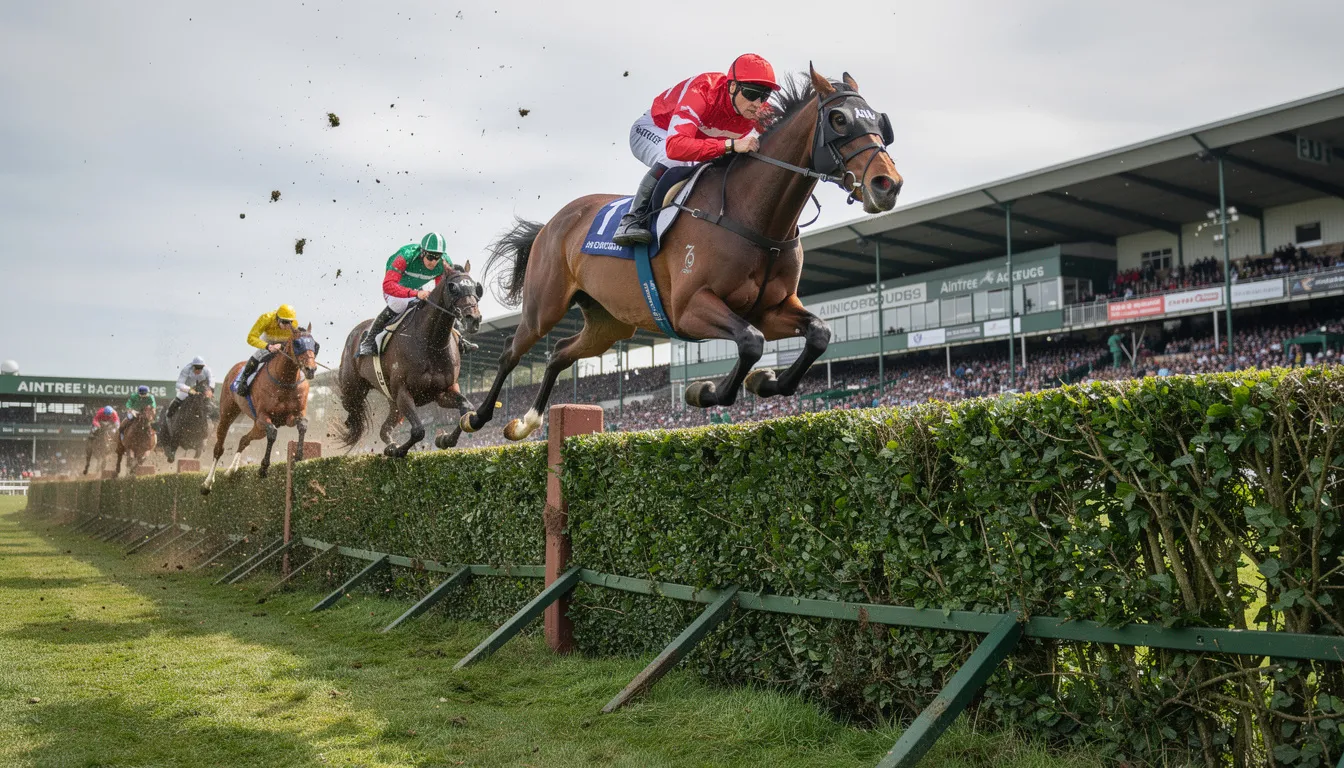
Example: Predicting the Grand National
The Grand National at Aintree—30 fences, four miles two and a half furlongs, and a field of 40 runners—presents unique prediction challenges.
The error rate is higher than virtually any other race because so many things can go wrong.
Over the last 20 years, winners at 50/1 and 100/1 have landed, scrambling form books and prediction models alike.
Neptune Collonges won by a nose, Auroras Encore came from nowhere at 66/1, and Mon Mome’s 100/1 success in 2009 remains etched in racing folklore.
Randomness and luck play a larger role here than in any other major race.
A cautious predictive approach focuses on:
- Jumping reliability: clean rounds at Aintree previously or over similar fences
- Proven stamina: winners in 3m+ races, ideally 3m2f or beyond
- Weight trends: horses towards the lower end of the weights historically outperform
- Trainer intentions: yards that target the race specifically (often evidenced by prep runs at Haydock or Wetherby Grand National Trial)
Consider spreading stakes over a small portfolio of selections—three or four horses with genuine chances—rather than lumping on a single pick.
Place markets and “without the favourite” markets can offer value when the outright win looks too random to predict confidently.
At Honest Betting Reviews, we evaluate Grand National strategies on multi-year performance.
A tipster who found the 2024 winner but lost on the previous five renewals hasn’t proven anything useful.
Exotic bets and each-way multiples need evidence across multiple big events before we recommend them.
Evaluating Prediction Services: How Honest Betting Reviews Helps
Our core process at Honest Betting Reviews is straightforward: we select a horse racing prediction service, paper-trade or real-bet their tips over three to six months, then publish full, unedited results.
No cherry-picking winners, no hiding losing runs.
The metrics we track include:
- Strike rate: percentage of winning selections
- Return on investment (ROI): level-stakes profit as a percentage of total staked
- Maximum drawdown: worst peak-to-trough decline during the trial
- Number of advised bets: sample size matters for statistical reliability
- Average odds: services backing short prices need higher strike rates to profit
- Odds availability realism: comparing advised odds to what was actually available
Some reviewed services fail. We leave negative results online to protect readers and illustrate the difficulty of beating horse racing markets.
Anyone can find winners occasionally; consistently finding value is rare.
Use our detailed reviews to cross-check any prediction product or tipster you’re considering rather than relying on vendor marketing alone.
We test services that cover today’s horse racing, tomorrow’s racing, Irish racing tips, and every race from big meetings to quiet midweek cards.
New customers considering a tipster subscription deserve independent verification before committing money.
Whether you’re chasing free bets from bookmaker sign-ups (remembering that free bet stakes aren’t returned, free bets expire after set periods, and eligibility restrictions often apply), using sports free bets strategically, or building a serious betting approach with multiple bet types across betting exchanges and traditional bookmakers, prediction accuracy underpins everything.
Customer offer promotions—whether free bet rewards valid for specified periods, acca free bets, or free bet builders—can add value, but only if your underlying selections have genuine edge.
Racing across UK and Ireland today offers endless opportunities—from novice hurdle races at small tracks to the biggest events on the calendar.
Horses from trainers like Indian River stables or big shout yards at the middle east meetings now held under UK and Ireland rules all feed into the data generated by modern prediction systems.
Single bets, multiple bet combinations, and bet slip construction all depend on finding genuine value in the odds.
At Honest Betting Reviews, we’re transparent about what works and what doesn’t.
We’ve tested services covering flat races, National Hunt racing, best horse racing tips claims, and everything in between.
Our goal isn’t to sell you anything—it’s to help you navigate a market full of exaggerated claims and protect your betting bank from predatory scams.
Predicting horse racing outcomes requires patience, discipline, and acceptance that even the best models lose regularly.
The difference between profitable bettors and everyone else isn’t luck—it’s evidence-based decision-making, honest record-keeping, and the willingness to walk away from bad value.
Check our review database before subscribing to any service, compare long-term ROI rather than headline winners, and approach every race with realistic expectations.
That’s how you turn predictions into profit.


Leave a Reply
Want to join the discussion?Feel free to contribute!